After 30 years at Telstra, sent home over a hearing test
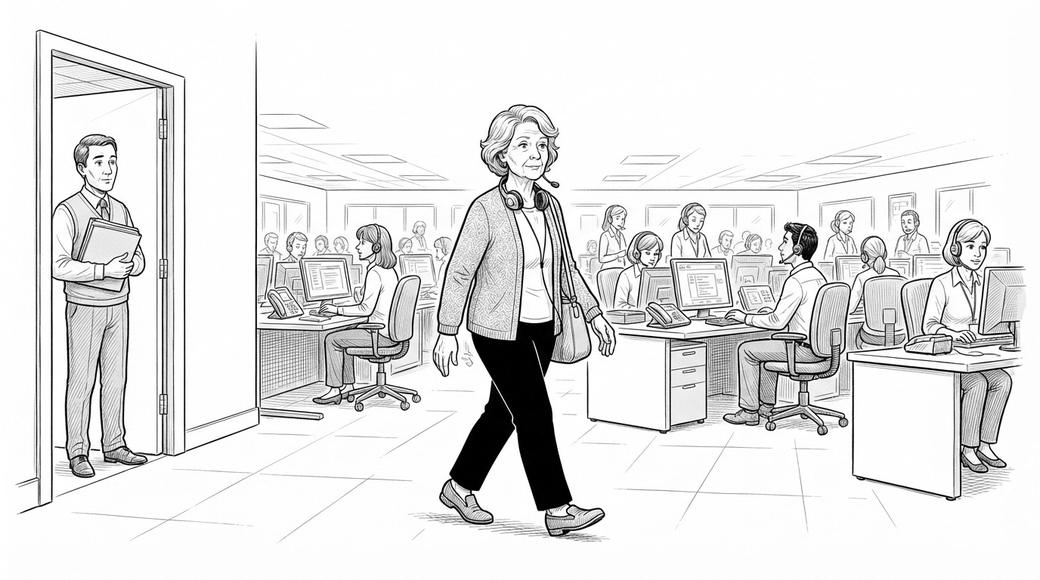
Valerie Martin joined Telstra in 1989 and from around 2000 answered Triple Zero calls. Since 2012 Telstra had known she had mild to moderate high-frequency hearing loss, and she worked with a headset covering both ears. From late 2017 Telstra considered her performance unsatisfactory. It put her on four performance plans and gave her two written warnings over slow answering and mishandled calls, including an ambulance call connected to the wrong suburb. The court also found she had altered the time on a call ticket.
In November 2019 an audiologist reported good speech discrimination, but Telstra's occupational doctor then reported that she was unsuitable for Triple Zero work. On 7 November 2019 her manager told her not to come back until she was medically cleared. Telstra paid her discretionary leave for a time, then nothing from 14 February 2020, the day she started her case. It later back-paid her base salary for those months, without admission. In May 2020 an ear specialist found her fit to return, but she did not go back. Her doctor certified her unfit for work, and she resigned in May 2021.
Her claims under the enterprise agreement, the Fair Work Act's pay rules and disability discrimination law all failed. But the court held that at common law an employer has no right to suspend an employee without pay. Doing so repudiated her contract, so whether the direction was reasonable did not matter. The court accepted that it materially contributed to a persistent depressive disorder.
Given her performance history, the court put the chance she would have stayed until her planned retirement at only 15%. That left $11,994.41 in lost wages after what Telstra had already paid. It awarded $30,000 for the psychiatric injury, and with interest the final judgment, in February 2025, was $45,933.92.
Being told to stay home while your employer checks your fitness is not the same as being lawfully stood down. Unless your contract or an agreement allows it, an employer that keeps you away from work and stops paying you may be breaching your contract.
Decided a month before the High Court's decision in Elisha v Vision Australia Limited [2024] HCA 50, which confirmed that damages for psychiatric injury can be recovered for breach of an employment contract. Final orders were made in Martin v Telstra Corporation Ltd (No 3) [2025] FedCFamC2G 274.
A published decision of the Federal Circuit and Family Court of Australia, retold in plain English. Lawcaptain did not act in this case. Every outcome depends on its own facts. General information, not legal advice about your situation.
Talk to us.
Call 1300 967 552, or leave your details and we will call you.
Contract disputes
 A hotel noise complaint, a 'sham' hearing and $1.44 millionHigh Court of Australia · 11 December 2024Read the case study
 Truck sales manager gave notice and was told to drop leafletsFederal Circuit Court of Australia · 21 November 2018Read the case study
 He stayed the whole bonus year but left before paydayFederal Circuit Court of Australia · 18 April 2019Read the case study