He brought in property and bought a business: 57.5% to him
- Together
- 2002 to 2016, one break
- Children
- Two
- Net pool
- About $949,000 with super
- Split
- 57.5% him / 42.5% her
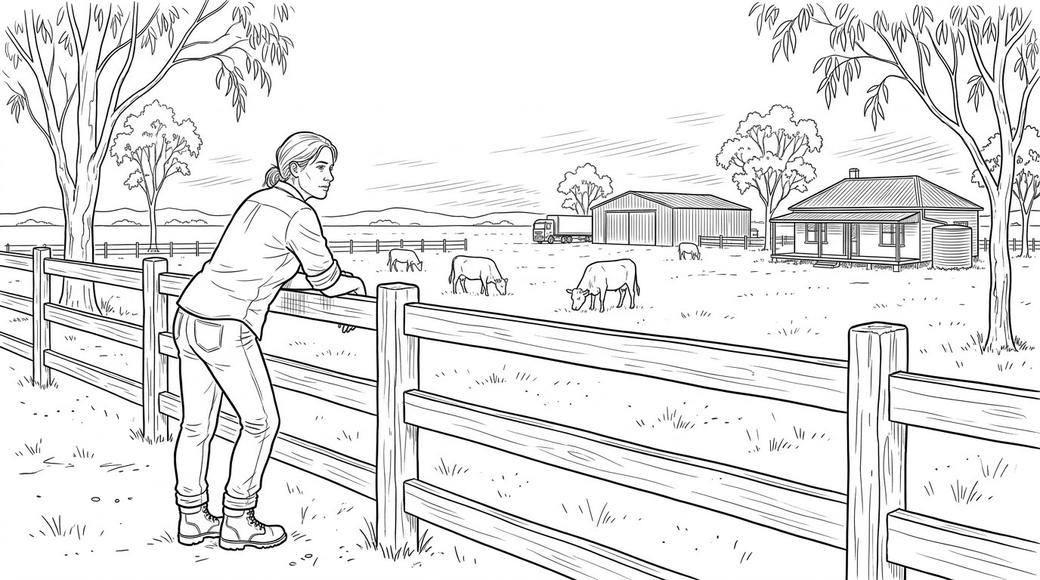
Mr and Ms Charles were together from about 2002 until early 2013, spent about a year apart, reconciled, and finally separated in about September 2016. They had two children. He came into the relationship owning two properties, bought before they lived together; she had a car, five head of livestock and a horse. Together they bought two adjoining rural properties in 2004 and 2012, largely with loans, some from his parents. He worked as a tradesman and later in transport, and paid the mortgages. She worked mostly part time, spent her wages on the household and the children, was the main carer and homemaker, and did most of the farm work, about 20 hours a week. Months before separation he bought a transport business for $305,000, entirely on vendor finance.
By the 2023 trial the net pool was $949,161 including super. He asked Judge Newbrun to quarantine his own properties and the business, and sought 75% on contributions; she sought 50%. The judge refused to quarantine: through her parenting and the wages she spent on the family she had indirectly helped him pay for them. Contributions were assessed at 60% to him and 40% to her.
On future needs, he earns about $141,000 a year, keeps the business and has $115,000 in super against her $30,333. She earns about $30,000 and has two young children with a new partner, who earns about $100,000 and pays most of the boarding school fees for her younger child with Mr Charles. Weighing all of this, the judge moved only 2.5% her way, for a final 57.5% to him and 42.5% to her.
She keeps the two jointly owned properties and the livestock; he keeps his own properties, the business and the debt to his parents. She must pay him $58,213 within three months, or one property will be sold.
Property one partner owned before the relationship is not automatically kept out: the other partner's indirect contributions can reach it. But a large head start still counts, and a new partner's income can be weighed when a court adjusts for the future.
Decided before 10 June 2025, when future needs were assessed under s 79(4)(e) and s 75(2) of the Family Law Act 1975 (Cth). The amended Act now lists them as current and future circumstances in s 79(5), largely to the same effect.
A published decision of the Federal Circuit and Family Court of Australia (Division 2), retold in plain English. Lawcaptain did not act in this case. Every outcome depends on its own facts. General information about Australian family law, not legal advice about your situation.
Sort out your own property split.
Agreed on a split? Make it binding with consent orders. Call 1300 967 552, or get an instant quote online.
Relationships with children
 Full-time care, a casual job, and 75% of the property outside superTogether15 years, marriedChildrenTwo, with their motherNet pool$520,547 outside superSplit75% her / 25% himFederal Circuit and Family Court of Australia (Division 2) · 28 June 2024Read the case study
 On a pension with the children, he was awarded 80% outside superTogetherAbout 15 years, marriedChildrenTwo, with their fatherNet pool$171,250 outside superSplit80% him / 20% herFederal Circuit and Family Court of Australia (Division 2) · 28 October 2025Read the case study
 An inheritance, a $257,000 pool and the family dogTogetherAbout 10 years, de factoChildrenTwo, with their motherNet pool$257,152 outside superSplit60% her / 40% himFederal Circuit and Family Court of Australia (Division 2) · 6 September 2024Read the case study