He said he owed $440,000, mostly to family. The court left it out
- Together
- De facto, from 2004
- Children
- Three, living with her
- Net pool
- About $628,000
- Split
- 58% her / 42% him
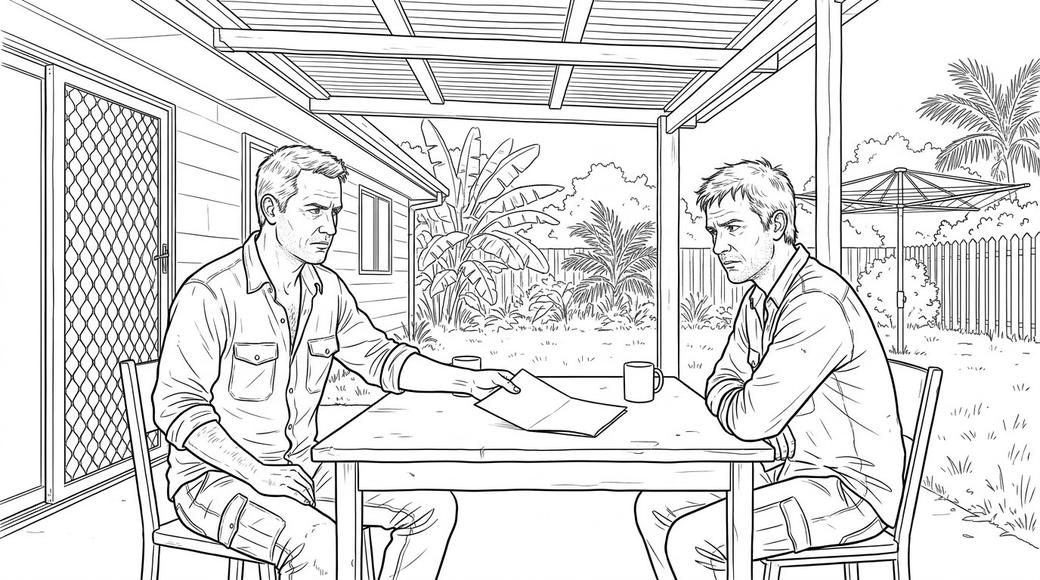
Mr Dyer and Ms Kaeser began living together in 2004 and had three children, who live with her. She works part-time as a public servant. He had worked as a tradesman. Their main asset was a house in Queensland worth $820,000, with a mortgage of about $317,000.
Mr Dyer said he owed large debts to his family: $267,000 to his brother, $123,000 to his father (including $100,000 in unpaid wages) and a $50,000 loan from another lender. With those debts counted, he put the pool at about $111,000. Ms Kaeser said the debts did not exist and put it at about $523,000.
Judge Young did not find Mr Dyer a reliable witness. He had claimed a $250,000 starting contribution, and had once dated the relationship from 2007 to match money that appeared in his account that year. The judge found that untrue and opportunistic. There was nothing but his word for the debts to his father and the other lender, and his father did not give evidence. His brother did, and produced letters of demand sent soon after the separation. The judge found the letters were written to support Mr Dyer's case in court. The judge accepted that $260,000 had been advanced in 2009 and 2013, but was not satisfied that any of it was still owed or would ever be pursued. Two houses had been sold without the brother being repaid. The debts came off the balance sheet. A $9,945 superannuation withdrawal Mr Dyer had used for his own purposes was added back.
That left about $628,000, including superannuation. Contributions were equal. But Mr Dyer had paid no child support since the separation, and Ms Kaeser had supported the three children on a limited income. The judge called this a very significant factor and made an adjustment in her favour that the judge put at about $100,000. The result was 58% to her, about $364,000, and 42% to him, about $264,000.
Mr Dyer was ordered to pay Ms Kaeser $288,969 within 60 days. If he did not, the house would be sold.
A debt to a relative counts only if it can be shown to exist and is likely to be enforced. Paperwork created after separation to prove a family loan can damage the case it was meant to help.
Decided before the property amendments of 10 June 2025. The court added back the $9,945 superannuation withdrawal. Since those amendments the Act expressly names material wastage in de facto cases (s 90SM(5)(d)), and a sum like this would now more likely be weighed as a factor than added back. The judgment gives the separation as February 2022 at [1] but February 2020 at [11]; the story does not depend on the year.
A published decision of the Federal Circuit and Family Court of Australia (Division 2), retold in plain English. Lawcaptain did not act in this case. Every outcome depends on its own facts. General information about Australian family law, not legal advice about your situation.
Sort out your own property split.
Agreed on a split? Make it binding with consent orders. Call 1300 967 552, or get an instant quote online.
Debts, spending & hidden assets
 His gambling cost about $155,000, and the house split moved her wayTogetherAbout 16 years, marriedChildrenTwo, now adultsNet pool$649,000 plus superSplit67.5% her / 32.5% himFederal Circuit and Family Court of Australia (Division 2) · 8 October 2021Read the case study
 He traded shares on borrowed money, so he bore the lossesTogetherOver 20 years, de factoChildrenTwo, now adultsNet poolAbout $180,000SplitAll to her bar his toolsFederal Circuit and Family Court of Australia (Division 2) · 9 May 2022Read the case study
 $2 million went through his hands. She was awarded 82.5% of the restTogetherAbout 22 years, marriedChildrenThree, now adultsNet poolAbout $1.22 millionSplit82.5% her / 17.5% himFederal Circuit and Family Court of Australia (Division 2) · 15 December 2025Read the case study