Buy your own truck or lose your job: decades later, still contractors
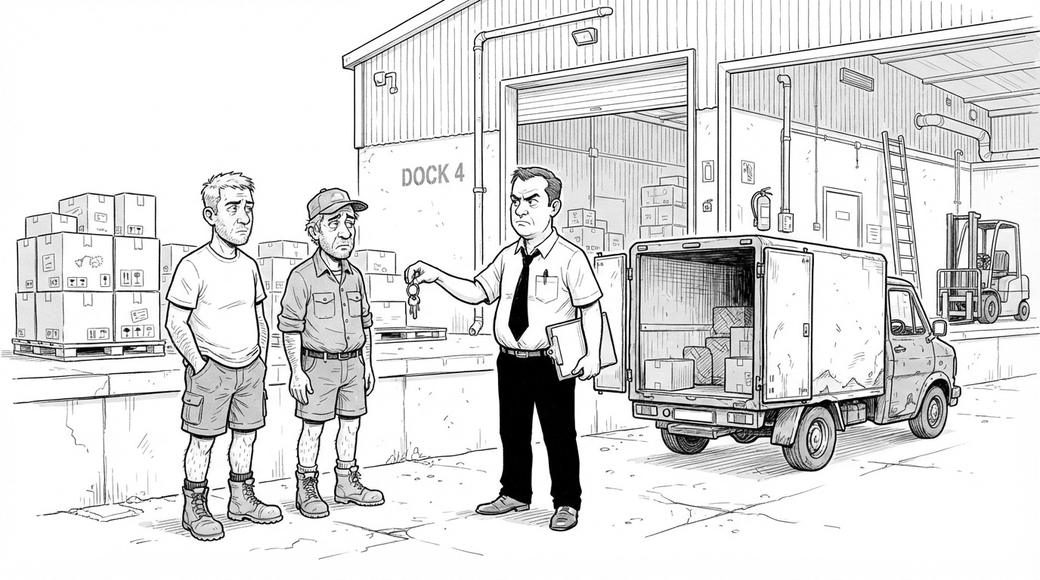
Mr Jamsek and Mr Whitby left school at 14 and 15. In 1977 they started with a lighting company, and from 1980 they drove its delivery trucks. Until late 1985 or early 1986, everyone agreed, they were employees.
In late 1985 Mr Jamsek and another driver asked for a pay rise. The company refused, and offered its drivers the chance to "become contractors" by buying their own trucks. They were told: "If you don't agree to become contractors, we can't guarantee you a job going forward." On their accountant's advice each man set up a partnership with his wife. The partnerships bought trucks for $15,000 and $21,000, signed delivery contracts and invoiced the company, later charging GST.
They delivered for the company until the arrangement ended in 2017, then sued for the entitlements of employees, including under the Fair Work Act and for long service leave. The trial judge held they were contractors. The Full Court of the Federal Court disagreed. It looked at how the relationship had worked over the decades and at the company's superior bargaining power.
The High Court allowed the company's appeal. No one claimed the contracts were a sham, so their written terms decided the character of the relationship. That the company had the upper hand when they were made "did not alter the meaning and effect of the contract". The contracts were with the partnerships, which owned the trucks, paid their running costs and operated them. As two judges put it, where the work depends on "a substantial item of mechanical equipment" supplied by the worker, "the personal is overshadowed by the mechanical".
A separate question, whether the drivers counted as employees under a wider definition in the superannuation guarantee law, was sent back to the Full Court. In March 2023 it held that they were not employees under that definition either. For Fair Work Act claims, Parliament has since changed the test.
Signing a contractor agreement can decide your rights, so get advice before agreeing to switch from employee to contractor. Since August 2024 the Fair Work Act also looks at how the work is really done, not only at the contract.
Overtaken in part by statute. From 26 August 2024, s 15AA of the Fair Work Act 2009 (Cth) requires the employee-or-contractor question to be decided by the real substance, practical reality and true nature of the relationship, including how the contract was actually performed. The contract-first approach applied here no longer governs that question for Fair Work Act purposes. The companion case decided the same day, CFMMEU v Personnel Contracting [2022] HCA 1, went the other way for a labour-hire worker. The superannuation question sent back by the High Court was decided against the drivers in [Jamsek v ZG Operations Australia Pty Ltd (No 3) [2023] FCAFC 48](https://www.austlii.edu.au/cgi-bin/viewdoc/au/cases/cth/FCAFC/2023/48.html).
A published decision of the High Court of Australia, retold in plain English. Lawcaptain did not act in this case. Every outcome depends on its own facts. General information, not legal advice about your situation.
Talk to us.
Call 1300 967 552, or leave your details and we will call you.
Underpayment
 Cash envelopes, pay-back slips and $15.3 million in penaltiesFederal Court of Australia · 5 August 2024Read the case study
 Never paid for one shift at a dog festival, he went to courtFederal Circuit and Family Court of Australia (Division 2) · 24 November 2025Read the case study
 Unpaid during COVID, he never said no, so the court said he agreedFederal Circuit and Family Court of Australia (Division 2) · 27 July 2026Read the case study