Cash envelopes, pay-back slips and $15.3 million in penalties
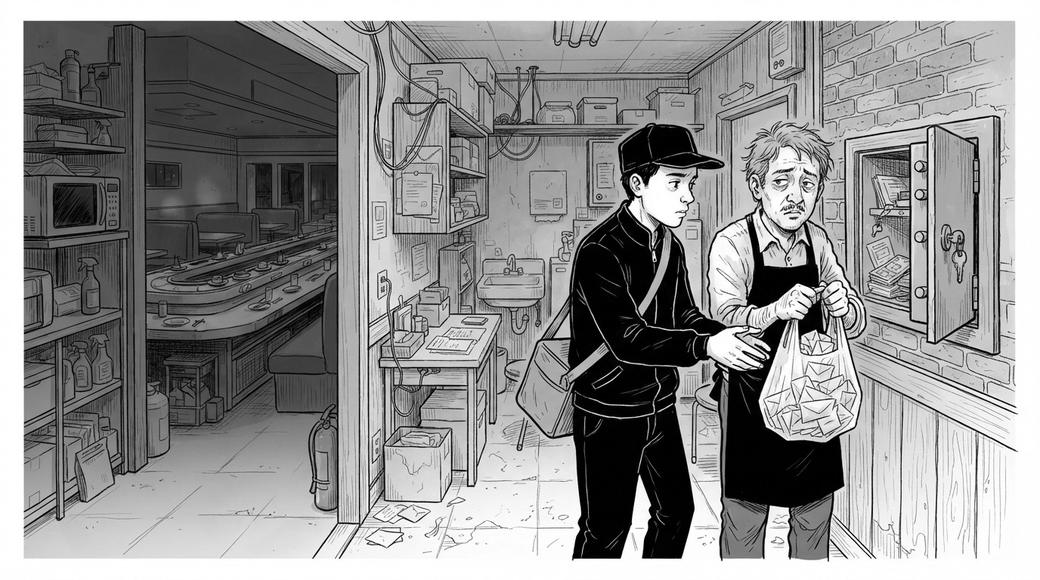
The Sushi Bay group ran sushi restaurants in New South Wales, the ACT and the Northern Territory. Its four companies had one director and chief executive, Ms Yi Jeong (Rebecca) Shin. The Fair Work Ombudsman sued over the pay of 163 workers, about 73% of the workforce, between 29 February 2016 and 26 January 2020. Most were on temporary visas.
The court found two schemes. Under the "Dual Rate Method", staff were paid award rates by bank transfer for a set number of hours, and the rest in cash at a lower "Sushi Bay Cash Rate". One pay guide listed award rates for a level 1 attendant of $20.06 an hour on weekdays, $25.08 on Saturdays and $30.09 on Sundays, and a cash rate of $15 for all three. Couriers took cash envelopes to the restaurants each fortnight.
Under the "Deduction Method", sponsored 457 visa workers found slips in their envelopes saying how much to pay back. One chef withdrew the cash and put it in the envelope for head office; some repayments went into Ms Shin's personal account. Justice Katzmann found the workers got no benefit, and that, depending on the company for their visas, they were unlikely to have had "any effective choice".
Payroll records showed only the "taxable" hours: 76 in one fortnight for a chef whose actual hours, on the company's own spreadsheet, were 119.5. False records went to Fair Work inspectors. Even after another court penalised Sushi Bay ACT and Ms Shin in 2019, the practices continued.
Underpayments totalled $653,129.97. The court imposed penalties of $3.2 million, $5.8 million, $2.4 million and $2.3 million on the four companies and $1.6 million on Ms Shin. The companies are in liquidation, and the liquidator said they "cannot comply" with orders to repay the workers. The court ordered Ms Shin's penalty to be paid to the Ombudsman and shared among the underpaid workers in proportion to their losses.
If part of your pay arrives in cash, or you are asked to pay any of it back, keep your own record of hours and payments. An employer cannot lawfully make you hand back wages, and a visa sponsorship does not change that.
The four companies are in liquidation. When the penalties were set in August 2024 the court recorded that the employees remained unpaid; the penalty against Ms Shin was ordered to be paid out to them. Since 1 January 2025 deliberately underpaying wages can be a criminal offence under the Fair Work Act (s 327A), but that law is not retrospective and did not apply to this conduct. The liability findings are in [Fair Work Ombudsman v Sushi Bay Pty Ltd (in liq) (No 2) [2024] FCA 76](https://www.austlii.edu.au/cgi-bin/viewdoc/au/cases/cth/FCA/2024/76.html).
A published decision of the Federal Court of Australia, retold in plain English. Lawcaptain did not act in this case. Every outcome depends on its own facts. General information, not legal advice about your situation.
Talk to us.
Call 1300 967 552, or leave your details and we will call you.
Underpayment
 Buy your own truck or lose your job: decades later, still contractorsHigh Court of Australia · 9 February 2022Read the case study
 Never paid for one shift at a dog festival, he went to courtFederal Circuit and Family Court of Australia (Division 2) · 24 November 2025Read the case study
 Unpaid during COVID, he never said no, so the court said he agreedFederal Circuit and Family Court of Australia (Division 2) · 27 July 2026Read the case study