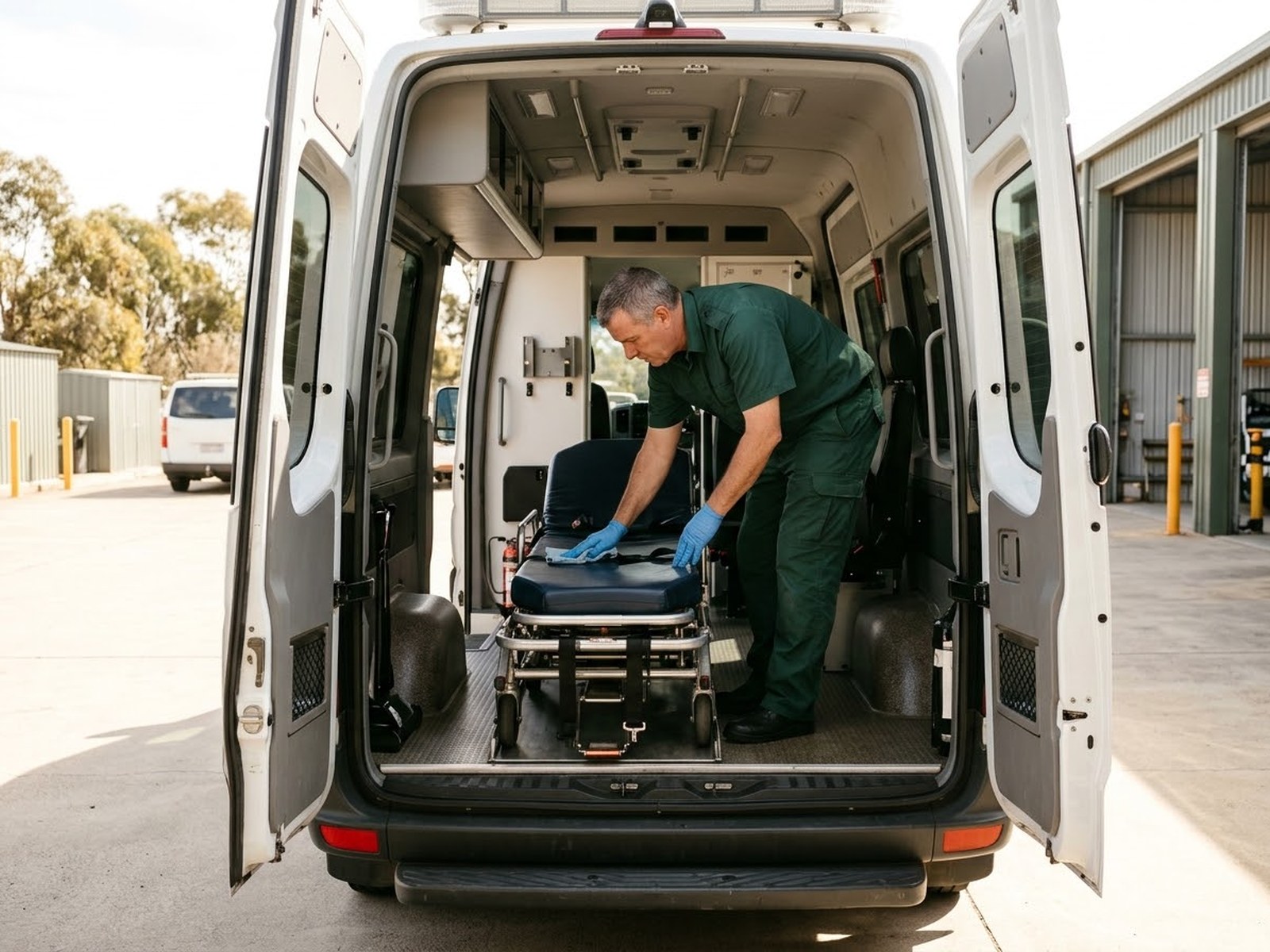
Who the award covers, and who it does not
- A specialist patient transport company, a private ambulance service or an event medical company is under this award, unless it is bound by another health award.
- It does not cover an employer bound by the Aged Care Award 2010, the Health Professionals and Support Services Award 2020, the Medical Practitioners Award 2020, the Nurses Award 2020 or the SCHADS award (cl 4.3). So a private hospital's own patient transport or orderly staff are under the Health Professionals and Support Services Award, not this one.
- State ambulance services are different. NSW Ambulance and the Queensland Ambulance Service are in their state industrial systems, and Ambulance Victoria employs its paramedics under Fair Work enterprise agreements, not this award. See the NSW, Queensland and Victoria pages.
- WA is different again. Road ambulance in WA is provided by St John Ambulance Western Australia Ltd, a company in the Fair Work system with its own enterprise agreements. Its paramedics and transport officers go to the Fair Work Commission for unfair dismissal, within 21 days, not the WA Industrial Relations Commission. The industrial hub has a guide for WA paramedics.
Classifications and pay from 1 July 2026
Operational rates rise with each year of service (cl 16.1). Weekly full-time rates, hourly in brackets:
Read moreShow less
| Classification | Year 1 | Year 2 | Year 3 |
|---|---|---|---|
| Trainee clinic transport officer | $1,158.00 ($30.47) | $1,167.30 ($30.72) | $1,175.60 ($30.94) |
| Clinical transport officer | $1,188.30 ($31.27) | $1,194.90 ($31.44) | $1,202.50 ($31.64) |
| Patient transport officer; communications call taker | $1,218.00 ($32.05) | $1,227.00 ($32.29) | $1,235.10 ($32.50) |
| Student ambulance officer or paramedic, Levels 1 to 3 | $1,179.10 to $1,274.50 | $1,188.30 to $1,288.10 | $1,193.50 to $1,295.80 |
| Ambulance attendant | $1,299.90 ($34.21) | $1,310.10 ($34.48) | $1,317.40 ($34.67) |
| Ambulance officer; mechanic | $1,309.50 ($34.46) | $1,319.50 ($34.72) | $1,326.90 ($34.92) |
| Station officer or team manager (branch under 10 staff) | $1,428.20 | $1,437.70 | $1,445.90 |
| Senior station officer | $1,557.00 ($40.97) | $1,566.70 ($41.23) | $1,574.20 ($41.43) |
- A patient transport officer holds a Certificate III in Non-emergency Client Transport or equivalent and gives basic care and transport to non-emergency patients (Schedule A, A.1.8). An ambulance attendant holds a paramedical science or emergency care diploma and gives more advanced care to non-emergency patients (A.1.7). An ambulance officer or paramedic holds a paramedic degree (A.1.1).
- Administrative officers: Band 1 starts at $1,103.40 a week ($29.04) and Band 4 is $1,507.10 ($39.66) (cl 16.1(b)).
- Higher duties are paid at the higher rate, including for paid leave and public holidays in that period (cl 16.2).
Ambulance and Patient Transport Industry Award 2020 (MA000098)
Private patient transport companies, private ambulance services and event medical companies. Not a private hospital's own transport staff, and not the state ambulance services.
- Patient transport officer, year 1 to 3
- $32.05 to $32.50 an hour ($1,218.00 to $1,235.10 a week)cl 16.1
- Ambulance officer, year 1
- $34.46 an hour ($1,309.50 a week)cl 16.1
- Weekend and public holiday (ordinary hours)
- 150%; 250%cl 21.1
- Shift allowance
- $59.71 a shift finishing 6 pm to 8 am or starting 6 pm to 6.30 amcl 18.2(g)
- On-call
- $4.38 an hour; a call-out 200%, minimum 1.5 hourscll 18.2(h), 20.6
- Overtime
- Monday to Friday 150% for 2 hours, then 200%; weekends 200%; public holiday 250%cl 20
- 13th consecutive shift without 24 hours off
- 300%cl 13.3(b)
- Casual
- 25% weekdays, 75% weekends, 100% public holidays; minimum 3 hourscl 11
Rates from 1 July 2026. Check today's rate in the Fair Work Ombudsman's Pay and Conditions Tool.
Rosters, consecutive shifts and the break after overtime
- Full-time hours are 38 a week or an average over the roster cycle, with 10/14 rosters by agreement. An employer may roster 40 hours a week and give either 12 extra days' leave a year or an accrued day off every 4 weeks (cl 13.1, 13.2).
- Part-time hours need an agreed written pattern of hours, days and start and finish times; the minimum shift is 4 consecutive hours, and all hours beyond the agreed hours are overtime (cl 10.2 to 10.5). A casual's minimum is 3 hours a start unless otherwise agreed (cl 11.1).
- Nobody may be required to work more than 10 consecutive shifts without 24 hours off. If you agree to more than 12, you are paid 300% for the 13th and later consecutive shifts until you get 24 hours off (cl 13.3).
- Rosters are posted 28 days ahead, showing 28 days of duty, rotating where practicable, with weekend duty shared equitably (cl 14).
- Overtime should leave at least 8 consecutive hours off between days. If it does not, you are released until you have had 8 hours off without loss of ordinary pay, or, if you are required to keep working, paid 200% until released (cl 20.4).
Overtime, weekends, on-call and allowances
- Overtime: Monday to Friday 150% for the first 2 hours, then 200%; Saturday and Sunday 200%; beyond rostered hours on a public holiday 250%; and work outside a 12-hour spread from the start of the last rostered duty 200%. Each day stands alone, and casual loadings are not paid on overtime (cl 20.1 to 20.3).
- Ordinary hours on weekends are 150% for full-time and part-time employees, and public holidays 250% (cl 21.1). A casual gets a loading of 25% on weekdays, 75% on Saturdays and Sundays and 100% on public holidays, instead of the weekend and public holiday rates (cl 11.2).
- Shift allowance: $59.71 a shift where rostered ordinary hours finish between 6 pm and 8 am or start between 6 pm and 6.30 am (cl 18.2(g)).
- On-call: $4.38 an hour on an on-call roster; a call-out is paid at 200% with a minimum of 1.5 hours a call; on-call limits include every second weekend free and at least 8 days free in each 14 (cl 18.2(h), 20.6). A recall when you are not on call is paid at 200% (cl 20.7), and stand-by outside ordinary hours counts as time worked (cl 20.8).
- Other allowances from 1 July 2026: single officer stretcher crew $19.90 an 8-hour shift; crewing with and training a student $6.24 a shift; communications centre $9.42 a shift; flying $79.61 a shift; and paramedic skills allowances payable for all purposes (cl 18.2).
Meal breaks and crib time
Under the award you get an unpaid meal break of at least 30 minutes. Operational employees (and others by agreement) instead get a paid 20-minute crib break, counted as time worked and taken when and where the employer directs. There are also two paid 10-minute rest breaks where practical, and 10 minutes' changing time where a uniform cannot be worn home (cl 15).
Read moreShow less
Whether a "paid meal break" in an agreement is part of your 38 ordinary hours depends on the agreement's words. In a Victorian case, the Full Bench held an agreement's paid meal break was not part of the 38 ordinary hours, even though it was paid (see the case below). If your crew is regularly required to stay available and respond during breaks, raise it and ask for crib time to be written into the roster or the agreement.