

Employment law · Hospitality

Restaurants, cafes, pubs and clubs: your rights at work.

For employees in restaurants, cafes, pubs, hotels, motels, resorts, clubs, casinos and catering. Your award and level, weekend and late-night rates, trial shifts and cash pay, what agreements usually say, real decisions from the industry, and what changes in your state.

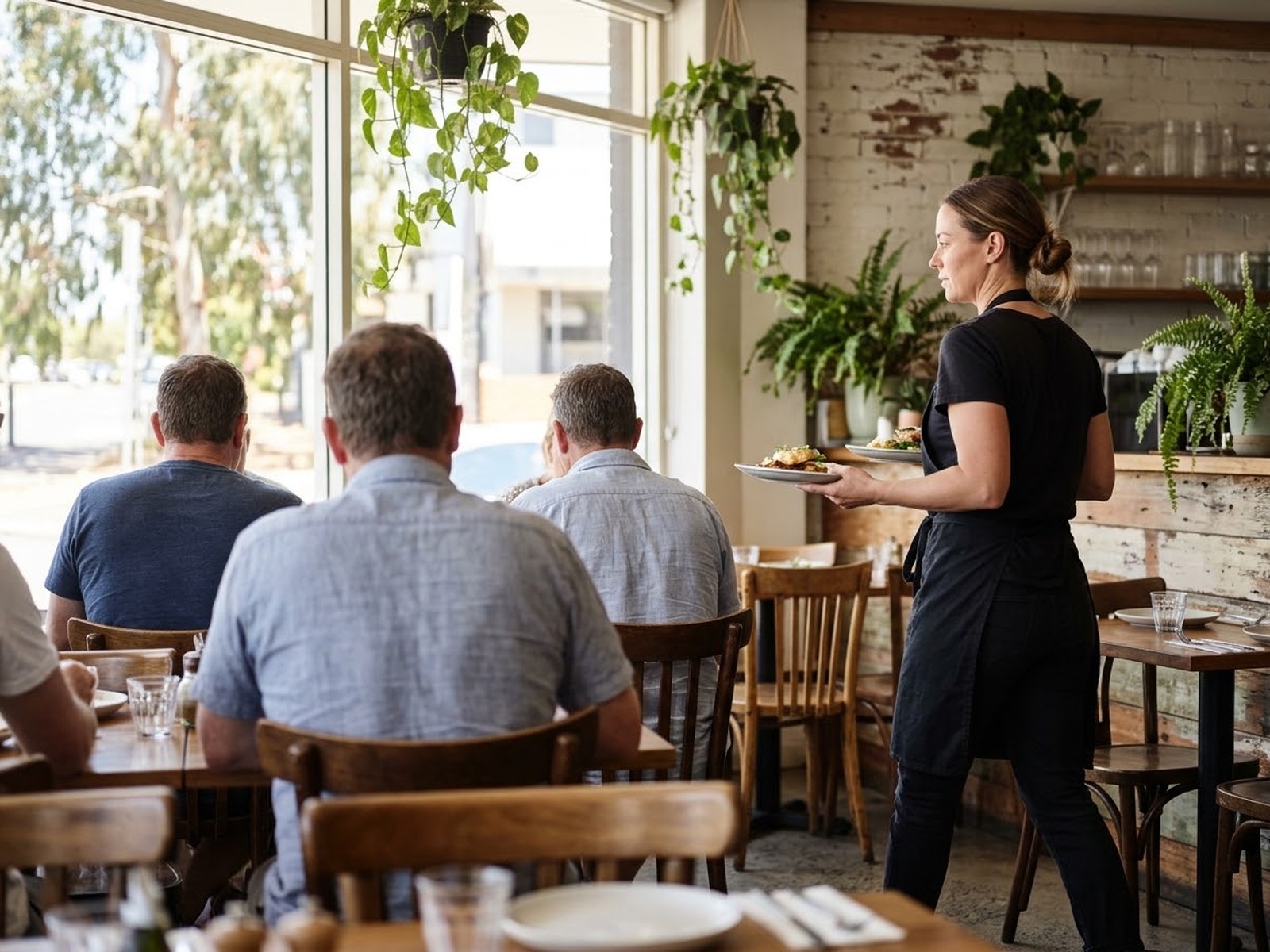
A waitress carries two plates across a bright neighbourhood restaurant at lunchtime.
$26.44an hour, Level 1 under the hospitality awards from 1 July 2026
2 hoursthe minimum casual shift under the Hospitality and Restaurant awards
21 daysto lodge an unfair dismissal or general protections dismissal claim

Time limit Dismissed? You have 21 days from the day the dismissal took effect to apply to the Fair Work Commission, for unfair dismissal or a general protections dismissal claim (Fair Work Act 2009 (Cth) ss 394(2), 366(1)). In the WA state system it is 28 days.

Which job, which rules?

Your award, your system and your options depend on who employs you and what their business is, not on your job title. Pick the closest.

System
Fair Work, in every state, unless a WA sole trader, partnership or family trust runs it.
Award or agreement
Hospitality Industry (General) Award 2020, or the group's agreement if it has one. A hotel's bistro and function rooms are under the same award.
Union
The United Workers' Union is covered by some pub group agreements; others name no union. Check your agreement.
If you are dismissed
Unfair dismissal or general protections at the Fair Work Commission, within 21 days.

Weekdays after 7 pm you get $2.95 an hour extra, and after midnight $4.42 (cl 29). Read about coverage

Award snapshot

The clauses that matter most at work. Full detail in Awards and pay.
Award snapshot

Hospitality Industry (General) Award 2020 (MA000009)

Hotels, pubs, bars, motels, resorts, serviced apartments, casinos, caterers and function centres.

Introductory
$978.10 a week ($25.74 an hour; casual $32.18)cl 18.1
Level 1
$1,004.90 a week ($26.44 an hour; casual $33.05)cl 18.1
Level 4 (qualified cook or waiter)
$1,119.10 a week ($29.45 an hour; casual $36.81)cl 18.1
Level 6 (chef de partie)
$1,221.10 a week ($32.13 an hour; casual $40.16)cl 18.1
Casual loading
25%, minimum engagement 2 hourscll 11.1, 11.3
Penalties
Saturday 125%, Sunday 150%, public holiday 225% (casual 150%, 175%, 250%); weekdays 7 pm to midnight plus $2.95 an hour, midnight to 7 am plus $4.42cl 29
Overtime
Monday to Friday 150% for 2 hours, then 200%; weekends 200%cl 28
Split shift allowance
$3.69 a day (break of 2 to 3 hours) or $5.60 (over 3 hours), full-time and part-timecl 26.14

Rates from 1 July 2026. Check today's rate in the Fair Work Ombudsman's Pay and Conditions Tool.

Award snapshot

Restaurant Industry Award 2020 (MA000119)

Stand-alone restaurants, cafes, reception centres, night clubs and roadhouses.

Level 1
$1,004.90 a week ($26.44 an hour; casual $33.05)cl 18.1
Level 4 (qualified cook or waiter)
$1,119.10 a week ($29.45 an hour; casual $36.81)cl 18.1
Level 6 (cook grade 5)
$1,221.10 a week ($32.13 an hour; casual $40.16)cl 18.1
Weekends and public holidays
Saturday 125%, Sunday 150%, public holiday 225%; casual Saturday 150%, Sunday 150% (Introductory to Level 2) or 175% (Levels 3 to 6), public holiday 250%cl 24
Late nights
Weekdays 10 pm to midnight plus $2.95 an hour; midnight to 6 am plus $4.42cl 24
Overtime
Monday to Friday 150% for 2 hours, then 200%; Saturday 175% for 2 hours, then 200%; Sunday 200%cl 23
Split shift allowance
$5.60 for each work period of 2 hours or more, full-time and part-timecl 21.3
Casual minimum
2 hours each engagementcl 11.3

Rates from 1 July 2026. Check today's rate in the Fair Work Ombudsman's Pay and Conditions Tool.

Award snapshot

Registered and Licensed Clubs Award 2020 (MA000058)

Not-for-profit registered and licensed clubs: RSL, leagues, bowling, golf, sporting and workers' clubs.

Level 1
$1,004.90 a week ($26.44 an hour)cl 18.3
Level 4 (trade cook)
$1,119.10 a week ($29.45 an hour)cl 18.3
Club managers, Levels 6 to 13
$63,672 to $80,316 a yearcl 18.3
Penalties
Saturday 150%, Sunday 175%, public holiday 250% (casuals the same)cl 24
Late and early work
Weekdays 7 pm to midnight plus $2.95 an hour, midnight to 7 am plus $4.42, casuals includedcll 11.2, 24.4
Missed meal break
150% from the end of 5 hours until the break is givencl 17.2
Broken periods of work
$4.48 a daycl 19.2(c)
Casual minimum
2 hours a shift (bingo callers 3, fitness instructors 1)cl 11.5

Rates from 1 July 2026. Check today's rate in the Fair Work Ombudsman's Pay and Conditions Tool.

Awards and pay in full →

What a typical agreement says

Many larger employers have an enterprise agreement on top of the award.

What we usually see

From a sample of 12 current hospitality agreements approved between December 2023 and November 2026: six casinos, three clubs and three pub and hotel employers. Each was read for the terms described, not end to end. A sample, not every agreement: the Commission holds hundreds of hospitality agreements. Always read your own.

  • TypicalTerm A nominal expiry about 2.5 to 4 years after approval, most often 30 June (Crown Sydney, The Star venues, Wrest Point, Mindil Beach, RACV, Publican.Co).
  • TypicalCasino penalty rates Most of the casino agreements in the sample match or exceed the award. The Star Sydney pays Saturday 7 am to 7 pm 125% (casual 150%), Saturday 7 pm to midnight 150% (175%), Sunday 150% (175%) and public holidays 250% (275%), against the award's 225% (250%). Crown Sydney pays overtime from 7 pm Friday to midnight Sunday at 200% (cl 14).
  • Watch forBelow-award percentages Mindil Beach sets Saturday at 120% (casual 140%) and Sunday at 140% (casual 162.5%) for ordinary hours, below the award, with higher base rates in the approval undertakings: the Gaming Introductory rate is $26.77, rising to $27.57 from the first full pay period on or after 7 December 2026, against the award's casino Introductory $26.13 (penalty table cl 23; base rates in the approval undertakings).
  • VariesClub wages Often tied to the award: Coffs Ex-Services pays 4% above the award from the first full pay period on or after 1 July 2026, 1 July 2027 and 1 July 2028 (cl 37.2-37.4); Canley Heights RSL raises wages from July 2027 by the greater of 2.5% and the Registered and Licensed Clubs Award 2020 increase, capped at 4% (cl 43.3-43.4).
  • VariesPub and club weekend rates McGuires' Hotels uses the award's percentages for ordinary hours (Monday to Friday 100%, Saturday 125%, Sunday 150%; casuals 125%, 150%, 175%) (cl 32.1). RACV pays Saturday and Sunday 150% (casuals 150% and 175%) (cl 10.1).
  • Watch forSalaried staff Publican.Co guarantees a salaried employee's negotiated salary stays at least 5% above the award minimum salary, a new cl 17.3(d) added by the employer's undertaking when the agreement was approved.
  • Watch forSenior managers Often excluded: McGuires' Hotels does not cover employees doing the duties of senior management responsible for a significant area of one or more hotels (cl 3.2).
  • Watch forSeveral agreements in one employer Casino groups have separate agreements for main operations, managers, property services, engineering and security. Check which one names your classification.
See the agreements we read (12)
AgreementApprovedNominal expiry
Crown Sydney Main Enterprise Agreement 2025 (AE531803)19 January 202630 June 2028
The Star Sydney Enterprise Agreement 2024 (AE525233)27 June 202430 June 2027
The Star Gold Coast Enterprise Agreement 2026 (AE533519)23 July 202630 June 2030
The Star Brisbane Enterprise Agreement 2025 (AE530115)19 August 202530 June 2028
Wrest Point Hotel Casino Enterprise Agreement 2026 (AE534621)16 November 202630 June 2029
Delaware North Mindil Beach Casino Resort Enterprise Agreement 2025 (AE529600)7 July 202530 June 2028
RACV Club and Resorts Collective Agreement 2026 (AE533623)4 August 202630 June 2029
CHRSL&SC Enterprise Agreement 2026 (Canley Heights RSL and Sporting Club) (AE534353)14 October 202614 October 2029
Coffs Ex-Services Memorial and Sporting Club Limited Enterprise Agreement 2026 (AE532365)20 March 202627 March 2029
Publican.Co Group Enterprise Agreement 2023/2024 (AE523586)19 February 202430 June 2027
McGuires' Hotels Enterprise Agreement 2023 (AE522557)1 December 202330 November 2027
East End Hotel Enterprise Bargaining Agreement 2023 (AE524369)22 April 202422 April 2028

Check your own agreement

Four steps. You can do the first two in five minutes.

  1. Find itYour payslip or contract usually names it. If not, search the Fair Work Commission's agreement search by your employer's name or ABN.
  2. Check it covers youRead the coverage clause: does it name your job and your venue? Casino groups have several agreements, and senior managers are often excluded.
  3. Check it still appliesIt operates 7 days after approval unless it names a later day (s 54), and keeps applying after its nominal expiry until it is replaced or terminated.
  4. Compare the whole packageCompare its rates, penalties and allowances with the award for your real roster, not one clause at a time.

What changes in your state

The work is the same; some of the law around it is not.

Hospitality work in each state

Same everywhere. Your award, enterprise agreement, the National Employment Standards, unfair dismissal and general protections are the same in every state (except for an unincorporated WA employer, or a WA club that is not a trading corporation).

Western Australia

State industrial system
Applies to a sole trader, a partnership of individuals or a trust with an individual trustee; 28 days to the WAIRCDiffers
Safety law
Work Health and Safety Act 2020 (WA)
Workers' compensation
Workers Compensation and Injury Management Act 2023 (WA)
Long service leave
Long Service Leave Act 1958 (WA), in both systems; check the Act
Labour hire licensing
None
Liquor and casino law
Liquor Control Act 1988 (WA): approved managers complete a licensing course, which on its own may not be a supervisory course for Level 5Differs
Employment law in WA →

New South Wales

State industrial system
None for private employers: all are in Fair Work
Safety law
Work Health and Safety Act 2011 (NSW)
Workers' compensation
Workers Compensation Act 1987 and Workplace Injury Management and Workers Compensation Act 1998 (NSW)
Long service leave
Long Service Leave Act 1955 (NSW); check the Act
Labour hire licensing
None
Liquor and casino law
Liquor Act 2007 (NSW) duties on licensees and staff; casinos under the Casino Control Act 1992 (NSW)Differs
Employment law in NSW →

Victoria

State industrial system
None for private employers: all are in Fair Work
Safety law
Occupational Health and Safety Act 2004 (Vic)
Workers' compensation
Notice of injury to your employer within 30 days (Workplace Injury Rehabilitation and Compensation Act 2013)Differs
Long service leave
Long Service Leave Act 2018 (Vic); check the Act
Labour hire licensing
Labour Hire Licensing Act 2018 (Vic): providers must be licensedDiffers
Liquor and casino law
Check your venue's licence conditions
Employment law in Victoria →

Queensland

State industrial system
None for private employers: all are in Fair Work
Safety law
Work Health and Safety Act 2011 (Qld)
Workers' compensation
Apply within 6 months after the entitlement arises (Workers' Compensation and Rehabilitation Act 2003)Differs
Long service leave
Industrial Relations Act 2016 (Qld), which applies to national system employees too; check the Act
Labour hire licensing
Labour Hire Licensing Act 2017 (Qld): providers must be licensedDiffers
Liquor and casino law
Check your venue's licence conditions
Employment law in Queensland →
Decided cases from hospitality

What the Commission and the courts decided.

Published decisions of the Fair Work Commission and the courts, retold in plain English from the decision itself. Lawcaptain did not act in these cases. Each links to the full decision.

A restaurant worker in her forties sits on a park bench in daylight reading a printed letter, a plain apron folded on her bag.
Photo is illustrative
Penalties
$15.3 million in penaltiesFederal Court of Australia · 5 August 2024

A sushi chain's wage theft brought $15.3 million in penalties, and the director's share went to the workers.

A group of sushi restaurants in NSW, the ACT and the NT underpaid about 163 employees for nearly four years, made some hand back wages, and kept false records.

Read the full storyShow less

Result. Penalties on four companies and their director; the director's $1.6 million to be paid out to the underpaid workers.

From February 2016 to January 2020 the group underpaid 163 employees, about 73% of its workforce; 85% of them were temporary visa holders ([43], [47]). They were paid below the Restaurant Industry Award 2010 and missed casual loadings, overtime, weekend and public holiday rates and annual leave. Twenty-three were required to pay back part of their wages ([45]).

Payroll records left out cash payments and understated hours, and false records were produced to a Fair Work Inspector. Some contraventions were serious contraventions because they were knowing and systematic ([2], [27], [61]).

The Court said penalties had to make conduct like this "economically irrational" ([121]). It imposed $15.3 million across four companies and the sole director ([123]).

The companies were in liquidation and had not paid the back pay, so the director's $1.6 million penalty was ordered paid to the Ombudsman for distribution to the workers in proportion to their underpayments ([3], [123]; order 2). The Court also recommended that the Ombudsman refer the matter to the ATO, Home Affairs and ASIC ([124]).

What it means for you

A company going into liquidation does not end the matter. The director can be penalised personally, and the penalty can be paid to the workers.
A new waitress in her thirties is shown how to use a coffee machine by an older colleague in a bright country cafe in the morning.
Photo is illustrative
Trial shifts
Trial day was her start dateFair Work Commission · 7 January 2025

The "unpaid trial" that started the job.

A resort, a small business, said a worker's first day was an unpaid trial to test her "fit in the team", and that she therefore fell short of the 12 months' service she needed to claim unfair dismissal.

Read the full storyShow less

Result. The employer's jurisdictional objection was dismissed, so her unfair dismissal claim could go ahead.

A welcome email had invited her to a first shift, and she first attended on 25 September 2023 ([8], [10]). Her employment ended in October 2024. The employer accepted that no document said the job depended on a successful trial ([10]).

Her bank statement showed $201.95 in wages, and the Commission found she was more likely than not paid for the shift ([12] to [13]).

But payment was not the point. Nothing showed the offer was conditional on a successful trial, and if she had not fitted in, the employer could simply have ended her employment then. Her employment began on the trial day, so she had served the 12 months ([13] to [15]).

The Deputy President observed in passing that "unpaid trials are permitted in very limited circumstances", without saying what they are ([14]).

What it means for you

If the job did not depend on passing the trial, the trial day can count towards your service. Keep the offer email and any record of pay for that shift.

Show more cases (2)Show fewer
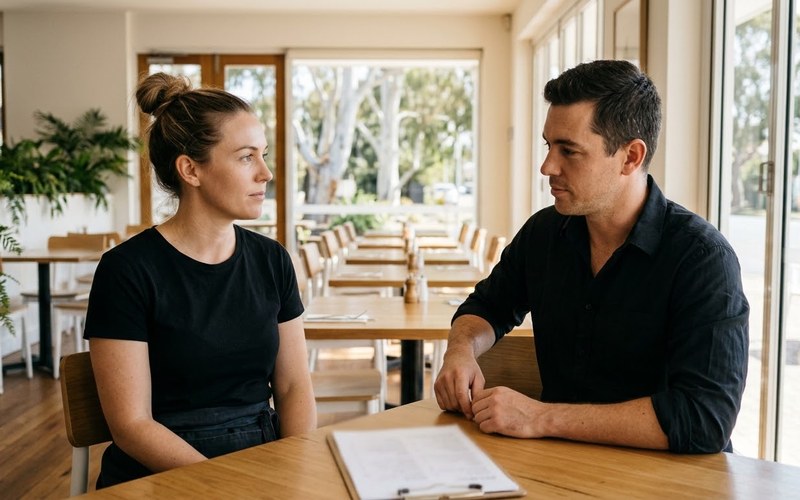
A chef in whites in his fifties and a manager sit across a small table in a bright back office of a hotel restaurant, a closed folder between them.
Photo is illustrative
TipsVic
Unfair dismissal; $12,091.05Fair Work Commission · 20 September 2022

Sacked for taking tips from a pool nobody had recorded.

A chef de partie at a restaurant in a Melbourne casino complex, about six and a half years into the job, was summarily dismissed for keeping part of the back-of-house tips.

Read the full storyShow less

Result. No valid reason; reinstatement inappropriate; compensation cut by 70% for not taking reasonable steps to find work and a further 50% for covertly recording a conversation.

The employer alleged that she and other senior chefs kept part of the tips pool before distributing it ([66]). She said she had counted and distributed the back-of-house tips only about three times, when her manager asked ([8]).

There were no records of the total pool, the split between front and back of house, or what each person was paid ([67]), and a 2019 staff vote on how tips would be shared had not been shown to be communicated as the employer's own procedure required ([65]). No witness saw her take tips ([68] to [69]), and the CCTV had not been kept ([36]).

Her alleged admissions came at the end of a 3.5-hour meeting after 6 pm, translated by a colleague who was not a professional interpreter and at times used a phone app. The Commission was not satisfied she understood the questions ([72] to [75]).

There was no valid reason and the dismissal was unfair ([103]). Compensation was cut by 70% because she had not taken reasonable steps to find other work, and by a further 50% because she had secretly recorded a conversation, leaving $12,091.05 ([134], [140], [146]).

What it means for you

If you are accused of taking tips, ask what records exist of the pool and what each person received. Without them the allegation is hard to prove. But look for work straight away and do not record meetings covertly.

A waitress in her thirties talks quietly with an older female colleague outside the back door of a cafe in bright daylight, both in plain aprons.
Photo is illustrative
Harassment by a director
$50,000 plus $40,000 in penaltiesFederal Circuit and Family Court of Australia (Division 2) · 26 March 2026

Harassed by the cafe's director, who then paid her personally.

A casual waitress at a Canberra cafe-bar sued the company and its sole director for underpayment, record-keeping breaches and sexual harassment by the director.

Read the full storyShow less

Result. By consent: $50,000 compensation, a $9,390 penalty for the harassment and a $30,610 penalty for pay and records breaches, all paid to her.

She started as a casual waitress at the cafe on 6 May 2024 and did not return after the harassment on 29 July 2024 ([10], [16]-[18]). The Restaurant Industry Award 2020 applied, and she was underpaid $6,079.08 ([26]).

The director admitted that he sexually harassed her in connection with her employment, through unwelcome sexual advances and unwelcome conduct of a sexual nature, in breach of s 527D (declaration 1). He also admitted his involvement in the company's failures over pay, payslips, superannuation and records (declarations 2 to 7).

A liquidator was appointed to the company the day before the hearing, so the claim against it could not go on. The case went ahead against the director ([2], [3]).

By consent he was ordered to pay her $50,000 compensation for hurt, distress and humiliation, a $9,390 penalty for the harassment and a $30,610 penalty for the other contraventions, the penalties paid to her (orders 1 to 3; [3]). The claim against the company was discontinued, and the Court noted that she intended to claim her unpaid wages from the liquidator (order 5).

What it means for you

A worker harassed by a director can claim against that person directly under the Fair Work Act, even if the business has gone broke.

Consent orders made on admissions: the amounts reflect the parties' agreement and the Court's approval, and the Court noted the evidence of loss was limited ([61], [64]).

A venue manager in her fifties briefs four staff in plain black uniforms before service at the bar of a bright suburban pub bistro, one of them a man in a turban.
For employers

If you run a hospitality business

Restaurants, cafes, pubs, hotels, clubs, caterers and casinos. These are the most common hospitality exposures.

  • Pay at least the award, whatever the payment method. Cash is allowed; a flat rate below the award, money handed back or false records are not, and directors can be liable personally. Cash pay, flat rates and wage theft →
  • Pay the penalties, loadings and split shift allowances. Each award sets its own weekend rates and evening times; a group with a pub and a club cannot use one rate card. Penalty rates, split shifts and breaks →
  • Salaries need the award's paperwork. An annualised wage, a manager's salary or a loaded rate needs a written arrangement, records and a yearly reconciliation. Chefs, managers and salaried staff →
  • Deductions only within the award. Till shortages and breakages only for wilful misconduct, and meals and accommodation only within the award's limits. Tips, surcharges and till shortages →
For unions and delegates

Delegates in the venue

The United Workers' Union is covered by most of the current casino, club and pub group agreements sampled on the agreements page, with the AMWU also at The Star's casinos. Delegates have award rights to communicate, use facilities and train (Hospitality award cl 37A; Restaurant and Clubs awards cl 31A).

  • Rosters against timesheets. Missed meal breaks and split shifts are easy to prove from the employer's own documents. Penalty rates, split shifts and breaks →
  • Classification disputes. The award's dispute clause ends in the Commission; a duty manager's level was arbitrated there. Awards and pay →
  • Casino and club bargaining. What a sample of current casino, club and pub group agreements say, and how they compare with the award. Enterprise agreements →
Leading cases

The decisions that set the rules.

$15.3 million in penalties against a sushi restaurant group and its director; the director's penalty was ordered paid to the underpaid workers.

A duty manager is not Level 5 without the appropriate training, including a supervisory course.

Show all leading cases (1)Show fewer

A contract caterer serving many industries keeps the Hospitality award on an aged care site.

Questions

The things people ask.

Which award covers me?

Hotels, pubs, motels, resorts, casinos and caterers: the Hospitality Industry (General) Award 2020. Stand-alone restaurants and cafes: the Restaurant Industry Award 2020. Not-for-profit clubs: the Registered and Licensed Clubs Award 2020. Takeaway and fast food: the Fast Food Industry Award 2020, covered on the retail pages. Large casinos, clubs and some pub groups have an enterprise agreement instead.

What is the hospitality award rate in 2026?

From 1 July 2026 Level 1 is $26.44 an hour ($33.05 casual) under the Hospitality, Restaurant and Clubs awards. A qualified cook or waiter at Level 4 is $29.45 and a chef de partie at Level 6 is $32.13. Weekend, public holiday and late-night rates are on top.

My boss pays cash, a flat rate. Is that legal?

Paying in cash is allowed. Paying less than the award, including its weekend, late-night and casual rates, is not, and a flat hourly rate rarely covers them. You can claim unpaid wages for up to 6 years from each underpaid pay day (Fair Work Act s 544).

Do I have to be paid for a trial shift?

Work you are rostered to do as an employee must be paid, and an unpaid "trial" can turn out to be the start of the job. See Trial shifts and casual work for what decides it.

I work at a small cafe in WA. Am I in the Fair Work system?

Only if the business is a company. A WA sole trader, partnership of individuals or trust with an individual trustee is in the WA state system, and an unfair dismissal claim goes to the WA Industrial Relations Commission within 28 days.

Free discussion · no obligation

Talk to us.

Call 1300 967 552, or leave your details and we will call you.

Do it yourself with AI

General information about Australian employment law, not legal advice about your situation. Updated November 2026.