Hospitality · Restaurant award

Cafes and restaurants have their own award, and it differs in the details.

The Restaurant Industry Award 2020 covers stand-alone restaurants, cafes, reception centres, night clubs and roadhouses. Its levels and base rates match the Hospitality award; its evening loading, casual Sunday rate, split shift allowance and overtime do not.

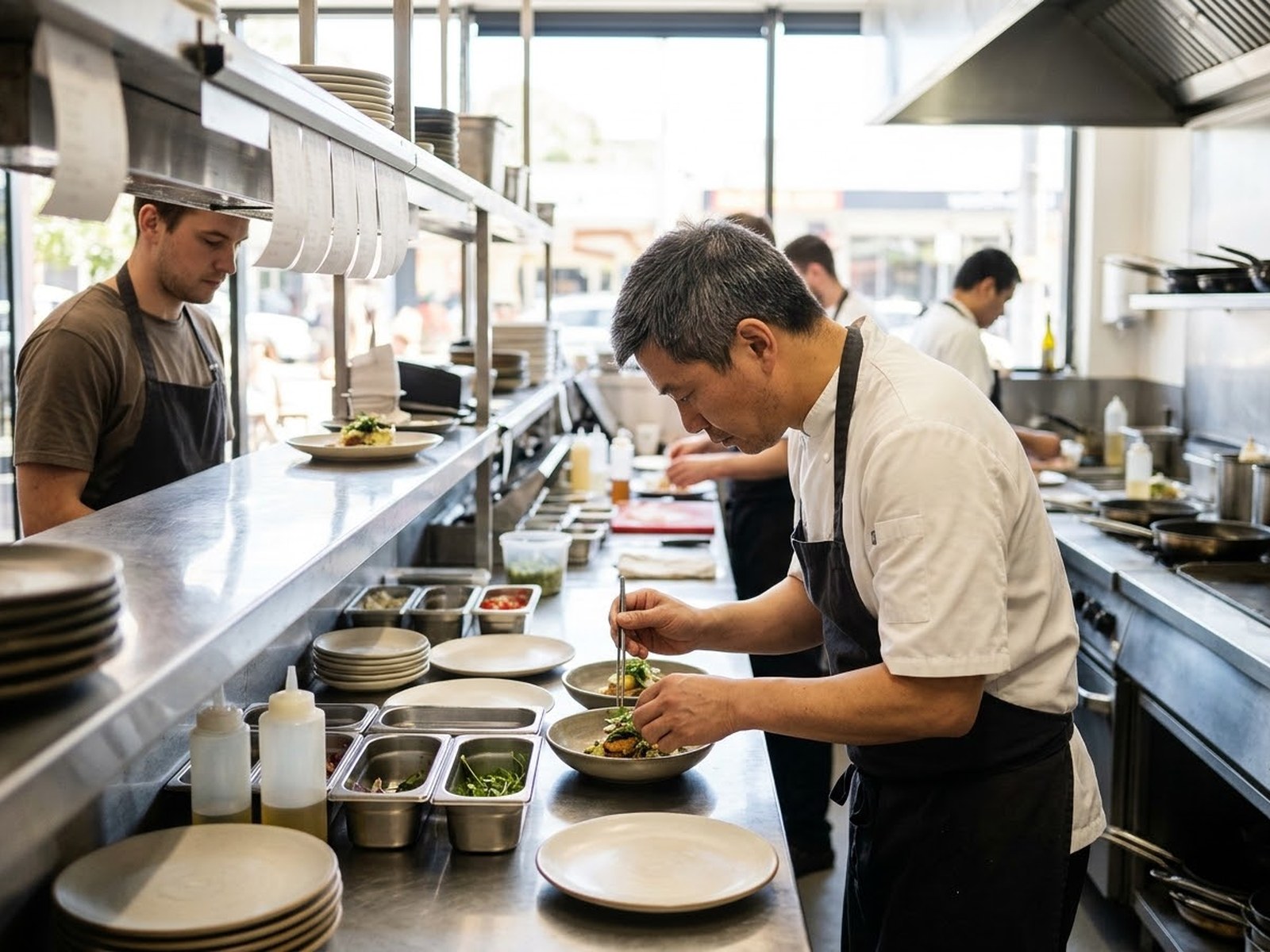
A cook of Chinese background in his forties plates dishes at the pass of a bright, open restaurant kitchen while a waiter in a plain apron waits to take them.
$26.44an hour, Level 1 from 1 July 2026 ($33.05 casual)
10 pmwhen the weekday late loading starts, not 7 pm
2 hoursthe minimum casual engagement

Check first Check who employs you. A restaurant or bistro inside a hotel, casino or club is not under this award: it is under the Hospitality or Clubs award. A takeaway counter is under the Fast Food award.

The Restaurant Industry Award 2020 (MA000119) covers employers in the restaurant industry: restaurants, cafes, reception centres, night clubs and roadhouses, including catering by a restaurant business (cl 4.1, 4.2). It is built on the same classification structure as the Hospitality Industry (General) Award 2020, so a kitchen hand, a waiter and a qualified cook sit at the same levels and earn the same base rates. Every rate here is the minimum from 1 July 2026; check today's figure in the Fair Work Ombudsman's Pay and Conditions Tool.

Does the award cover your cafe or restaurant?

The award does not cover (cl 4.2, 4.4(d)):

Read moreShow less
  1. a restaurant run in or with a hotel, motel, casino or other business under the Hospitality award, such as a hotel's bistro: that is the Hospitality award;
  2. a club's bistro or dining room: the Registered and Licensed Clubs Award 2020;
  3. a takeaway counter or fast food business: the Fast Food Industry Award 2020, covered on the retail pages;
  4. contract caterers whose main business is catering on contract, in-flight catering, aged care catering, boarding schools and hospitals.

Labour hire staff and group training apprentices placed in a restaurant are covered (cl 4.3). Where awards overlap, the classification most appropriate to your work decides (cl 4.5).

Levels and pay from 1 July 2026

LevelTypical rolesWeeklyHourlyCasual hourly
IntroductoryNew starter, up to 3 months$978.10$25.74$32.18
Level 1Food and beverage attendant grade 1, kitchen attendant grade 1$1,004.90$26.44$33.05
Level 2Food and beverage attendant grade 2, cook grade 1, kitchen attendant grade 2$1,029.10$27.08$33.85
Level 3Food and beverage attendant grade 3, cook grade 2, kitchen attendant grade 3$1,062.90$27.97$34.96
Level 4Food and beverage attendant grade 4 (tradesperson), cook grade 3 (tradesperson)$1,119.10$29.45$36.81
Level 5Food and beverage supervisor, cook grade 4 (tradesperson)$1,189.40$31.30$39.13
Level 6Cook grade 5 (tradesperson)$1,221.10$32.13$40.16

Juniors under 20 are paid a percentage of the adult rate (cl 18.2), but a junior doing liquor service is paid the adult rate (cl 13.5). See Junior and apprentice rates.

Award snapshot

Restaurant Industry Award 2020 (MA000119)

Stand-alone restaurants, cafes, reception centres, night clubs and roadhouses.

Level 1
$1,004.90 a week ($26.44 an hour; casual $33.05)cl 18.1
Level 4 (qualified cook or waiter)
$1,119.10 a week ($29.45 an hour; casual $36.81)cl 18.1
Level 6 (cook grade 5)
$1,221.10 a week ($32.13 an hour; casual $40.16)cl 18.1
Weekends and public holidays
Saturday 125%, Sunday 150%, public holiday 225%; casual Saturday 150%, Sunday 150% (Introductory to Level 2) or 175% (Levels 3 to 6), public holiday 250%cl 24
Late nights
Weekdays 10 pm to midnight plus $2.95 an hour; midnight to 6 am plus $4.42cl 24
Overtime
Monday to Friday 150% for 2 hours, then 200%; Saturday 175% for 2 hours, then 200%; Sunday 200%cl 23
Split shift allowance
$5.60 for each work period of 2 hours or more, full-time and part-timecl 21.3
Casual minimum
2 hours each engagementcl 11.3

Rates from 1 July 2026. Check today's rate in the Fair Work Ombudsman's Pay and Conditions Tool.

Where it differs from the Hospitality award

Five differences catch out cafe and restaurant staff and payroll:

Read moreShow less
  1. the weekday late loading starts at 10 pm, not 7 pm, and the early loading runs from midnight to 6 am (cl 24);
  2. a casual at Introductory to Level 2 gets 150% on Sunday, while a casual at Levels 3 to 6 gets 175% (cl 24, Table 8); a full-time or part-time employee gets 150% at every level;
  3. the split shift allowance is $5.60 for each separate work period of 2 hours or more, not a daily amount (cl 21.3);
  4. Saturday overtime is 175% for the first 2 hours, then 200% (cl 23);
  5. time off instead of overtime is at the overtime rate, so 2 hours at 150% earns 3 hours off (cl 23.5).

Example Level 1 rates (Schedule B.1.3): Sunday $39.66 for full-time, part-time and casual staff alike; a casual Level 3 on Sunday $48.95; a casual Level 1 on a public holiday $66.10.

Part-time hours must be in writing

Before you start as a part-timer, you and your employer must agree in writing your guaranteed hours (at least 8 and fewer than 38 a week) and the days and times you are available. The guaranteed hours change only with your written consent. You are rostered for no fewer than 3 and no more than 11.5 hours a day, with 2 days off a week (cl 10).

Read moreShow less

Hours beyond 38 a week, beyond the daily maximum or beyond your rostered hours are overtime (cl 10.13). If you have regularly worked more than your guaranteed hours for 12 months, you can ask in writing for higher guaranteed hours. A worker whose payslips said part-time, but who had irregular hours and no written agreement on guaranteed hours, was held to be owed casual rates instead (see the case below).

Breaks and rosters

For a shift of 5 to 10 hours you get an unpaid meal break of at least 30 minutes, after the first hour and within the first 6 hours; by agreement made during the shift it can be taken within 6.5 hours (cl 16.4). If you are not given it at the rostered time, you are paid 50% extra from when it was due until you get it or the shift ends (cl 16.5, 16.6).

Rosters change by agreement or on 7 days' notice (cl 15.3). You need at least 10 hours between finishing one day and starting the next (8 at a roster changeover) (cl 15.1), and after overtime an 8-hour break, or overtime rates continue (cl 23.2). A split shift must fall within a 12-hour spread.

Schedule R no longer applies

Schedule R, the COVID-19 exemption rate of 170% for Level 5 and 6 full-timers, is still printed in the award but operated only from 11 August 2021 to 10 August 2022 (Sch R.1). An employer still paying a chef or supervisor under Schedule R is paying under a clause with no effect, and the ordinary overtime and penalty clauses apply.

There is no meals and accommodation deduction clause in this award. A deduction for staff meals or housing needs your written authorisation and must be principally for your benefit (Fair Work Act s 324). Breakages and till shortages may be deducted only for wilful misconduct (cl 31).

Decided cases from hospitality

What the Commission and the courts decided.

Published decisions of the Fair Work Commission and the courts, retold in plain English from the decision itself. Lawcaptain did not act in these cases. Each links to the full decision.

$33,600 penalties; back pay orderedFederal Circuit and Family Court of Australia · 7 May 2026

A fine dining restaurant ignored two notices to pay a cook and a supervisor.

An inspector found a Sydney fine dining restaurant had underpaid a cook classified at cook grade 4 and a food and beverage supervisor under the Restaurant Industry Award 2020. The restaurant did not comply with the compliance notices.

Read the full storyShow less

Result. Penalties of $28,000 against the company and $5,600 against its sole director; the unpaid amounts, interest and superannuation ordered by agreement.

The Fair Work Ombudsman issued two compliance notices to the restaurant company, one for each worker, requiring it to work out and pay what they were owed under the Restaurant Industry Award 2020 ([1]-[3], [9]).

The company did not comply, and the Ombudsman sued the company and its sole director.

The Court imposed two penalties of $14,000 on the company, and $5,600 on the director as a person involved in the failure to comply. By agreement, the unpaid amounts, interest and superannuation were ordered to be paid (orders 1-5; [57]-[61]).

What it means for you

If an inspector issues a compliance notice and the restaurant ignores it, the court can order the money paid and penalise the director personally.

$2,893.80 orderedFederal Circuit Court of Australia · 3 February 2020

Her payslips said part-time. With no written hours, she was owed casual rates.

A waitress at a restaurant was shown as part-time on her payslips, but worked irregular hours and never had a written agreement on guaranteed hours.

Read the full storyShow less

The waitress's payslips described her as part-time. Her hours were irregular, and there was no written agreement setting her guaranteed hours, as the award required for part-time employment ([9], [20]-[22]).

The Court held she was not a part-time employee and was entitled to be paid as a casual under cl 12.9 of the Restaurant Industry Award 2010, then in force.

The claim was undefended. The Court ordered $2,893.80 (order 1; [29]).

What it means for you

The label on your payslip does not decide whether you are part-time. Without a written agreement on guaranteed hours, a worker called part-time may be owed casual rates.

For employers

If you run a restaurant or cafe

  • Confirm the award before anything else. A restaurant inside a hotel or club is not under this award, and a takeaway counter is under the Fast Food award.
  • Use this award's own settings. The 10 pm evening start, the casual Sunday split by level, the per-period split shift allowance and Saturday overtime at 175%.
  • Put part-time hours in writing before the first shift. Guaranteed hours and availability, and every change, signed by the employee. Without them you risk owing casual rates.
  • Do not rely on Schedule R. It ended on 10 August 2022.
  • Answer a compliance notice. Ignoring one brings penalties on the company and on the director as well as the back pay.
For unions and delegates

For unions and delegates

  • Rosters against timesheets. Missed meal breaks and split shifts are easy to prove from the employer's own documents. Penalty rates, split shifts and breaks →
  • Check the part-time paperwork. A missing written agreement on guaranteed hours changes what the worker is owed.
Leading cases

The decisions that set the rules.

A restaurant's sole director was penalised personally for the company's failure to comply with two compliance notices.

Without a written agreement on guaranteed hours, a waitress described as part-time was owed casual rates.

Show all leading cases (1)Show fewer

Cut the Restaurant award's full-time and part-time public holiday rate from 250% to 225%; its Sunday rates were not changed.

Questions

The things people ask.

What is the Restaurant award pay rate in 2026?

From 1 July 2026 a Level 1 employee under the Restaurant Industry Award 2020 earns at least $26.44 an hour, or $33.05 as a casual. Level 4, a qualified cook or waiter, is $29.45 and Level 6 (cook grade 5) is $32.13 (cl 18.1).

Is there a separate cafe award?

No. Cafes are covered by the Restaurant Industry Award 2020, unless the cafe is run in or with a hotel or other business under the Hospitality award, in a club, or is a takeaway business under the Fast Food award.

Do restaurant workers get paid more after 7 pm?

Not under this award. The weekday late loading starts at 10 pm: $2.95 an hour from 10 pm to midnight and $4.42 an hour from midnight to 6 am, on top of the ordinary or casual rate (cl 24).

What is the Sunday rate for a casual waiter?

It depends on the level. A casual at Introductory to Level 2 gets 150% on Sunday and a casual at Levels 3 to 6 gets 175% (cl 24). A full-time or part-time employee gets 150%.

What is the split shift allowance under the Restaurant award?

$5.60 for each separate work period of 2 hours or more in a broken working day, for full-time and part-time employees (cl 21.3). Casuals do not get it.

My employer still pays the COVID exemption rate. Is that allowed?

No. Schedule R operated only from 11 August 2021 to 10 August 2022. Since then the ordinary overtime and penalty clauses apply.

Free discussion · no obligation

Talk to us.

Call 1300 967 552, or leave your details and we will call you.

Do it yourself with AI

General information about Australian employment law, not legal advice about your situation. Updated November 2026.