Hospitality · Penalty rates

Sunday in a pub, a cafe and a club is not paid the same way.

Weekend and public holiday rates, the weekday late-night loadings, split shift allowances, meal breaks and overtime under the Hospitality, Restaurant and Clubs awards, from 1 July 2026.

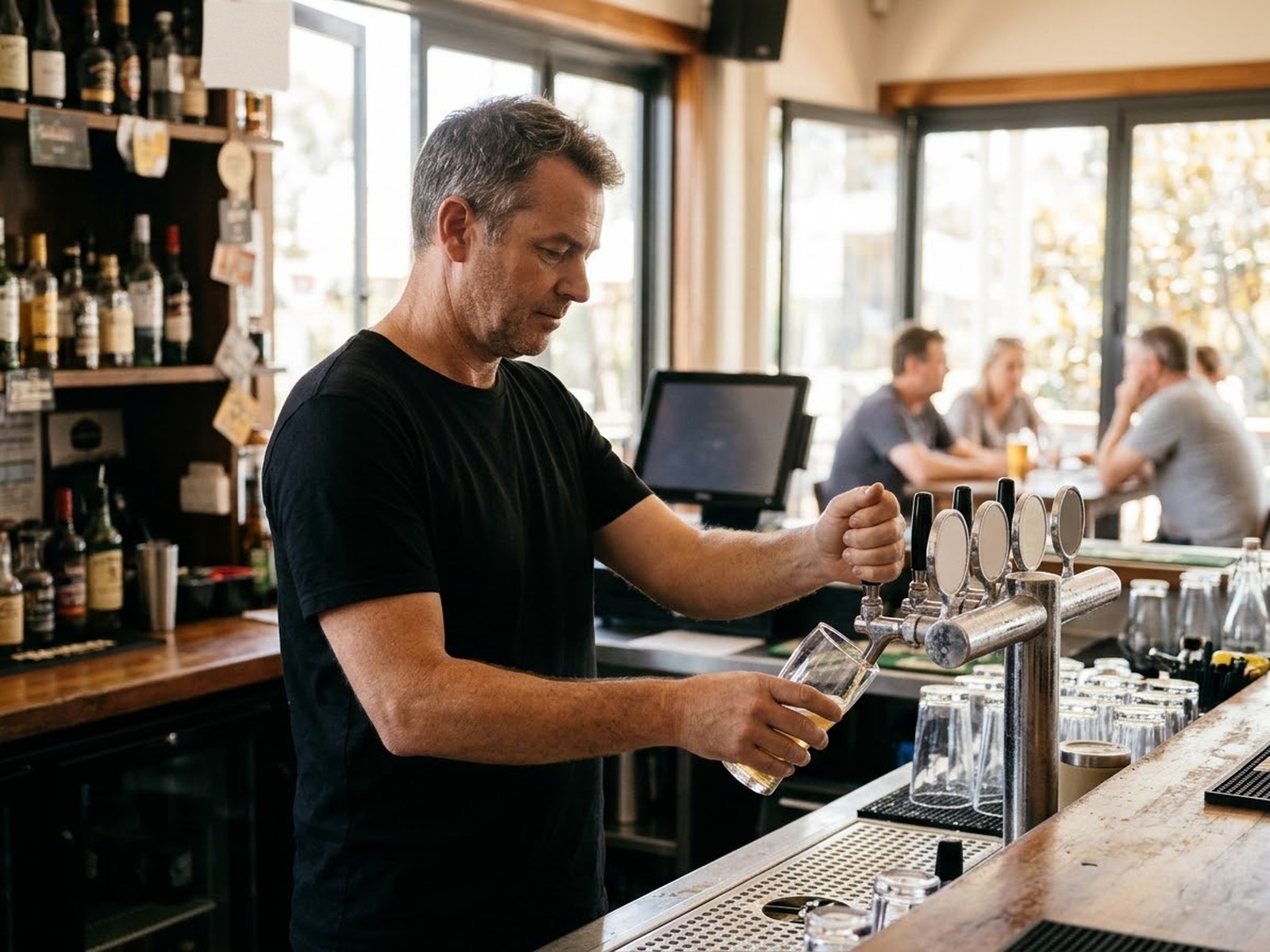
A bartender in his forties in a plain black shirt pulls a beer at the taps of a bright suburban pub on a sunny Saturday afternoon, light through big windows.
150%Sunday for full-time and part-time staff in hotels, pubs and cafes
175%Sunday in a club, and for a hotel or pub casual
$5.60a split shift allowance, from 1 July 2026

Check first Check which award covers your employer before you compare rates: a hotel, a stand-alone cafe and a not-for-profit club each pay weekends differently. If you are on an enterprise agreement, its own penalty table applies.

Hospitality work happens when other people are off: evenings, weekends and public holidays. Each of the three main awards pays for that differently. This page compares the Hospitality Industry (General) Award 2020 (MA000009, hotels, pubs, accommodation, casinos and caterers), the Restaurant Industry Award 2020 (MA000119, stand-alone restaurants and cafes) and the Registered and Licensed Clubs Award 2020 (MA000058, not-for-profit clubs). Dollar figures are from 1 July 2026; check the current figure in the Fair Work Ombudsman's Pay and Conditions Tool.

Weekends and public holidays

Hotels, pubs, casinosRestaurants, cafesClubs
Saturday125%; casual 150%125%; casual 150%150%; casual 150%
Sunday150%; casual 175%150%; casual 150% (Introductory to Level 2) or 175% (Levels 3 to 6)175%; casual 175%
Public holiday225%; casual 250%225%; casual 250%250%; casual 250%
Minimum on a public holiday4 hours (casual 2)4 hours (casual 2)4 hours (non-casual)
Clausecl 29cl 24cl 24
Read moreShow less

Casual percentages include the 25% casual loading. Only the highest penalty applies at any one time, but the missed meal break penalty is paid on top (Hospitality award cl 29.3; Restaurant award cl 24.3; Clubs award cl 24.5).

A full-time or part-time employee can agree to 125% (in a club, 150%) plus a day added to annual leave or a day off within 28 days, instead of the public holiday rate (Hospitality award cl 29.4(d); Restaurant award cl 24.4(d); Clubs award cl 24.3(b)).

You can refuse a request to work on a public holiday if the refusal is reasonable (Fair Work Act s 114). The nature of the workplace and its operational needs count, so a venue that trades on public holidays will often be able to ask, but your circumstances and the notice you were given count too.

Why clubs pay more on Sundays

In 2017 the Penalty Rates decision cut the Hospitality award's Sunday rate for full-time and part-time staff from 175% to 150%, leaving casuals at 175%, and cut public holiday rates from 250% to 225% for full-time and part-time staff in a group of awards that included the Hospitality and Restaurant awards ([2017] FWCFB 1001 at [55], [61], [63], [1915]). The Clubs award's claims were not granted on the material then before the Bench, and its public holiday rates were deferred ([60], [1915]).

So a full-time or part-time bar attendant gets 150% on Sunday in a hotel and 175% in a club. Since 2025, s 135A of the Fair Work Act stops the Commission reducing a penalty or overtime rate when it makes or varies a modern award; it does not apply to enterprise agreements.

Late nights and early mornings

AwardLoading from 1 July 2026Times, Monday to Friday
Hospitality$2.95 an hour; $4.42 an hour7 pm to midnight; midnight to 7 am
Restaurant$2.95 an hour; $4.42 an hour10 pm to midnight; midnight to 6 am
Clubs$2.95 an hour; $4.42 an hour7 pm to midnight; midnight to 7 am (not maintenance and horticultural staff)

The loadings are flat dollar amounts for each hour or part hour, added to the ordinary or casual rate, and casuals get them too. They are not paid on Saturdays, Sundays or public holidays, which carry their own percentages.

Split shifts

A split or broken shift must fall within a spread of 12 hours from first start to last finish (Hospitality award cl 15.1(c)(v), 15.2(e); Restaurant award cl 15.1(g)). Full-time and part-time employees are paid an allowance; casuals are not:

Read moreShow less
  1. Hospitality award: $3.69 a day if the break between the shifts is 2 to 3 hours, $5.60 a day if it is more than 3 hours (cl 26.14);
  2. Restaurant award: $5.60 for each separate work period of 2 hours or more in a broken day (cl 21.3);
  3. Clubs award: $4.48 a day for working ordinary hours in more than one period (cl 19.2(c)).

Split shift allowances are small and easily missed. In one WA cafe prosecution, 21 of 22 part-time staff, 9 of them juniors, had not been paid them (see the case below).

Meal and rest breaks

Hotels (cl 16)Restaurants (cl 16)Clubs (cl 17)
Unpaid meal break30 minutes for a shift over 6 hours, after 2 hours and within the first 6; optional, on written request, for 5 to 6 hours30 minutes for a shift of 5 hours or more, after the first hour and within the first 6 (6.5 by agreement)30 minutes for more than 5 hours, between 1.5 and 5 hours after starting
Paid rest breaks20 minutes for 8 to 10 hours; two for over 1020 minutes if the meal break is rostered after 5 hours; more for long shifts20 minutes after more than 5 hours following the meal break
If the meal break is not given50% extra from 6 hours after starting until it is given50% extra from when it was due until it is given150% from the end of 5 hours until it is given

The missed meal break penalty runs until you get the break or the shift ends, and it is paid on top of any weekend or public holiday rate. If you work through your break on a busy night, write down the time you started, the time you got the break (if you did) and the time you finished.

Rosters, breaks between shifts and overtime

Rosters change by agreement or on 7 days' notice (Hospitality award cl 15.5(d); Restaurant award cl 15.3(d); Clubs award cl 16.2). You need at least 10 hours between finishing one day and starting the next, or 8 at a roster changeover (Hospitality award cl 15.5(e); Restaurant award cl 15.1(e)). A part-timer cannot be rostered outside their written availability (cl 10.7 of each award).

Read moreShow less

Under the Hospitality award, after more than 3 consecutive days of over 10 ordinary hours you must get a break of at least 48 hours (cl 15.1(c)). For a sous chef at an island resort, the Court found breaches of the breaks between shifts, consecutive long days and late-hours penalty clauses of the award then in force, with compensation left for a later hearing ([2024] FedCFamC2G 6 at [142], [146]).

OvertimeHospitalityRestaurantClubs
Monday to Friday150% for 2 hours, then 200%150% for 2 hours, then 200%150% for 2 hours, then 200%
Saturday200%175% for 2 hours, then 200%175% for 2 hours, then 200%
Sunday200%200%200%
Time off insteadHour for hourAt the overtime rateAt the overtime rate

You can refuse unreasonable additional hours (Fair Work Act s 62), taking into account the usual patterns of work in the industry and your circumstances.

Decided cases from hospitality

What the Commission and the courts decided.

Published decisions of the Fair Work Commission and the courts, retold in plain English from the decision itself. Lawcaptain did not act in these cases. Each links to the full decision.

$45,000 penalties; $27,920.69 repaidFederal Court of Australia · 20 February 2018

21 of 22 staff at a Rockingham cafe were never paid the split shift allowance.

A cafe in Rockingham, WA, underpaid its 22 part-time staff, juniors among them, on minimum rates, junior rates, penalties and split shifts under the Restaurant Industry Award 2010.

Read the full storyShow less

Result. Penalties of $37,500 on the company and $7,500 on the manager, plus a training order. The workers had been paid the $27,920.69 after the Ombudsman intervened.

The company ran a cafe in Rockingham and admitted underpaying 22 part-time employees, including juniors ([1]-[2], [4]).

Among the contraventions, it had not paid the split shift allowance to 21 employees, 9 of them juniors. Under the award then in force the allowance was paid whenever an employee was required to work a separate work period of two hours or more. That shortfall alone was $5,511.94 ([80]). None of the 22 had been given payslips that complied with the regulations ([81]).

The total loss was $27,920.69 ([88]). It was repaid, but only because the Fair Work Ombudsman intervened ([90]).

The Court imposed penalties of $37,500 on the company and $7,500 on the manager, and ordered compliance training ([121]; orders 3, 5). In a later prosecution for re-offending, the penalties were $191,646 and $38,394 ([2020] FCCA 3036, orders 4-5).

What it means for you

Check your payslips for the split shift allowance and the late-night loadings. They are small amounts per shift, but they add up and can be claimed for up to 6 years.

For employers

If you run a venue

  • Set payroll by award and by venue. A group with a pub and a club cannot use one rate card: the club's Sunday and public holiday rates are higher for permanent staff.
  • Roster meal breaks at the right time. The penalty for a missed meal break runs until the break is given or the shift ends, on top of any other penalty.
  • Pay split shift allowances to permanent staff. And keep the whole split shift within a 12-hour spread.
  • Give 10 hours between shifts. A late close followed by an early open breaches the award unless the roster allows the break.
For unions and delegates

For unions and delegates

  • Compare a month of rosters with timesheets. Missed breaks and split shifts are easy to prove from the employer's own documents.
  • Watch the club and hotel boundary. A privately owned venue calling itself a club is usually under the Hospitality award, with lower permanent Sunday rates. Which system and which award →
Leading cases

The decisions that set the rules.

Cut the Hospitality award's full-time and part-time Sunday rate to 150% and public holiday rates to 225%; the Clubs award was not cut.

A cafe that missed split shift allowances, junior rates and penalties for 22 staff was penalised $45,000.

Show all leading cases (1)Show fewer

An island resort breached the award's breaks between shifts, consecutive long days and late-hours penalty clauses for a sous chef paid below the salary absorption rate.

Questions

The things people ask.

What is the Sunday rate under the Hospitality award?

150% of the ordinary rate for full-time and part-time employees and 175% for casuals (Hospitality Industry (General) Award 2020 cl 29). From 1 July 2026 that is $39.66 an hour at Level 1, or $46.27 for a Level 1 casual.

Do I get paid more after 7 pm in a pub?

Yes, on weekdays. Under the Hospitality award you get $2.95 an hour extra from 7 pm to midnight and $4.42 an hour from midnight to 7 am, Monday to Friday, casuals included. In a stand-alone restaurant or cafe the loading starts at 10 pm.

What is a split shift and what is the allowance?

A shift worked in two or more parts in one day, all within 12 hours. Full-time and part-time staff get $3.69 or $5.60 a day under the Hospitality award (depending on the length of the break), $5.60 per work period under the Restaurant award and $4.48 a day under the Clubs award. Casuals do not get it.

I didn't get my meal break. What am I owed?

Under the Hospitality award, 50% extra from 6 hours after you started until you get the break or finish. Under the Restaurant award, 50% extra from when the break was due. Under the Clubs award, 150% from the end of 5 hours. It is paid on top of any weekend rate.

What is the public holiday rate in a club?

250% for full-time, part-time and casual staff under the Registered and Licensed Clubs Award 2020 (cl 24), with a 4-hour minimum for non-casuals.

Can my boss roster me to close at midnight and open at 7 am?

Not under the Hospitality or Restaurant award without a breach: you need at least 10 hours off between finishing one day and starting the next, or 8 at a roster changeover.

Free discussion · no obligation

Talk to us.

Call 1300 967 552, or leave your details and we will call you.

Do it yourself with AI

General information about Australian employment law, not legal advice about your situation. Updated November 2026.