Hospitality · Wage theft

Cash pay can be lawful. Less than the award is not.

Flat cash rates, pay you were made to hand back, false records and payslips, and the directors, managers and bookkeepers who can be made to pay. How to work out what you are owed and claim it.

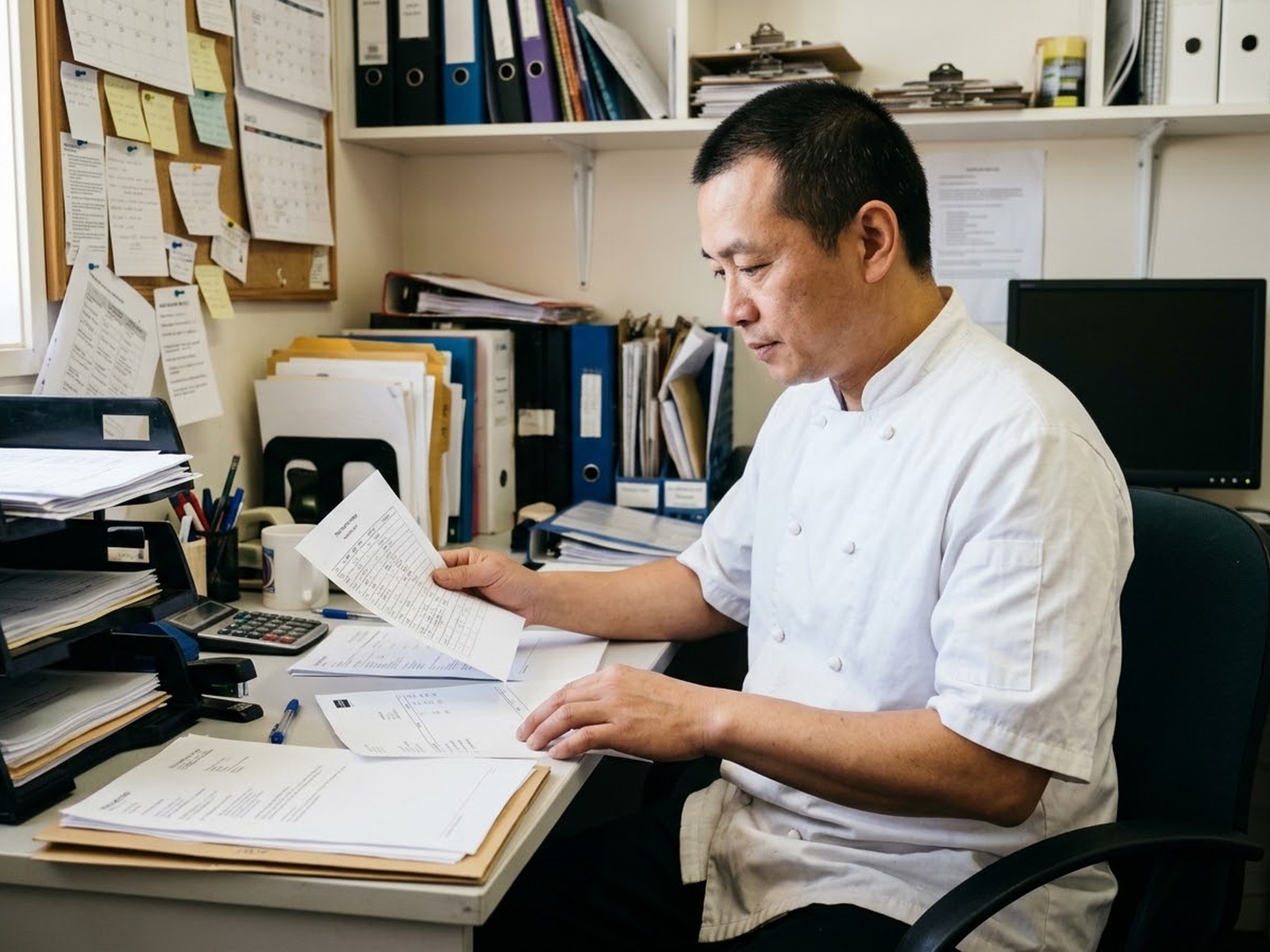
A cook of Chinese background in his forties, in plain kitchen whites, sits at a small desk in the bright back office of a restaurant comparing a printed roster with a payslip.
6 yearsto claim each underpaid amount (Fair Work Act s 544)
$100,000the limit for the small claims procedure (s 548)
$15.3 millionin penalties against a sushi restaurant group and its director

Time limit You have 6 years from the date each amount fell due to claim it under the Fair Work Act (s 544). Older amounts are lost one pay day at a time, so do not wait.

Underpayment in cafes, restaurants, pubs and hotels follows a few patterns: a flat hourly rate, often in cash, with no weekend or night rates; pay handed back to the owner as a "loan" repayment or visa cost; records and payslips that leave hours out. This page covers each one, the cases the courts have decided, who can be made to pay besides the company, and how to claim. The award is usually one of the Hospitality Industry (General) Award 2020 (MA000009), the Restaurant Industry Award 2020 (MA000119) or the Registered and Licensed Clubs Award 2020 (MA000058); see Which system and which award. Fast food is on the retail pages.

Is a flat cash rate legal?

Being paid in cash is not unlawful in itself. A flat rate is lawful only if it is at least what the award requires for every hour you actually worked, in every pay period, including weekend, evening and public holiday rates, casual loading, split shift allowances and overtime. A flat rate often falls short where the roster includes weekends, evenings or public holidays. See Penalty rates, split shifts and breaks and Awards and pay.

Read moreShow less
  1. A full-time qualified cook at a cafe in Echuca was paid flat rates below the Restaurant Industry Award 2010. The cafe paid $45,731.29 in wages, $2,851.21 in leave and $2,378.13 in superannuation only after the Ombudsman sued over a compliance notice it had not complied with, and the company and its sole director were still penalised ([2022] FedCFamC2G 1035 at [8], [95]).
  2. A food and beverage attendant at a restaurant was paid a flat $18.75 an hour and dismissed after co-workers complained about her pay. On default judgment she was awarded her underpayments, $4,541.49 for economic loss and $2,000 general damages, and a later penalty of $103,290 was ordered paid to her ([2025] FedCFamC2G 687, orders 3 and 4; [2025] FedCFamC2G 1276, order 1).

Made to hand back pay, repay a "loan" or cover visa costs

Some employers pay the right amount into the bank, then require part of it back in cash. Your employer must pay you in full (s 323) and must not require you to spend or pay an amount where that is unreasonable and for its benefit (s 325). Threats or false statements to make you pay can also breach ss 343 and 345.

Read moreShow less

What the courts have found:

  1. at two Indian restaurants in Wollongong and Nowra, one cook was made to repay "loans" the director had never made, about $511 a fortnight, in breach of ss 323 and 325, and demands that he cover the employer's PAYG tax breached ss 325, 343 and 345; a demand that the other cook pay visa sponsorship costs breached s 325 ([2022] FCA 712 at 17 to (j));
  2. in a sushi restaurant group, 23 employees were required to pay back part of their wages, which breached s 325 ([2024] FCA 869 at [45]); and
  3. a cook on a 457 visa at a Leederville restaurant was told that handing back pay was "a condition of his visa". The Court set that penalty at 95% of the maximum ([2023] FedCFamC2G 211 at [30]).

If you are on a visa, see Visa workers: the same pay rules apply to you.

False records and missing payslips

Your employer must keep time and wage records for 7 years and give you a payslip (ss 535, 536). Records that leave out cash payments or understate hours are a breach in themselves. If your employer did not keep or produce a record it had to keep, it bears the burden of disproving what you say about the matter the record should show (s 557C).

Read moreShow less
  1. In the sushi restaurant group, payroll records left out cash payments and understated hours, and false records were produced to a Fair Work Inspector. Some contraventions were "serious contraventions" because they were knowing and systematic ([2024] FCA 869 at [2], [27], [61]).
  2. A buffet restaurant gave false and misleading records to the Ombudsman. The company, its director and its payroll bookkeeper were all penalised ([2021] FCCA 1430, orders 1 to 3).

Keep your own record from the start: the dates and hours you worked (photos of the roster, texts, your own diary) and every payment, cash or bank.

Who can be made to pay

Not only the company. Anyone "involved in" a contravention is liable too (s 550):

Read moreShow less
  1. a director: a director of a WA restaurant company that had been wound up was ordered to pay the cook $38,822.68 himself, and a $58,950 penalty ([2023] FedCFamC2G 20 at [195]; [2023] FedCFamC2G 211, order 1);
  2. a bookkeeper: $19,500 against the buffet restaurant's payroll bookkeeper for her part in the false records and the false documents given to the Ombudsman ([2021] FCCA 1430, declaration 3 and order 3);
  3. an accountant: an accounting firm that knew the award rates and ran a fast food chain's flat-rate payroll was knowingly concerned ([2018] FCAFC 134 at [33] to [34]); the same principle can reach any payroll adviser; and
  4. managers who make the pay decisions.

If the companies go into liquidation, the director can still be penalised and the penalty paid out to the workers. In the sushi group case the director's $1.6 million penalty was ordered paid to the Ombudsman for distribution to the employees in proportion to their underpayments ([2024] FCA 869 at [123], order 2). Franchisors and holding companies can be liable in some cases; see Unpaid work and underpayment on the retail pages.

Asking about your pay is protected

A complaint or inquiry about your pay is a workplace right, so your employer must not take adverse action against you, such as cutting shifts or dismissing you, because you made it (ss 340, 341). The restaurant attendant above recovered damages and a penalty after she was dismissed when her pay was raised.

Read moreShow less

Be careful when a supervisor rather than the owner reacts. A casual kitchen worker at a buffet restaurant asked about an apparent underpayment, and the head chef told him "You just work until today, OK? Don't come tomorrow". Two days later the sole director admitted and fixed the underpayment and asked whether he wanted to keep working, and he declined. The Court held the head chef had no authority to dismiss, so the company had not dismissed him, and his claim failed. It did not need to decide whether his pay inquiry was a workplace right ([2026] FedCFamC2G 1724 at [2], [4], [15], [17], [27] to [29]).

How to claim

  1. Get your records. Ask the employer in writing for your time and wage records and payslips; a former employee can ask too.
  2. Work out the shortfall. Rebuild each pay period: hours worked, your level, the rate in force on those dates (rates change each 1 July), penalties, allowances and super. The Fair Work Ombudsman's Pay and Conditions Tool gives current rates.
  3. Ask your employer, in writing, to fix it. Many underpayments are fixed at this stage.
  4. Complain to the Fair Work Ombudsman. It can investigate and issue a compliance notice (s 716), and courts penalise employers and directors who ignore one. Keep the Ombudsman told where to reach you: in one tavern case, back pay for a worker who could not be found was to be kept by the Commonwealth after 180 days ([2021] FCCA 1964, order 2(b) to (d)).
  5. Go to court yourself. The small claims procedure in the Federal Circuit and Family Court is for claims up to $100,000 (s 548). You can ask for any penalty to be paid to you (s 546(3)): in a sous chef's own claim (not a small claim), a $33,000 penalty was ordered paid to him ([2026] FedCFamC2G 518, orders 1 and 2).
  6. Unpaid superannuation. In one cafe cook's case the Federal Court held there was no right to sue for unpaid superannuation guarantee contributions in the Fair Work jurisdiction, and left open whether an award term could found a claim ([2020] FCA 766 at [57] to [60]). On a default judgment another court has ordered compensation for unpaid super under an award clause ([2025] FedCFamC2G 687, order 3(iv)). You may have a court claim for super as well as an ATO complaint; check your award's superannuation clause.

Intentional underpayment can now be a crime

Since 1 January 2025 an employer commits an offence if it is required to pay an amount to or for an employee, intentionally engages in conduct, and that conduct results in a failure to pay the amount in full when due (s 327A). Superannuation, and some leave amounts for employees brought into the national system by state referrals, are excluded (s 327A(2)). It applies to conduct after that date, including conduct that is part of a course of conduct that began earlier.

Read moreShow less

The maximum for an individual is 10 years' imprisonment, a fine, or both. Where the underpayment can be worked out, the maximum fine is the greater of 3 times the underpayment and 5,000 penalty units for an individual, or 25,000 penalty units for a company (s 327A(5), (6)). The offence sits alongside the civil claim: you can still recover the money through the steps above.

Decided cases from hospitality

What the Commission and the courts decided.

Published decisions of the Fair Work Commission and the courts, retold in plain English from the decision itself. Lawcaptain did not act in these cases. Each links to the full decision.

$15.3 million in penaltiesFederal Court of Australia · 5 August 2024

A sushi chain's wage theft brought $15.3 million in penalties, and the director's share went to the workers.

A group of sushi restaurants in NSW, the ACT and the NT underpaid about 163 employees for nearly four years, made some hand back wages, and kept false records.

Read the full storyShow less

Result. Penalties on four companies and their director; the director's $1.6 million to be paid out to the underpaid workers.

From February 2016 to January 2020 the group underpaid 163 employees, about 73% of its workforce; 85% of them were temporary visa holders ([43], [47]). They were paid below the Restaurant Industry Award 2010 and missed casual loadings, overtime, weekend and public holiday rates and annual leave. Twenty-three were required to pay back part of their wages ([45]).

Payroll records left out cash payments and understated hours, and false records were produced to a Fair Work Inspector. Some contraventions were serious contraventions because they were knowing and systematic ([2], [27], [61]).

The Court said penalties had to make conduct like this "economically irrational" ([121]). It imposed $15.3 million across four companies and the sole director ([123]).

The companies were in liquidation and had not paid the back pay, so the director's $1.6 million penalty was ordered paid to the Ombudsman for distribution to the workers in proportion to their underpayments ([3], [123]; order 2). The Court also recommended that the Ombudsman refer the matter to the ATO, Home Affairs and ASIC ([124]).

What it means for you

A company going into liquidation does not end the matter. The director can be penalised personally, and the penalty can be paid to the workers.

$200,000 in penalties, paid to the cooksFederal Court of Australia · 21 June 2022

A cook was made to repay "loans" he had never received.

Two trade-qualified cooks at a family business with two Indian restaurants in Wollongong and Nowra, on or seeking sponsored visas, said they were made to pay back part of their wages.

Read the full storyShow less

Result. Contraventions found in 2022; penalties of $150,000 on the company and $50,000 on the director, paid in equal shares to the two cooks ([2023] FCA 671)

The cooks said they had to hand back a large part of their pay as repayments of loans from the director, to cover PAYG tax and to pay for their visa applications ([5]). The Court found no loans had been made. One cook's "loans" were cashback payments of about $511 a fortnight, demanded in breach of ss 323 and 325 (17 to (h)).

The demands that the same cook cover the employer's tax breached ss 325, 343 and 345, and the demand that the other cook pay visa sponsorship costs breached s 325. The director was knowingly concerned in the company's contraventions (17 to (j); catchwords).

The hours were not arranged as the award required and weekend rates were not paid, but the cooks' claims of 12-hour days, overtime and missed breaks were not proved ([17]). On classification, one cook's duties fell within Cook grade 4, and the equivalent of grade 5 at the second restaurant; the other's were between grades 3 and 4, closer to 4 ([17], [286]).

In 2023 the Court imposed penalties of $150,000 on the company and $50,000 on the director, payable in equal shares to the two cooks ([2023] FCA 671).

What it means for you

Money you are made to hand back is recoverable, however it is described. Keep your bank records, and keep your own record of hours: here the long-hours claims failed for want of proof.

For employers

If you pay hospitality staff

  • Pay every hour at the award rate, with the right penalty, every pay period. A flat rate needs a calculation that proves it covers each roster.
  • Never take money back from staff. Not as a loan repayment, not for tax and not for a visa. Sponsorship costs are the sponsor's.
  • Keep true records and payslips. Missing records shift the burden of proof to you (s 557C), and false records make every other breach worse.
  • If you find an underpayment, fix it quickly, with interest. Get advice before you deal with the Ombudsman: since 1 January 2025 intentional underpayment can be a crime (s 327A).
For unions and delegates

For unions and delegates

  • Offer wage checks. Visa workers and young workers often will not complain. A quiet check against the Pay and Conditions Tool can be a first step.
  • Unions can sue. A union can bring proceedings for members (s 540) and ask that penalties be paid to the workers.
Leading cases

The decisions that set the rules.

Penalties of $15.3 million for underpayment, cashbacks and false records, with the director's penalty paid out to the workers.

One cook's "loan" repayments were cashbacks in breach of ss 323 and 325, and the demand that the other pay visa sponsorship costs breached s 325.

Show all leading cases (3)Show fewer

A director of a wound-up restaurant company was involved in every contravention and ordered to pay the cook personally.

A payroll bookkeeper was penalised as an accessory to the false records and the false documents given to the Ombudsman.

An accountant who knew the award and ran a flat-rate payroll was knowingly concerned in the underpayment.

Questions

The things people ask.

My boss pays cash, a flat $20 an hour. Is that legal?

Not if you are an adult. From 1 July 2026 the lowest adult rate under the Hospitality, Restaurant and Clubs awards is $25.74 an hour before any casual loading, so $20 is below the minimum; junior rates are lower. Cash is not unlawful in itself, but the amount must be at least what the award requires for every hour, in every pay period, including weekend, evening and public holiday rates and casual loading. A flat rate often falls short where you work weekends. Check your level and rates in the Pay and Conditions Tool.

My boss makes me hand back part of my pay. What can I do?

Requiring you to pay back wages, repay a "loan" or cover the employer's costs can breach ss 323 and 325 of the Fair Work Act. Keep your bank statements and a note of each amount handed back, then raise it in writing, with the Fair Work Ombudsman or in court.

My employer never gave me payslips. Can I still claim?

Yes. Your employer must keep records and give payslips. If it did not, it has to disprove what you say about the matter the record should have shown (s 557C), so your own notes of hours and payments carry weight.

The company went into liquidation. Is my money gone?

Not necessarily. Directors and others involved in the underpayment can be personally liable (s 550), and a court can order a director's penalty paid to the workers, as it did in the sushi group case.

Is wage theft a crime in Australia?

Since 1 January 2025, intentionally engaging in conduct that results in an employee not being paid in full when due can be a criminal offence under s 327A of the Fair Work Act, with up to 10 years' imprisonment for an individual.

How far back can I claim?

6 years from the date each amount fell due (s 544).

Free discussion · no obligation

Talk to us.

Call 1300 967 552, or leave your details and we will call you.

Do it yourself with AI

General information about Australian employment law, not legal advice about your situation. Updated November 2026.