Hospitality · Junior and apprentice rates

Under 20 or an apprentice? Serving drinks can mean the adult rate.

Junior percentages under the Hospitality, Restaurant and Clubs awards from 1 July 2026, why a junior working as a liquor service employee is owed the adult rate, the limits on shifts for under-18s, and what apprentice cooks and waiters must be paid.

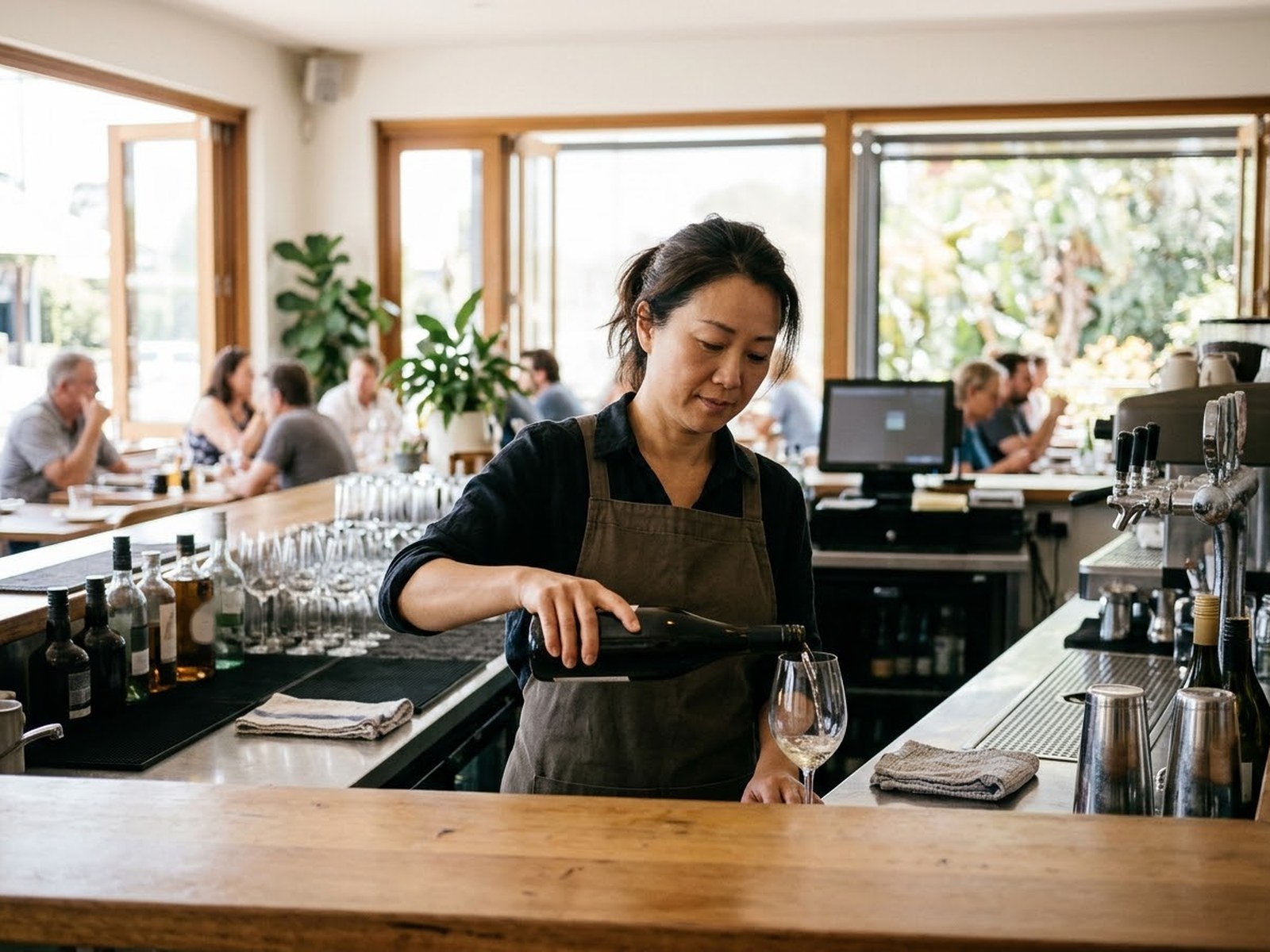
A Chinese-Australian bar supervisor in her forties pours a glass of wine behind the bar of a bright suburban bistro at lunchtime.
20the age at which the Hospitality, Restaurant and Clubs awards pay the full adult rate
Adult ratefor a junior working as a liquor service employee, under all three awards
10 hoursthe longest shift an employee under 18 can be required to work

Check first If you are under 20 and pour, serve or take orders for alcohol, even only some of the time, check whether you are a liquor service employee. If you are, the award gives you the adult rate for that work.

A junior in hospitality is an employee under 20. The Hospitality Industry (General) Award 2020 (MA000009), the Restaurant Industry Award 2020 (MA000119) and the Registered and Licensed Clubs Award 2020 (MA000058) each pay juniors a percentage of the adult rate for their level, and each sets aside the junior rate for liquor service. Penalty rates and the casual loading are percentages of the junior rate. The rates on this page apply from 1 July 2026; check the current rate in the Fair Work Ombudsman's Pay and Conditions Tool. Fast food juniors are under a different award, on the retail pages: Retail awards and pay.

What percentage of the adult rate do I get?

AgeHospitality award (cl 18.4)Restaurant award (cl 18.2)Clubs award (cl 18.6)
Under 1750%50%60%
1760%60%60%
1870%70%70%
1985%85%85%
20100%100%100%
Read moreShow less

At Level 1, where the adult rate is $26.44 an hour from 1 July 2026, that gives these junior rates:

  1. a 16-year-old in a hotel, cafe or restaurant: $13.22 an hour;
  2. a 17-year-old: $15.86 an hour, and the same for a 16 or 17-year-old in a club (60%);
  3. an 18-year-old: $18.51 an hour; and
  4. a 19-year-old: $22.47 an hour (Hospitality award Schedule B.3.2).

A casual junior also gets the 25% casual loading. Junior office staff under the Hospitality award have their own scale, starting at 45% under 16 (Table 6). For your award and level, see Awards and pay.

I'm under 20 and serve drinks. Should I get the adult rate?

Each award says that a junior working as a liquor service employee must be paid the adult rate for the classification of the work (Hospitality award cl 13.5; Restaurant award cl 13.5; Clubs award cl 13.1). Where the law allows it, juniors may work in a bar (Hospitality and Restaurant awards cl 13.4).

Read moreShow less

The Federal Circuit Court has read the rule broadly:

  1. being a liquor service employee does not depend on any particular share of your time spent on alcohol, and is not limited to working behind a bar ([2021] FCCA 1455 at [166], [168]);
  2. taking orders for drinks, opening and pouring them and taking them to tables, on the floor as well as behind the bar, was enough ([169], [170], [177]); and
  3. making and serving drinks in licensed premises, with the server's duties to check age, refuse intoxicated customers and pour correct measures, are "not the tasks of junior employees, entailing as they do, trust and a significant level of responsibility" ([14], [180]).

If you were paid junior rates while doing that work, you may be owed the difference for the hours you worked as a liquor service employee. Check your rosters and payslips for the shifts you worked the bar or served drinks. The minimum age for serving alcohol and the responsible service of alcohol rules are state law: see RSA, liquor licensing and dismissal.

I'm under 18. What are the limits on my shifts and my pay?

The awards add protections for employees under 18:

Read moreShow less
  1. an employer must not require you to work more than 10 hours in a shift (Hospitality, Restaurant and Clubs awards cl 13.3);
  2. under the Hospitality award, no deduction for breakages, till shortages, meals or accommodation may be made from your pay without a parent's or guardian's written agreement (cl 36.3, 37.3);
  3. an individual flexibility arrangement with you must also be signed by a parent or guardian (Hospitality award cl 5.7(b)); and
  4. your employer may ask for proof of age, and must pay for a birth certificate if it asks for one (Hospitality award cl 13.6).

State laws also limit the hours and kinds of work school-age children may do. They differ by state: see What changes by state.

What does an apprentice cook earn?

Under the Hospitality award, a junior apprentice in a trade other than waiting, such as a cook, is paid a percentage of the standard weekly rate for each year of the apprenticeship (cl 19.1, Table 7). Waiting apprentices have their own table (cl 19.2, Table 10). From 1 July 2026:

Read moreShow less
YearPercentage of the standard rateHourly
Year 155%$16.20
Year 265%$19.14
Year 380%$23.56
Year 495%$27.98

Adult apprentices are treated differently:

  1. an adult apprentice who started on or after 1 January 2014 gets at least 80% of the standard weekly rate in year 1 ($23.56 an hour) and at least the lowest adult rate after that ($25.74 an hour) (cl 19.5; Schedule B.9.2);
  2. an existing employee who becomes an adult apprentice must not take a pay cut if they have 6 months' full-time or 12 months' part-time or casual service with the employer (cl 19.5(c)); and
  3. a cooking apprentice who meets the proficiency standard gets the standard rate earlier in year 4 (cl 19.3); a waiting apprentice, in year 2 (cl 19.4).

Waiting apprenticeships and competency-based progression have their own tables (cl 19.1(c), 19.2). The Clubs award has its own apprentice clause (cl 18.5), with the same 80% floor for adult apprentices in year 1.

Training, fees and textbooks

Under the Hospitality award:

Read moreShow less
  1. time spent in required training is time worked;
  2. the employer reimburses course fees and required textbooks, and pays for block release travel that needs an overnight stay (cl 12.7, 12.8);
  3. an apprentice under 18 cannot be required to work overtime or shiftwork (cl 12.5, 12.6); and
  4. no apprentice can be required to work in a way that stops them attending training, except in an emergency (cl 12.5, 12.6).

School-based apprentices are covered by Schedule D: for a full-time student, 25% of the on-the-job hours are paid as training time.

Decided cases from hospitality

What the Commission and the courts decided.

Published decisions of the Fair Work Commission and the courts, retold in plain English from the decision itself. Lawcaptain did not act in these cases. Each links to the full decision.

Adult rate for bar work confirmedFederal Circuit Court of Australia · 8 July 2021

Paid junior rates while pouring drinks at 18 and 19.

A licensed cafe paid a food and beverage attendant junior rates from 18 until she turned 20, although she often worked behind the bar and served alcohol on the floor. The Fair Work Ombudsman said she was owed the adult rate.

Read the full storyShow less

Result. Compliance notice confirmed; the cafe's application dismissed.

The cafe, in Blackwood in Adelaide, was licensed and seated 89 ([5], [6]). The attendant gained her responsible service of alcohol certificate two days after turning 18 ([23], [24]).

The Fair Work Ombudsman issued a compliance notice requiring the cafe to pay her the adult rate from her 18th birthday until she turned 20 ([25] to [27]). The cafe applied to the Court to review it, and both sides agreed to run the case as a test of the Restaurant Industry Award 2020 ([35] to [37]).

The cafe said only principal or significant liquor duties counted ([30]). The Court disagreed: being a liquor service employee does not depend on any share of time spent on alcohol, and is not limited to the bar ([166], [168]). She took orders for drinks, opened and poured them and took them to tables, and so was a liquor service employee ([169], [170], [177]).

The Court described that work as "sophisticated tasks, within the context of a licenced premises", "not the tasks of junior employees" ([180]). The notice was confirmed ([183]; order 1).

What it means for you

If you are under 20 and serve or pour alcohol as part of your job, even some of the time, check whether you were paid the adult rate for that work.

Decided under the Restaurant Industry Award 2020 as it then stood (cl 15.1); the rule is now cl 13.5 of that award. The decision applied South Australian liquor law.

For employers

If you employ juniors or apprentices

  • Move the rate on each birthday. Check the date of birth when you hire, and put the next step in the payroll calendar.
  • Pay the adult rate for liquor service. A junior who takes drink orders, pours or serves alcohol is a liquor service employee for that work, whatever share of the shift it takes (cl 13.5, Clubs cl 13.1).
  • Keep under-18 shifts to 10 hours. And take no deduction from an under-18's pay without a parent's or guardian's written agreement (Hospitality award cl 36.3, 37.3).
  • Reimburse apprentices' fees and textbooks. Within the time in cl 12.7(d), and treat required training as time worked.
For unions and delegates

For unions and delegates

  • Ask for the bar rosters. Rosters showing who worked the bar, matched against payslips, show whether juniors on liquor service were paid the adult rate.
  • Check apprentice progression. Year steps, proficiency pay and the adult apprentice floor (cl 19.3 to 19.5) are easy to miss on payroll.
Leading cases

The decisions that set the rules.

A worker aged 18 and 19 who served alcohol, on the floor and behind the bar, was a liquor service employee owed the adult rate.

A Rockingham cafe that underpaid 22 part-time staff, juniors among them, was penalised, and was penalised far more heavily when it offended again.

Show all leading cases (1)Show fewer

A cafe that did not comply with a compliance notice over $976.06 owed to a 19-year-old casual, after a dispute about his junior rate, was penalised $5,000.

Questions

The things people ask.

What does a 16-year-old get paid at a cafe?

Under the Restaurant Industry Award 2020 from 1 July 2026, at Level 1, $13.22 an hour (50% of the adult rate), plus the 25% casual loading if you are casual, and penalty rates as a percentage of that rate. The Hospitality award pays the same at Level 1. Check the current rate in the Pay and Conditions Tool.

I'm 18 and work behind the bar. Am I on junior rates?

Not for the work you do as a liquor service employee: the Hospitality, Restaurant and Clubs awards all require the adult rate for it (cl 13.5; Clubs cl 13.1). The Federal Circuit Court has held that this covers serving drinks on the floor as well as behind the bar, whatever share of your time it takes.

When do I get the full adult rate?

At 20, under the Hospitality, Restaurant and Clubs awards. At 19 you get 85% of the adult rate.

Can my boss make me work a 12-hour shift? I'm 17.

An employer must not require an employee under 18 to work more than 10 hours in a shift (cl 13.3 of each award). State laws may limit your hours further.

What does an apprentice chef earn?

Under the Hospitality award from 1 July 2026, a junior apprentice cook gets $16.20 an hour in year 1, $19.14 in year 2, $23.56 in year 3 and $27.98 in year 4. An adult apprentice who started on or after 1 January 2014 gets at least $23.56 in year 1 and $25.74 after that.

Can my employer take a till shortage out of my pay? I'm 17.

Under the Hospitality award, not without a parent's or guardian's written agreement (cl 36.3). See also Tips, surcharges and till shortages.

Free discussion · no obligation

Talk to us.

Call 1300 967 552, or leave your details and we will call you.

Do it yourself with AI

General information about Australian employment law, not legal advice about your situation. Updated November 2026.