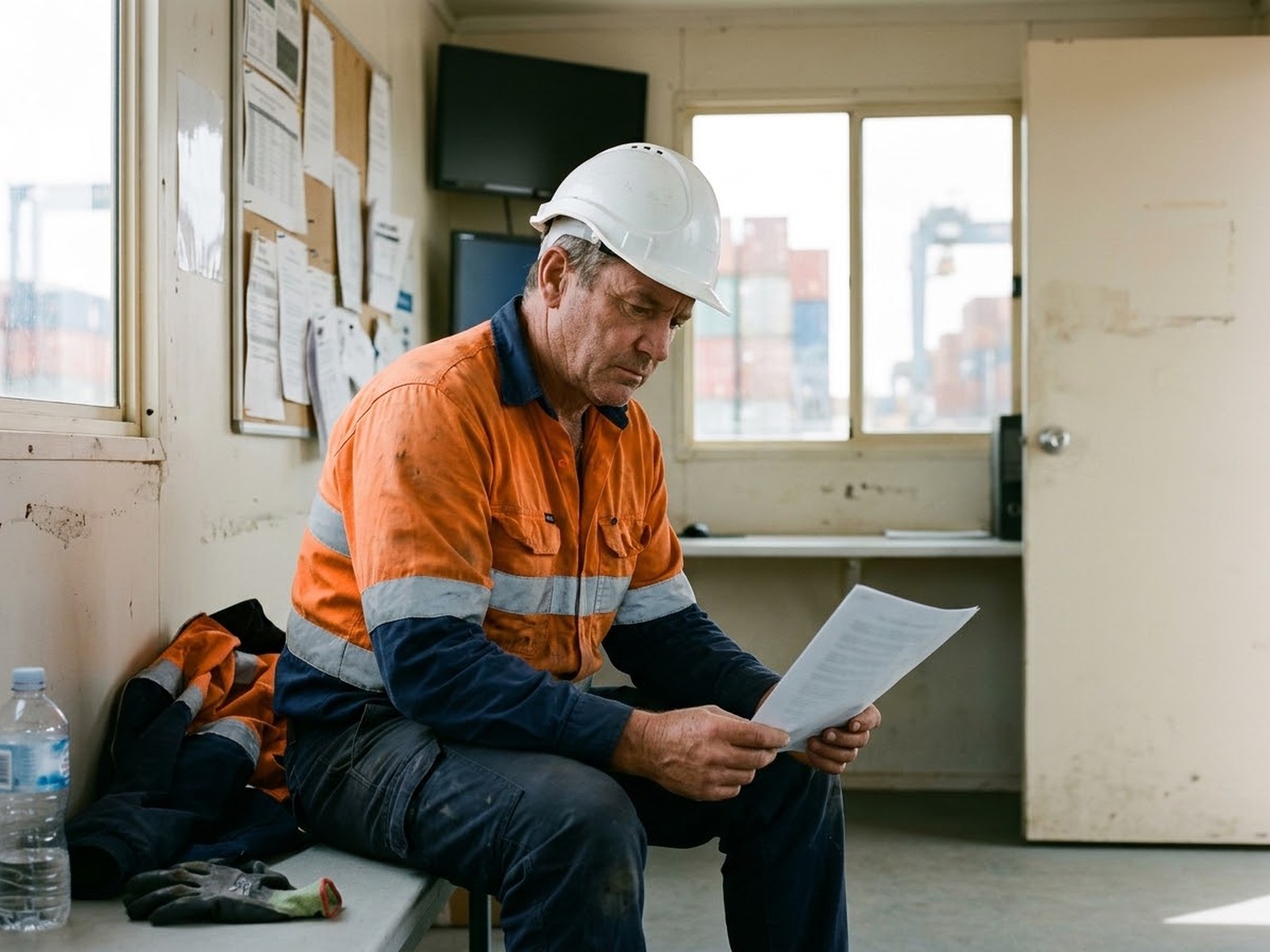
When your employer can test you
A transport employer can require a test where:
Read moreShow less
- the enterprise agreement provides for it (DP World's agreements set out random, suspicion, post-incident and target testing with oral swab screening; Linfox, Toll, DHL and Transdev agreements point to a company policy);
- your contract requires you to follow the employer's policies as amended from time to time, and the policy provides for testing; or
- a law requires it, as in rail and aviation (see below).
The justification is safety. Managing the risk of workers impaired by alcohol or drugs is part of the employer's work health and safety duty ([2015] FWCFB 4075 at [69], [72]), and you have a duty to take reasonable care and cooperate with reasonable safety policies (Work Health and Safety Act s 28 in NSW and WA; Occupational Health and Safety Act 2004 (Vic) s 25).
If you or your union disagree with the policy itself (urine or saliva, the cut-offs, who attends, the discipline), the dispute can go to the Commission under the agreement's dispute clause. The Commission asks whether it would be unjust or unreasonable for the employer to implement the policy in that form ([2015] FWCFB 4075 at [57]). Challenge the policy that way, not by refusing a test.
Almost 25 years on the wharf, and a reading that was not what the employer said it was.
Read the full storyShow less
Result. Reinstatement without lost pay stands; DP World's appeal dismissed.
He had started with the company in October 1999. On 27 May 2024 a random saliva test was non-negative for cocaine, and urine confirmed the metabolites ([1] to [2]). He said he had used cocaine about 24 hours before the shift, and only while on leave ([3]). He was dismissed at a show cause meeting on 7 June 2024 ([4]).
The Deputy President found a valid reason, but that the dismissal was harsh and unreasonable. He was not intoxicated. DP World had treated an inactive metabolite reading as "high range" when the expert evidence did not support that. The policy did not tell employees that it tests for inactive metabolites or covers hangover effects. Rehabilitation was available under the policy but was not considered. His mental health and long service also counted ([64]).
The Full Bench granted DP World permission to appeal but found no error. Those reasons rationally supported the conclusion, and the facts did not allow only one outcome ([65], [73]).
Ask what the test actually detected and whether your employer's description of it is backed by the evidence. If the policy offers rehabilitation, ask whether it was considered. Expert toxicology evidence may decide the case.
Saliva or urine: what the result shows
The expert evidence accepted by the Full Bench in the Port Kembla coal terminal case was:
Read moreShow less
- neither urine nor oral fluid testing detects impairment ([2015] FWCFB 4075 at [43] to [46]);
- oral fluid (saliva) has a window of detection of a few hours, close to the period of likely impairment, so a positive saliva result is more likely to be associated with impairment ([62]); and
- urine detects inactive metabolites, so a positive urine result shows use "in the preceding hours, days or weeks", long after impairment has passed; the impairing effect of cannabis lasts up to about six hours ([49] to [51]).
Whether urine testing is allowed depends on your agreement and policy. There is no rule that saliva must be used. At DP World, the Full Bench read the agreement in context and held that a clause saying the policy "will utilise swab testing" did not stop urine being used to confirm a positive swab ([2014] FWCFB 7889 at [37] to [41]).
A positive test and your job
The Commission asks whether there was a valid reason for the dismissal and whether it was harsh, unjust or unreasonable, taking everything in s 387 into account. In a safety-critical transport job:
Read moreShow less
- a proven breach of a drug and alcohol policy is likely to be a valid reason. Sydney Trains' operations are safety-critical and compliance with its policy was "a fundamental element" of a station attendant's employment ([2020] FWCFB 1373 at [35]);
- the reason is the breach itself: attending work with a proscribed level in your system. That you were not impaired, or did not intend a breach, does not stop it being a valid reason, but it can make dismissal harsh under s 387(h) ([2020] FWCFB 1373 at [31] to [34]);
- a "zero tolerance" policy the employer has not applied consistently still gives a valid reason ([30]), but inconsistency counts when the Commission weighs harshness.
What tends to decide whether dismissal was harsh:
- the reading: a high reading or repeated positives weigh against you; a trace or metabolite-only reading, or one below the legal limit for driving, weighs for you;
- whether it was a first breach, and any earlier warnings;
- your service, age, record and job prospects;
- honesty: early disclosure helps, delay hurts ([2014] FWCFB 6249 at [26]);
- whether the policy clearly explained what "drug free" means and that metabolites are tested;
- whether the employer considered rehabilitation or target testing instead of dismissal, especially where its own policy offers it; and
- how others with positive tests were treated.
Who kept their job, and who did not
The Commission has ordered reinstatement after a positive result where:
Read moreShow less
- a Queensland Rail track worker of nearly 39 years read 0.037 on a random breath test and 0.025 on the retest, against a zero limit; the dismissal was harsh and he was reinstated with continuity and 50% of his lost pay ([2022] FWC 3343 at [5], [19] to [20], [168] to [170], [178] to [182]);
- a Sydney Trains work group leader of 26 years returned a cocaine metabolite after leave; Sydney Trains repeated the policy failings criticised in [2020] FWCFB 1373 and did not consider alternatives; reinstatement, with lost pay less 20% ([2023] FWC 3209 at [160] to [169], [184]); and
- a side-loader garbage truck driver of 16 years had a confirmatory reading of 0.007 about 8 hours after social drinking, his first breach, and two other employees had received lesser sanctions under the same policy; the Full Bench held the breach was a valid reason but dismissal was harsh, and ordered reinstatement ([2025] FWCFB 141 at [114] to [115], [119], [124] to [125]).
Dismissal stood where the facts were stronger against the worker:
- a straddle carrier stevedore returned three positive methamphetamine results within about a year, after a written warning and a final warning ([2024] FWCFB 463 at [3] to [5], [68], [70]);
- a Brisbane stevedore of 25 years used cannabis every evening for 16 days and returned THC about 37 times the cut-off ([2022] FWCFB 142 at [10], [18], [66] to [68]; judicial review dismissed, [2024] FCA 116); and
- a Queensland Rail protection officer of 16 years, aged 31, tested positive about six months after a warning; his own view that he was not impaired was irrelevant, and the Commission distinguished the long clean record in [2022] FWC 3343 ([2024] FWC 3165 at [158], [160]).
Refusing a test, or not giving a sample
Refusing a test, or failing to give a sample, is usually treated as seriously as a positive result. A heavy rigid truck driver, sent for a test after he was found off his route, gave no urine sample over nearly three hours after being told that failure counted as a non-negative under the policy and would lead to dismissal. His dismissal was not unfair ([2020] FWC 3151 at [1], [5] to [12]).
Read moreShow less
If you genuinely cannot give a sample:
- say so straight away and ask for a saliva or breath test instead;
- ask for your union delegate or a support person;
- write down what happened, with times; and
- do not walk away or refuse.
In aviation, refusing a test required by the Civil Aviation Safety Authority is itself an offence (Civil Aviation Safety Regulations 1998 (Cth) reg 99.330), with a defence where a medical condition made a sample impossible, and force may not be used to take a sample (reg 99.120).
If you might test positive, you may be able to decline a call-in shift without giving the reason; check whether call-ins are voluntary under your agreement or policy. A senior ferry master who accepted a shift after smoking cannabis the night before, and delayed telling his employer, lost his case ([2014] FWCFB 6249 at [22], [25] to [28]).
Prescribed medicines and medicinal cannabis
Most policies require you to disclose medication that may affect safety, including over-the-counter medicine, and to follow the dose.
Read moreShow less
- A medicinal cannabis prescription is no answer if you did not disclose it as the policy requires. A Brisbane stevedore of over 19 years with an undisclosed prescription returned THC at 10 times the policy's high range; his dismissal was not unfair ([2024] FWC 2351 at [1] to [5], [142] to [146]).
- A poorly worded policy can still make a dismissal unfair. A bus and ferry operator's compliance coordinator returned a saliva result consistent with Nurofen Plus, which he had not declared as the policy required. That was a valid reason, but his conduct rested on a wrong reading of a poorly worded policy, so the dismissal was unfair. Reinstatement was refused and $17,795.08 ordered; the Full Bench increased it by four weeks' wages plus superannuation ([2019] FWCFB 898 at [9] to [16], [47] to [52]).
- On the road in NSW, it is an offence to drive with any prescribed illicit drug in your oral fluid, blood or urine (Road Transport Act 2013 (NSW) s 111(1)). There is a defence for morphine taken as prescribed or as codeine medicine (s 111(5), (6)), but not for THC, even on prescription, so you may have no defence; check the current law in your state before driving on medicinal cannabis.
Disclose a prescription to the employer's medical officer before a test, ask how the policy treats it, and get your doctor's view on whether you are fit for safety-critical work. If the condition treated is a disability, discrimination law may also be relevant.
Rail and aviation: testing required by law
Under the Rail Safety National Law as applied in NSW:
Read moreShow less
- a rail transport operator must prepare and implement a drug and alcohol management program for rail safety workers (s 115);
- a rail safety worker must not carry out rail safety work with any concentration of alcohol in the blood (unless the regulations prescribe another), with delta-9-THC, methamphetamine or MDMA in oral fluid or blood, or so much under the influence as to be incapable of working (s 128(1), (5)); a worker who has signed on and is available is taken to be carrying out rail safety work (s 128(1a));
- samples may be used only for the Law's purposes, control of railway operations or disciplinary proceedings (s 129); and
- for operations in NSW, the program must include random testing of at least 25% of rail safety workers each year and testing within 3 hours after a prescribed incident (Rail Safety National Law National Regulations 2012 reg 28(2)(a)).
In WA, the Rail Safety National Law Application Act 2024 (WA) s 26 stops an authorised person requiring a breath test where it would harm the worker's health or the worker cannot give a sufficient breath sample. Other states may apply these rules differently; check your state's rules.
In aviation, air operators, aerodrome operators, maintenance organisations and others must have a drug and alcohol management plan for staff who perform safety-sensitive aviation activities (Civil Aviation Safety Regulations 1998 (Cth) reg 99.030). For port work, see ports and rail.