Which award covers your warehouse
The test is your employer's business, not the building. On the words of the two awards:
Read moreShow less
- a warehouse operated as part of, or in connection with, your employer's own road transport business is a distribution facility. Its storeworkers are distribution facility employees, levels 1 to 4, under the Road Transport and Distribution Award 2020 (MA000038), which covers that work to the exclusion of other awards (MA000038 cl 2, 4.1, 4.2(b));
- a warehouse or cold store whose operator stores, packs and dispatches but does not run a road transport business, because the trucks are someone else's, falls under the Storage Services and Wholesale Award 2020 (cl 4.2, 4.3(b)); and
- a wholesaler's warehouse falls under the storage award, unless the wholesaler runs its own road transport business from it.
| Storage award | Hourly from 1 July 2026 | Road transport award | Hourly from 1 July 2026 |
|---|---|---|---|
| Storeworker grade 1 (after 12 months) | $27.72 | Distribution facility employee level 1 | $27.83 |
| Storeworker grade 2 | $27.97 | Distribution facility employee level 2 | $28.32 |
| Storeworker grade 3 | $28.77 | Distribution facility employee level 3 | $29.42 |
| Storeworker grade 4 | $29.61 | Distribution facility employee level 4 | $30.78 |
If your employer both stores goods for clients and runs a fleet, you may be under the higher road transport rates. Check whose trucks they are, which site they run from, and how much of the business is transport, and ask the union. More: Awards and pay.
Two long-serving workers reinstated after an unsafe forklift lift.
Read the full storyShow less
Result. No valid reason for either dismissal; both workers reinstated.
The two had about 16 and 20 years' service ([8]-[12], [63]).
The Commission found that Toll's factual mistakes had inflated the seriousness of the breach, and that it had not genuinely weighed their long records ([64]-[67]).
There was no valid reason for either dismissal ([68]-[69]). Both were reinstated ([76]).
A safety breach is not automatically a valid reason. If the employer has the facts wrong, or has not weighed your record, say so and show it.
Your grade and pay under the storage award
| Grade | What it is (Schedule A) | Hourly | Casual hourly |
|---|---|---|---|
| Grade 1 | New employee: storing, packing, receiving, picking, stock checks, non-licensed equipment | $27.08 on commencement, $27.41 after 3 months, $27.72 after 12 months | $33.85, $34.26, $34.65 |
| Grade 2 | Licensed operation of materials handling equipment, such as a forklift | $27.97 | $34.96 |
| Grade 3 | Quality control; store layout; supervises up to 10 employees | $28.77 | $35.96 |
| Grade 4 | Responsible for a warehouse or large section; leading hand of more than 10; inventory control | $29.61 | $37.01 |
Read moreShow less
- A picker who holds a forklift licence and is required to use it is likely to be at least grade 2, whatever the roster calls them, because licensed operation of materials handling equipment is an indicative grade 2 task (Sch A.2.2(e)(i)).
- A team leader directing other storeworkers is likely to be grade 3 for a team of up to 10 and grade 4 for more than 10, because those are the indicative tasks at each grade (Sch A.3.2(f)(iv), A.4.2(g)(ii)).
- For a weekly employee, higher duties for up to 3 hours in a day earn the higher rate for the time worked (minimum one hour); over 3 hours earns a full day at the higher rate; over 20 hours in a week earns the full week (cl 15.3).
Hours, shifts and overtime
Day workers' ordinary hours fall between 7.00 am and 5.30 pm, Monday to Friday, on 4 or 5 days of no more than 8 hours (cl 13.1). Ten-hour days and weekend ordinary hours need agreement with the majority of employees or with you individually (cl 13.1(d), (e)); without it, that work is overtime. Shift penalties are 112.5% for early morning, 115% for afternoon and 130% for night shift (cl 20.4), and a day worker cannot be made to work afternoon shift without specific agreement (cl 20.2). Overtime is 150% for the first 2 hours then 200%, and 175% then 225% for casuals (cl 11.3, 21.1).
Allowances and accident pay
Cold store work earns $1.13 an hour or part of an hour between -15.6 and -18.9 degrees, $1.69 below that to -23.3 degrees, and $2.25 below -23.3 degrees (cl 17.2(b)). If you are injured at work and on workers' compensation, your employer must top up your weekly payments to your award weekly wage for up to 26 weeks from the injury, and dismissal within that time does not end it (cl 18). Many warehouse workers do not know accident pay exists.
Storage Services and Wholesale Award 2020 (MA000084)
Storeworkers, pickers, forklift drivers and team leaders at 3PL, wholesale and cold storage sites that do not run their own trucking business from the warehouse.
- Storeworker grade 1
- $27.08 an hour on commencement, $27.41 after 3 months, $27.72 after 12 monthscl 15, Sch B
- Storeworker grade 2
- $1,062.80 a week ($27.97 an hour; casual $34.96)cl 15, Sch B
- Storeworker grade 4
- $1,125.30 a week ($29.61 an hour; casual $37.01)cl 15, Sch B
- Casuals
- 25% loading; at least 4 hours each startcl 11.1, 11.2
- Shift penalties
- Early morning 112.5%; afternoon 115%; night 130%cl 20.4
- Overtime
- 150% for the first 2 hours, then 200% (casual 175%, then 225%)cl 21.1
- Weekends
- Saturday 150%; Sunday 200%; public holidays 250% (casual 275%)cl 22
- Accident pay
- Workers' compensation topped up for up to 26 weekscl 18
Rates from 1 July 2026. Check today's rate in the Fair Work Ombudsman's Pay and Conditions Tool.
Labour hire and casual conversion
Many pickers are supplied by a labour hire agency. The agency is your employer, but the 3PL controls the site and owes its own safety duties.
Read moreShow less
If the host's enterprise agreement would cover your work if the host employed you directly, you can ask the Commission for a regulated labour hire arrangement order, so you are paid at least the host's agreement rates (s 306E). The Commission must make the order if:
- your employer supplies employees to perform work for the host;
- the host's agreement would apply if it employed you directly; and
- the host is not a small business employer (s 306E(1)).
It must not make one where the arrangement is for a service rather than a supply of labour (s 306E(1A)), or where an order would not be fair and reasonable (s 306E(2)).
Casual conversion
A casual who believes they no longer meet the definition of a casual, for example because they work a regular, systematic roster, may notify their employer in writing after 6 months (12 months with a small business employer), if no dispute about it is current and no notice was refused or dispute resolved in the past 6 months (s 66AAB). The employer must consult and respond in writing within 21 days, and may refuse only because you still meet the casual definition, on fair and reasonable operational grounds, or because accepting would breach a recruitment law (s 66AAC). Peak-season and labour hire workers: the notice goes to your employer, which may be the agency, not the host.
Pick rates, scanners and new duties
Pick rates are usually measured against a time standard for each task, built into the warehouse or labour management system and fed by scanners, voice picking or wrist units. How a rate is used should be in the agreement or a written policy. A new system or a new standard is usually a major change, so read the consultation clause too.
Read moreShow less
Your employer can usually change what you do. Long-serving forklift drivers and clerks at Linfox's Truganina distribution centre resisted a direction that everyone pick. The Full Bench held their contracts allowed their duties to change, which excluded any implied custom and practice term, and the agreement's custom and practice clause protected only a practice that existed when it was made ([2018] FWCFB 1563 at [30]-[31], [41], [47]). A fresh dispute also failed, and the further appeal was dismissed ([2020] FWCFB 1553 at [35]).
A dismissal for poor performance against a rate is tested under the ordinary unfair dismissal rules, and the questions are likely to be whether the standard was fair, whether you were warned and given time to improve (s 387(e)), and whether the measurement is reliable.
If you are being performance-managed on rates:
- ask for the data behind your rate and the standard it is measured against;
- record the delays the system does not see: waiting for stock, faulty equipment, congestion, training others; and
- raise any injury or pain early, because the rate may be causing it.
Scanner and camera monitoring: Cameras and surveillance.
Forklift breaches, injury and dismissal
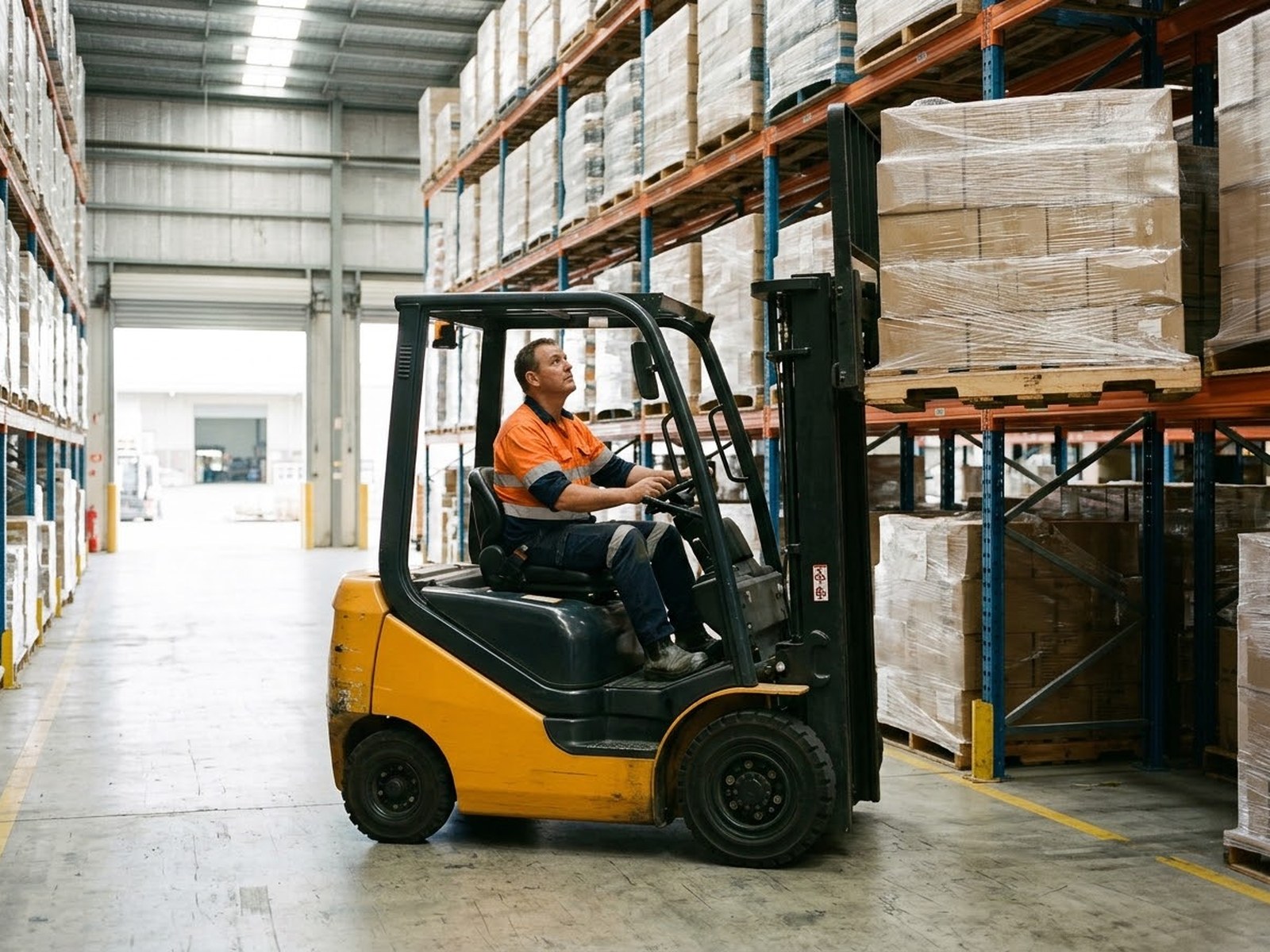
A safety breach can be a valid reason for dismissal, but the employer must get the facts right and genuinely weigh your record. Earlier warnings for the same kind of conduct make a later dismissal hard to challenge: a storeperson who drove a reach forklift seated against a safety direction and was aggressive to a supervisor, after a final warning, lost his claim ([2014] FWC 1649 at [100]-[103]). Dishonesty usually ends a claim regardless of service: a forklift driver with about 10 years' service who worked at another company while on medical certificates, and lied about it, also lost ([2014] FWC 4790 at [1], [136]-[138]).
Read moreShow less
The operator owes its own duty to plan the work. After a worker was crushed by a forklift unloading a container at a warehouse Linfox ran at Arndell, the Federal Court declared that Linfox had failed to have a procedure for the task, keep people out of the container while the forklift worked, supply a suitable forklift, and train and supervise, and imposed a $90,000 penalty ([2015] FCA 61 at [1]-[4], [25]).
If you are hurt
Repetitive lifting at pace is the main cause of injury in a warehouse. Report every injury in writing, see a doctor, and claim workers' compensation through your employer's state scheme: State differences. A labour hire worker claims against the agency's insurer and may also have a claim against the host, but needs evidence of what the work really was. In NSW, a cold store picker supplied by an agency sued the host and lost, because breach of duty was not established; he had pleaded a target of 170 to 180 cartons an hour, but the records showed about 34 an hour ([2017] NSWDC 332 at [4], [53], [77]). For a forklift accident claim, get advice on your state's workers' compensation and injury rules. An injured worker may be dismissed for incapacity, but only after a fair process.
Testing on site: Drug and alcohol testing.
When the site loses its client
A 3PL that loses a client often closes the site. Whether you get redundancy pay depends on whether your job ends and on your agreement. In the Toll Altona case, which is under appeal, about 122 employees were relocated to other Toll sites when Nike did not renew its contract, and no redundancy pay was owed because no one's employment was terminated. The agreement's protection against significant disadvantage still applied, and it had not been met for the five test employees (see the case below).
Read moreShow less
If you are made redundant, it must be a genuine redundancy (s 389):
- your employer no longer requires the job done by anyone;
- it complied with the consultation clause in your award or agreement; and
- it would not have been reasonable to redeploy you within the employer's or an associated entity's enterprise.
Redundancy pay under the National Employment Standards (s 119) can be reduced by the Commission if your employer finds you other acceptable employment (s 120). Your agreement may pay more, and a site or client agreement often has its own relocation and redundancy schedule.
When the work moves to another employer
- If the client takes the work back in-house and employs you within 3 months to do the same, or substantially the same, work, that is a transfer of business (s 311(5)), so your agreement can follow you and your service may carry over (s 122).
- If the client moves the work to a rival 3PL, there is usually no transfer of business unless assets pass between the two providers under an arrangement between them, or they are associated entities (s 311(3), (6)). Check the facts, and ask the union.
- If there is no transfer, your redundancy entitlement stays with your old employer, even if the new 3PL hires you.
More: Redundancy.