Aged care and disability · Sleepovers, shifts and travel

Sleepovers, split shifts and the drive between clients.

What the SCHADS Award and the Aged Care Award pay for a sleepover, a broken shift, a cancelled visit, remote work and on call, and the kilometres between clients, and what they do not pay.

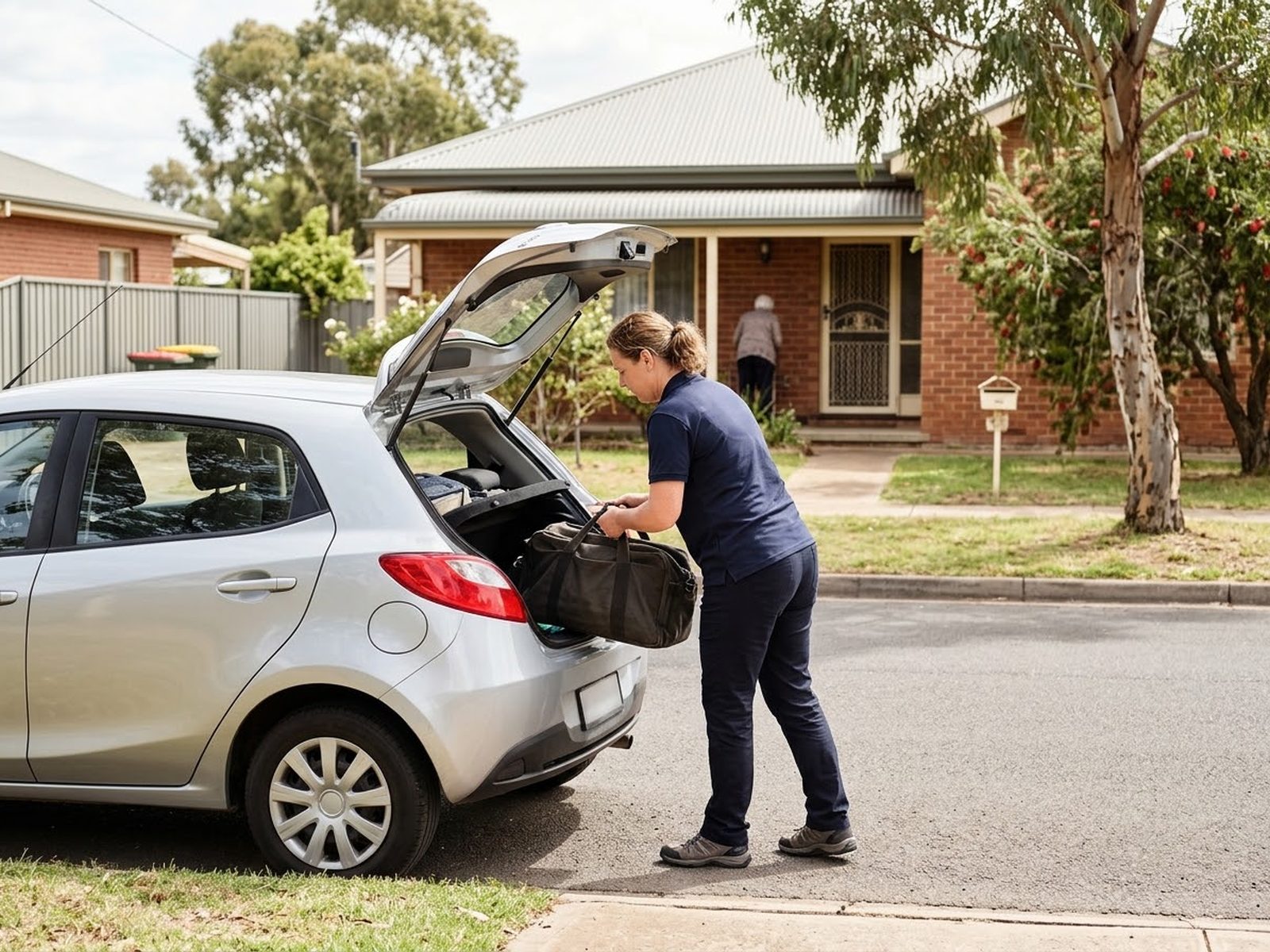
A home care worker loads her car between client visits.
4.9%of the SCHADS standard rate a night: the sleepover allowance, about $62.87 from 1 July 2026
4 hoursof paid work the employer must roster or pay immediately before or after each sleepover
$1.05per km vehicle allowance between clients, from 1 September 2026 to 28 February 2027

Check first An enterprise agreement can change every rule on this page. Read your agreement's own sleepover, broken shift and travel clauses first; the award rules below apply where you have no agreement.

Disability and home care work is broken up in ways most jobs are not: overnight sleepovers in a client's home or a group home, shifts split into two or three periods around a client's day, visits cancelled at short notice, and driving from one client to the next. The SCHADS Award has a clause for each, and they are the entitlements most often missed. Clause numbers below are SCHADS unless stated, and amounts are those from 1 July 2026.

Sleepovers in disability and supported living

A sleepover is where your employer requires you to sleep overnight at premises where the client you are responsible for is located (including respite), and it is not 24-hour care or an excursion (cl 25.7). The terms:

Read moreShow less
  1. The span is a continuous 8 hours, with a separate room, a bed, clean linen, facilities and free board (cl 25.7(c)).
  2. The allowance is 4.9% of the standard rate a night, about $62.87 (cl 25.7(d)).
  3. Any work during the sleepover is paid at overtime rates, with a minimum of 1 hour; if it goes past 1 hour, overtime for the whole of it (cl 25.7(e)).
  4. Your employer must roster, or pay, at least 4 hours' work immediately before or after the sleepover, as well as the allowance (cl 25.7(f)).
  5. The sleepover is not a break between shifts. The usual 10-hour break may be 8 hours either side of a sleepover by agreement (cl 25.4).

Night shift loading next to a sleepover

A sleepover "is separate from and not part of a shift". So a worker whose ordinary hours before and after a sleepover do not fall between midnight and 6.00 am does not get the night shift loading on those hours ([2026] FCAFC 25 at [43]-[44]). The award now says so expressly: work before and after a sleepover is "treated separately" for the afternoon, night and public holiday loadings (cl 29.3(d)).

The items that go missing in practice are the allowance itself, overtime when you are woken to work, and the 4-hour paid period. A care business that ignored a Fair Work Ombudsman compliance notice that included an unpaid sleepover allowance was penalised 85% of the maximum ([2024] FedCFamC2G 1213).

Sleepovers in residential aged care

Sleepovers are rare in residential aged care, and some providers' agreements now say there will be none. Where the Aged Care Award applies, a sleepover has a span of 8 to 10 hours, an allowance of 5.20% of the standard rate a night (about $65.31), only emergency work may be required, and casuals may not be used exclusively or almost exclusively for sleepovers (Aged Care Award cl 22.9).

24-hour care

Home care employees only, and only by agreement: you are available in the client's home for 24 hours, with no more than 8 hours of care, a chance to sleep 8 continuous hours, and 8 hours' pay at 155%. Care beyond 8 hours is overtime, and you may refuse unreasonable extra hours (cl 25.8).

Broken shifts

Broken shifts are allowed only for disability services work and home care (cl 25.6, cl 20.12):

Read moreShow less
  1. One unpaid break (other than a meal break): your employer may roster it; the allowance is $21.81 a broken shift.
  2. Two unpaid breaks: only if you agree before each occasion, unless it is part of your written regular pattern; the allowance is $28.87.
  3. The span is up to 12 hours from start to finish, with double time after 12 hours, and at least 10 hours off before the next day's broken shift.
  4. Each period of work is paid at least 2 hours for part-time and casual employees (cl 10.5). A gap that falls inside that 2-hour minimum is paid as work, not a break.
  5. Shift loadings apply only to a period of work that itself meets the afternoon or night shift definition.

In residential aged care, broken shifts are only for casual and part-time employees and need mutual agreement; breaks can total up to 4 hours within a 12-hour span, and each portion must meet the 2-hour minimum (Aged Care Award cl 22.8).

Cancelled visits and shifts

When a client cancels or reschedules a home care or disability service within 7 days, and you are a full-time or part-time employee rostered to provide it, your employer may (cl 25.5(f)):

Read moreShow less
  1. direct you to other work in those hours, paying the greater of the cancelled shift and the work done; or
  2. cancel the shift and either pay it, or (only if you had at least 12 hours' notice) give you make-up time within 6 weeks, with 7 days' notice and consultation, paid at the greater of the two.

Casuals are not covered by this clause. Keep a note of when you were told of each cancellation.

Travel between clients, and from home

  1. Between clients during a shift: the travel time is work, and kilometres in your own car attract the vehicle allowance: $1.01 per km from 1 July 2026, and a temporary $1.05 per km from 1 September 2026 to 28 February 2027 (cl 20.7(a), (aa)). The Aged Care Award has the same temporary rate (cl 15.7(aa)).
  2. From home to the first client and from the last client home: neither time nor kilometres are paid under the award. An application to change that was dismissed in 2025 ([2025] FWCFB 67).
  3. Travel during an unpaid break in a broken shift is not paid as such; the broken shift allowance was set with the extra travel of presenting for work twice in mind ([2025] FWCFB 67 at [34]-[35]).
  4. Your agreement may differ. One large provider's Victorian home care agreement pays $0.99 per km, and for travel between home and the first or last place of work pays the kilometres beyond 25 km in each direction (Regis Aged Care In-home and Centre Based Services (Victoria) Enterprise Agreement 2024, cl 10(f)).

Remote work and on call

Phone calls, rostering and emails outside your rostered hours are paid, with a minimum of 15 minutes (on call, 6.00 am to 10.00 pm), 30 minutes (on call, 10.00 pm to 6.00 am) or 1 hour (not on call, or remote meetings and training) (cl 25.10). The on call allowance is $25.66 for a weekday period and $50.81 at weekends and on public holidays (cl 20.11).

What to do if you think you are short

  1. Keep your own record: the roster, the start and finish of each period, each sleepover and any work during it, kilometres between clients, and each cancellation with the time you were told.
  2. Compare each pay with the clauses above, or your agreement's equivalents.
  3. Raise any shortfall in writing. An underpayment claim can go back 6 years (Fair Work Act 2009 (Cth) s 544), and unpaid sleepover and broken shift allowances add up quickly.
Decided cases from aged care and disability

What the Commission and the courts decided.

Published decisions of the Fair Work Commission and the courts, retold in plain English from the decision itself. Lawcaptain did not act in these cases. Each links to the full decision.

No night loading; appeal dismissedFull Court of the Federal Court of Australia · 20 March 2026

A sleepover next to a shift did not turn it into a night shift.

A part-time disability support worker was rostered on 123 sleepovers in 2020 and 2021, each next to a period of ordinary hours. She never worked between midnight and 6.00 am.

Read the full storyShow less

Result. The Fair Work Ombudsman's appeal was dismissed: the night shift loading was not payable on ordinary hours worked either side of a sleepover.

A Fair Work inspector issued a compliance notice requiring the provider to pay the 15% night shift loading for the shifts before and after the sleepovers. The theory was that the sleepover was part of the shift, so the shift ran past midnight.

The provider challenged the notice and won at first instance ([2025] FCA 743). The Ombudsman appealed.

The Full Court held that the SCHADS Award distinguishes between work and a sleepover. A sleepover is "temporally connected to but separate from the shift", and so "is separate from and not part of a shift" ([43]). The clause allowing a shift to include a sleepover permits one way of working; it does not make every adjacent sleepover part of the shift ([44]).

The night shift loading was not payable, and the appeal was dismissed.

What it means for you

A sleepover next to your shift does not make it a night shift. Check instead that you were paid the sleepover allowance, overtime for any work during it, and at least 4 hours' paid work before or after it.

The current award states the same rule expressly (SCHADS cl 29.3(d)).

Application dismissedFair Work Commission, Expert Panel · 31 March 2025

A support worker asked for paid travel to his first client. The award was not changed.

A home care and disability support worker drove his own car from home to his first client, home from his last, and between the periods of a broken shift. None of that travel was paid.

Read the full storyShow less

Result. The application to vary SCHADS cl 20.7 so that home-to-first-client and last-client-to-home travel, and travel in broken shift breaks, is paid was dismissed.

He applied to the Commission to vary the SCHADS Award so that those legs would attract the vehicle allowance and paid time.

The Expert Panel found that the award does not pay a kilometre allowance or time for travel from home to the first client or from the last client home, consistent with industry practice and the Fair Work Ombudsman's advice.

In 2021 the 4 yearly review had dealt with travel through minimum payments and broken shift allowances, and had set the broken shift allowance having "taken into account the additional travel time associated with effectively presenting for work on 2 occasions" ([34]-[35]).

Without cogent evidence that those measures were failing, the change was not necessary to meet the modern awards objective, and the application was dismissed.

What it means for you

Time and kilometres between clients during a shift are paid; the legs from home and back are not, under the award. Your agreement may be better, so check its travel clause, and keep a travel log.

For employers

If you run a disability or home care service

  • Configure payroll for the sleepover terms. The allowance, the 1-hour minimum for work during a sleepover, and the 4-hour paid period immediately before or after it (cl 25.7).
  • Configure the broken shift rules. The 2-hour minimum per period of work, the allowance for each broken shift, agreement before a second break, and the 12-hour span.
  • Record each cancellation. Note whether it came within 7 days and whether the employee had 12 hours' notice before using make-up time (cl 25.5(f)).
  • Expect the Commission to test sleepover terms. If an agreement removes or reduces sleepover terms, it will be compared with the award at approval. Enterprise agreements →
For unions and delegates

For unions and delegates

  • Sleepovers and the night loading. After [2026] FCAFC 25, treating a sleepover as part of the shift for the night loading is a bargaining claim, not an award entitlement.
  • Travel from home is open to revisit. The Expert Panel left travel time to be revisited on evidence. Members' travel logs, unpaid time and costs are the evidence it lacked.
Leading cases

The decisions that set the rules.

A sleepover is separate from and not part of a shift, so it does not attract the night shift loading for the hours either side.

SCHADS does not pay time or kilometres from home to the first client or from the last client home; the application to change it was dismissed.

Show all leading cases (1)Show fewer

A care business penalised $7,012.50 for ignoring a compliance notice that included an unpaid sleepover allowance and shift loadings.

Questions

The things people ask.

How much is the sleepover allowance?

Under SCHADS, 4.9% of the standard rate a night, about $62.87 from 1 July 2026, plus overtime for any work during the sleepover (minimum 1 hour) and at least 4 hours' paid work immediately before or after it (cl 25.7). Under the Aged Care Award, 5.20% of the standard rate, about $65.31 (cl 22.9).

Do I get the night shift loading for a shift next to a sleepover?

Not because of the sleepover. The Full Federal Court held that a sleepover is separate from and not part of a shift, so hours worked before and after it attract the night loading only if they themselves fall in the night shift definition ([2026] FCAFC 25 at [43]-[44]; SCHADS cl 29.3(d)).

Should I be paid for driving between clients?

Yes. Travel between clients during a shift is work, and kilometres in your own car attract the vehicle allowance: $1.01 per km from 1 July 2026, temporarily $1.05 from 1 September 2026 to 28 February 2027 (SCHADS cl 20.7). Travel from home to your first client and from your last client home is not paid under the award ([2025] FWCFB 67).

How much is the broken shift allowance?

Under SCHADS, $21.81 for a broken shift with one unpaid break and $28.87 for two. A second break needs your agreement before each occasion unless it is in your written regular pattern, and the whole shift must finish within 12 hours (cl 25.6, cl 20.12).

My client cancelled. Do I still get paid?

If you are full-time or part-time and the client cancelled within 7 days, you must be paid the shift, given other work, or (only with at least 12 hours' notice) offered make-up time within 6 weeks (SCHADS cl 25.5(f)). Casuals are not covered by this clause.

Free discussion · no obligation

Talk to us.

Call 1300 967 552, or leave your details and we will call you.

Do it yourself with AI

General information about Australian employment law, not legal advice about your situation. Updated November 2026.