Resources · Right of entry and delegates

Union visits to remote sites, and delegates on a roster.

When a union official can come to your mine, plant or vessel, who must arrange the transport and the bed when the site is remote, what your delegate is entitled to, and where protected union activity ends.

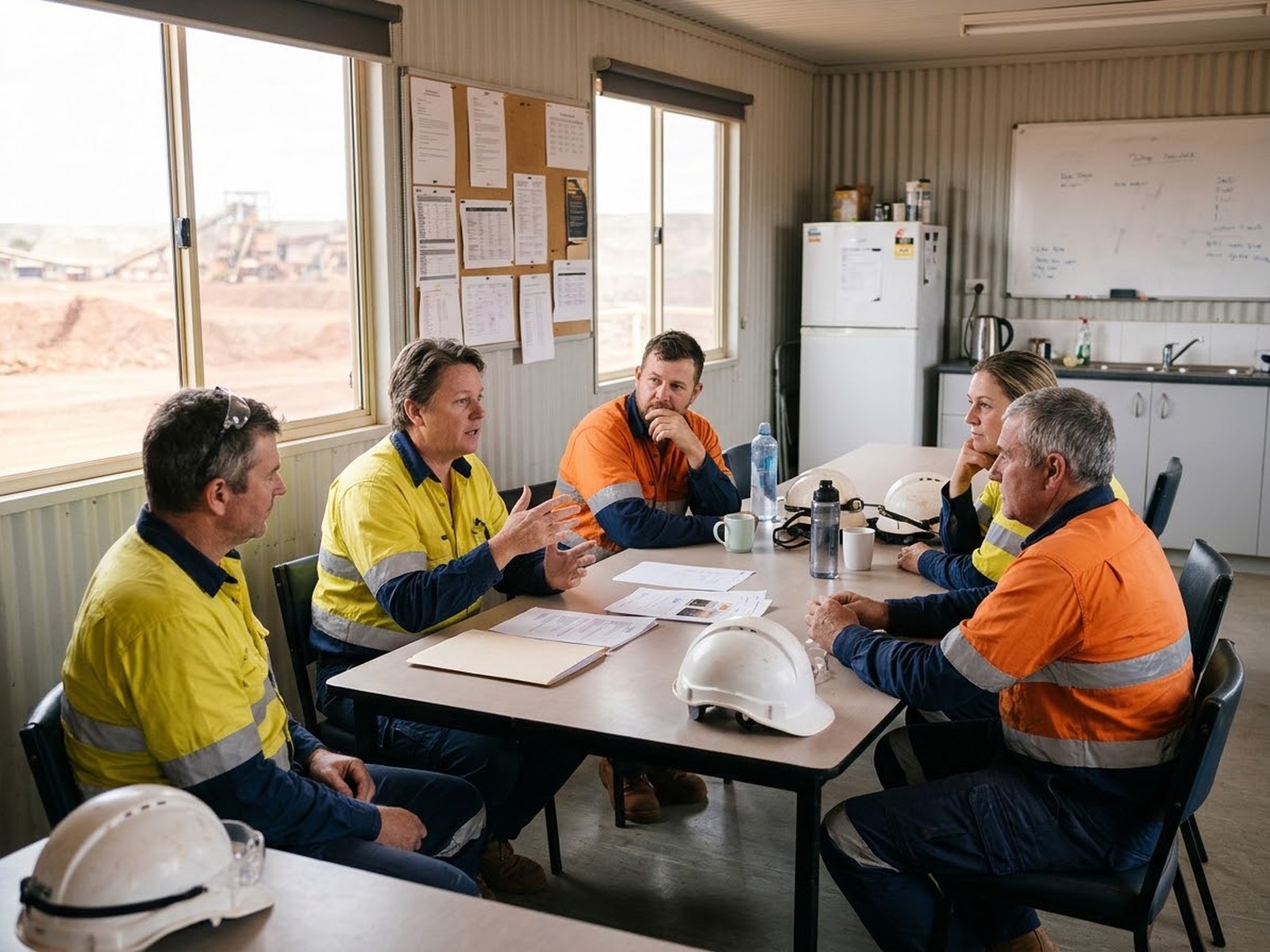
A workplace delegate talks with co-workers in a crib room.
24 hoursthe least notice a permit holder must give before entering (and no more than 14 days)
At costthe most a remote occupier may charge for a permit holder's transport or accommodation
1 July 2024the date the re-made delegates' rights term in every award operates from

Time limit If you are dismissed for union membership or activity, a general protections application must be made within 21 days after the dismissal took effect. Other adverse action has different time limits, so get advice early.

A union official with a Fair Work entry permit can visit a mine, plant or vessel, but a resources site raises problems a city workplace does not: getting there, where to sleep, and where on site the meeting happens. The Fair Work Act deals with each of them. This page is for members and delegates on a roster, and for the unions and officials who need to reach them.

When a union official can visit your site

A permit holder is a union official the Fair Work Commission has found fit and proper to hold an entry permit (Fair Work Act 2009 (Cth) s 512). A permit holder may enter a site:

Read moreShow less
  1. to investigate a suspected contravention of the Fair Work Act or a fair work instrument that affects a member who works there (s 481); and
  2. to hold discussions with employees who work there, whose interests the union may represent and who wish to take part (s 484).

Notice must be given during working hours at least 24 hours, and not more than 14 days, before the entry (s 487(3)). Entry rights may be exercised only during working hours, and discussions held only in meal or other breaks (s 490). You choose whether to take part, and your employer cannot stop you attending in your break.

Where the meeting happens

The permit holder must comply with reasonable work health and safety requirements (s 491) and reasonable requests about the route to the meeting place (s 492A). Discussions take place in a room or area agreed with the occupier. If there is no agreement, they take place in any room or area where the workers ordinarily take their breaks and that the occupier provides for breaks (s 492).

Case study
No transport obligation yetFair Work Commission · 22 September 2020

A transhipper nine kilometres offshore, and one email asking for a ride.

A permit holder wanted to visit workers on a transhipper vessel at the Sino Iron project. The company confined entry to a meeting room on land.

Read the full storyShow less

Result. Section 521D was engaged in principle, but the parties were not yet "unable" to agree.

A permit holder sought entry to a transhipper vessel about nine kilometres offshore at the Sino Iron project. The company confined entry to a landside meeting room for COVID-19 reasons, which the Commission accepted as a reasonable safety requirement.

The Commission held that s 521D was engaged in principle: the vessel cannot be reached at sea without the occupier's transport. But a single brief email request, met with an offer to discuss it later, did not mean the parties had been unable to agree, so the obligation to provide transport had not yet arisen ([47] to [50]).

What it means for you

The duty to provide transport to a remote site turns on the record. Ask early, try to agree, and get the occupier's answer in writing before going to the Commission.

Remote and offshore sites: transport and a bed

Two sections deal with sites that cannot be reached, or have nowhere to stay, unless the occupier provides it: s 521C for accommodation and s 521D for transport. The occupier must make an accommodation or transport arrangement if all of these are met (ss 521C(2), 521D(2)):

Read moreShow less
  1. providing it would not cause the occupier undue inconvenience;
  2. the permit holder or the union asks for it;
  3. the request is made a reasonable period before it is needed; and
  4. the parties have been unable to agree an arrangement by consent.

The occupier must not charge more than is necessary to cover its cost, and this is a civil remedy provision (ss 521C(3), 521D(3)). The Commission may treat the permit holder's conduct while in the occupier's transport or accommodation as conduct in the exercise of entry rights (ss 521C(4), 521D(4)). It can also deal with disputes about whether accommodation is reasonably available, whether a site is reasonably accessible, undue inconvenience, the timing of the request, and when entry rights may be exercised at a remote site (s 505).

At the Sino Iron project, a permit holder sought entry to a transhipper vessel about nine kilometres offshore. Section 521D applied in principle, because the vessel cannot be reached at sea without the occupier's transport. But one brief email request, answered with an offer to discuss it later, did not show the parties were "unable" to agree (CFMMEU v Cape Preston Port Co [2020] FWC 4502 at [47] to [50]).

Mine safety representatives with their own entry powers

  1. NSW coal. Industry safety and health representatives, nominated by the Mining and Energy Union, may enter coal mines on reasonable notice, or without notice where there is a serious and immediate risk (Work Health and Safety (Mines and Petroleum Sites) Act 2013 (NSW) ss 28 to 29).
  2. Queensland coal. The union may appoint up to three full-time industry safety and health representatives after a ballot (Coal Mining Safety and Health Act 1999 (Qld) ss 109 to 110). They may act only for safety and health purposes (s 117).

To exercise a state work health and safety entry right, a union official must also hold a Fair Work entry permit (s 494) and comply with reasonable safety requests (s 499). More on mine safety: Safety and stopping unsafe work.

Your rights as a workplace delegate

A workplace delegate is entitled to (s 350C(2) to (3)):

Read moreShow less
  1. represent members' industrial interests, including in disputes;
  2. reasonable communication with members and potential members;
  3. reasonable access to the workplace and its facilities; and
  4. unless the employer is a small business, reasonable paid time during normal hours for training.

What is reasonable depends on the size and nature of the enterprise, the employer's resources and the facilities available (s 350C(5)). An employer must not unreasonably refuse to deal with a delegate, mislead a delegate, or unreasonably hinder the delegate's rights (s 350A(1)).

On a roster

On remote sites the practical questions are delegates on opposite swings, access to camp facilities for meetings, and members who live across several states. Each goes to what is reasonable under s 350C(5). If you are a delegate on a FIFO roster, agree in writing with your employer how you will communicate with members on the other swing, and which facilities you can use.

The delegates' rights term in your award

The Full Federal Court quashed the delegates' rights terms first put into nine awards, including four mining and energy awards challenged by the Mining and Energy Union, for jurisdictional error (CFMEU v Australian Industry Group [2025] FCAFC 187 at [1] to [3], [105]). The Commission then varied all modern awards to include a revised term operating from 1 July 2024 (Variation of modern awards to include a delegates' rights term [2026] FWCFB 5 at [13], [35]). Check the delegates' rights clause in the award or agreement that covers you.

Union activity is protected; conduct during it is not

Being a member or a delegate, or taking part in lawful union activity, is protected. Abusive conduct while doing it is not, and the decisions on resources sites draw that line clearly.

Read moreShow less
  1. Picket conduct. A Saraji mine worker who waved a "No principles Scabs No guts" sign at people entering the mine during a union protest was lawfully dismissed. The decision-maker's accepted reasons were the offensiveness of the conduct and company policy, not the union activity (CFMEU v BHP Coal [2014] HCA 41 at [10], [90]; Hayne and Crennan JJ dissenting). A show cause letter to a lodge treasurer who abused a former member crossing a picket at Norwich Park was likewise not for a prohibited reason (CFMEU v BHP Coal [2012] FCA 1201 at [251]).
  2. Union officers chosen for redundancy. An underground coal mine admitted dismissing a lodge president and lodge secretary in a redundancy program because of their union offices and membership, and a site safety and health representative because of that role. Reinstatement and penalties of $120,000 were ordered (CFMEU v North Goonyella Coal Mine [2013] FCA 1444, orders [1] to [3], [7] to [11]).
  3. Refusing to hire a former official. A maintenance contractor on Bass Strait oil and gas sites refused to employ a rigger because he had been a union official and had represented the union's claims. That contravened s 346 (AWU v CBI Constructors [2016] FCA 745 at [58]).
Decided cases from resources

More cases from the industry.

Published decisions of the Fair Work Commission and the courts, retold in plain English from the decision itself. Lawcaptain did not act in these cases. Each links to the full decision.

Dismissal lawful, 3:2High Court of Australia · 16 October 2014

A protest was protected. The sign he waved was not.

During a union protest, a Saraji mine worker waved a "No principles Scabs No guts" sign at people entering the mine. He was dismissed.

Read the full storyShow less

A worker at the Saraji mine took part in a union protest, and waved a sign reading "No principles Scabs No guts" at people entering the mine. He was dismissed.

By a majority of three to two, the High Court held the dismissal lawful. The decision-maker's accepted reasons were the offensiveness of the conduct and company policy, not the union activity ([10], [90]). Hayne and Crennan JJ dissented.

What it means for you

Taking part in a protest is protected. Abuse of the people crossing it is not, and an employer that proves it acted on the conduct alone can dismiss for it.

Award delegates' terms quashedFull Court of the Federal Court · 17 December 2025

The first delegates' rights terms were quashed, then re-made for every award.

The Mining and Energy Union challenged the delegates' rights term inserted into four mining and energy awards.

Read the full storyShow less

Result. Terms quashed for jurisdictional error; a revised term was then made for all awards from 1 July 2024.

The Commission had inserted delegates' rights terms into modern awards. The Mining and Energy Union challenged the term in four mining and energy awards.

The Full Court quashed the delegates' rights terms in nine awards, including those four, for jurisdictional error ([1] to [3], [105]).

The Commission then varied all modern awards to include a revised delegates' rights term operating from 1 July 2024 (Variation of modern awards to include a delegates' rights term [2026] FWCFB 5 at [13], [35]).

What it means for you

If you are a delegate, check the current delegates' rights clause in your award or agreement, not an older copy.

Show more cases (1)Show fewer
Refusal to hire unlawfulFederal Court of Australia · 24 June 2016

Not hired because he had been a union official.

A maintenance contractor on Bass Strait oil and gas sites refused to employ a rigger because of his history with the union.

Read the full storyShow less

Result. Section 346 contravened; a penalty was imposed.

A maintenance contractor working on Bass Strait oil and gas sites refused to employ a rigger. The reason was that he had been a union official and had represented the union's claims.

The Federal Court held that refusing to employ him for that reason contravened s 346 of the Fair Work Act 2009 (Cth), and a penalty was imposed ([58]).

What it means for you

Your union history is protected when you apply for a job, not only once you are hired.

For employers

If you run a resources business

  • Answer remote entry requests in writing. Offer dates and terms for transport and accommodation, record any undue inconvenience, and charge cost only (ss 521C, 521D).
  • Keep entry conditions genuine. Safety requirements on entry must be genuine and reasonable (s 491); induction, PPE and escort rules are usual. A designated meeting room should be a place workers actually use for breaks (s 492).
  • Decide discipline on the conduct alone. Discipline for conduct during union activity must be decided, and documented, on the conduct itself (CFMEU v BHP Coal [2014] HCA 41).
For unions and delegates

For unions and delegates

On a remote site, entry and delegates' rights are won or lost on the record you build and on members' conduct.

  • Build the transport and accommodation record. Make an early request under s 521C or s 521D, make a genuine attempt to agree, and get the occupier's response in writing before applying to the Commission under s 505 (CFMMEU v Cape Preston Port Co [2020] FWC 4502).
  • Use safety representatives where they fit better. In NSW and Queensland coal, industry safety and health representatives have their own entry powers for safety and health, which may suit a safety issue better than a Fair Work permit.
  • Brief members before action. Brief members on picket conduct and social media before any protected action. Protest is protected; abuse is not (CFMEU v BHP Coal [2014] HCA 41).
  • Settle how delegates on opposite swings work. Agree in writing how a delegate communicates with members on the other swing, uses camp facilities and reaches members across states; each goes to what is reasonable under s 350C(5).
Leading cases

The decisions that set the rules.

Section 521D applies to an offshore transhipper, but one email request was not enough to show the parties were unable to agree.

Dismissing a worker for waving an offensive sign at a union protest was lawful, because the reason was the conduct, not the union activity.

Show all leading cases (4)Show fewer

The first delegates' rights terms in nine awards, including four mining and energy awards, were quashed for jurisdictional error.

All modern awards now include a revised delegates' rights term operating from 1 July 2024.

Selecting lodge officers and a safety and health representative for redundancy because of those roles led to reinstatement and penalties.

Refusing to hire a rigger because he had been a union official contravened s 346.

Questions

The things people ask.

Can a union official visit me at a remote mine site?

Yes. An official with a Fair Work entry permit can enter to hold discussions with employees in meal or other breaks, and to investigate suspected breaches affecting members, after giving at least 24 hours' and no more than 14 days' notice (ss 481, 484, 487, 490). You choose whether to take part.

Does the mine have to fly or drive a union official to site?

Where a site cannot reasonably be reached, or there is nowhere to stay, without the occupier's help, the occupier must arrange transport or accommodation at no more than cost if asked a reasonable time ahead, the parties cannot agree, and it would not cause undue inconvenience (ss 521C, 521D). In [2020] FWC 4502 one email request was not enough.

Where can union meetings be held on site?

In a room or area agreed with the occupier. Without agreement, in any room or area where workers ordinarily take breaks and that the occupier provides for breaks (s 492). The official must follow reasonable safety requirements and route requests (ss 491, 492A).

What rights does a union delegate have on a FIFO roster?

To represent members, to reasonable communication with members, to reasonable access to the workplace and its facilities, and (outside a small business) to reasonable paid training time (s 350C). What is reasonable depends on the site, so agree in writing how you will reach members on the other swing.

Can I be sacked for union activity at a mine?

Not for being a member or delegate, or for lawful union activity. But conduct during it, such as abusing people crossing a picket, is not protected ([2014] HCA 41). If you are dismissed for union activity, you have 21 days to make a general protections application.

Can an employer refuse to hire me because I was a union official?

No. Refusing to employ a rigger because he had been a union official and had represented the union's claims contravened s 346 of the Fair Work Act ([2016] FCA 745).

Free discussion · no obligation

Talk to us.

Call 1300 967 552, or leave your details and we will call you.

Do it yourself with AI

General information about Australian employment law, not legal advice about your situation. Updated November 2026.