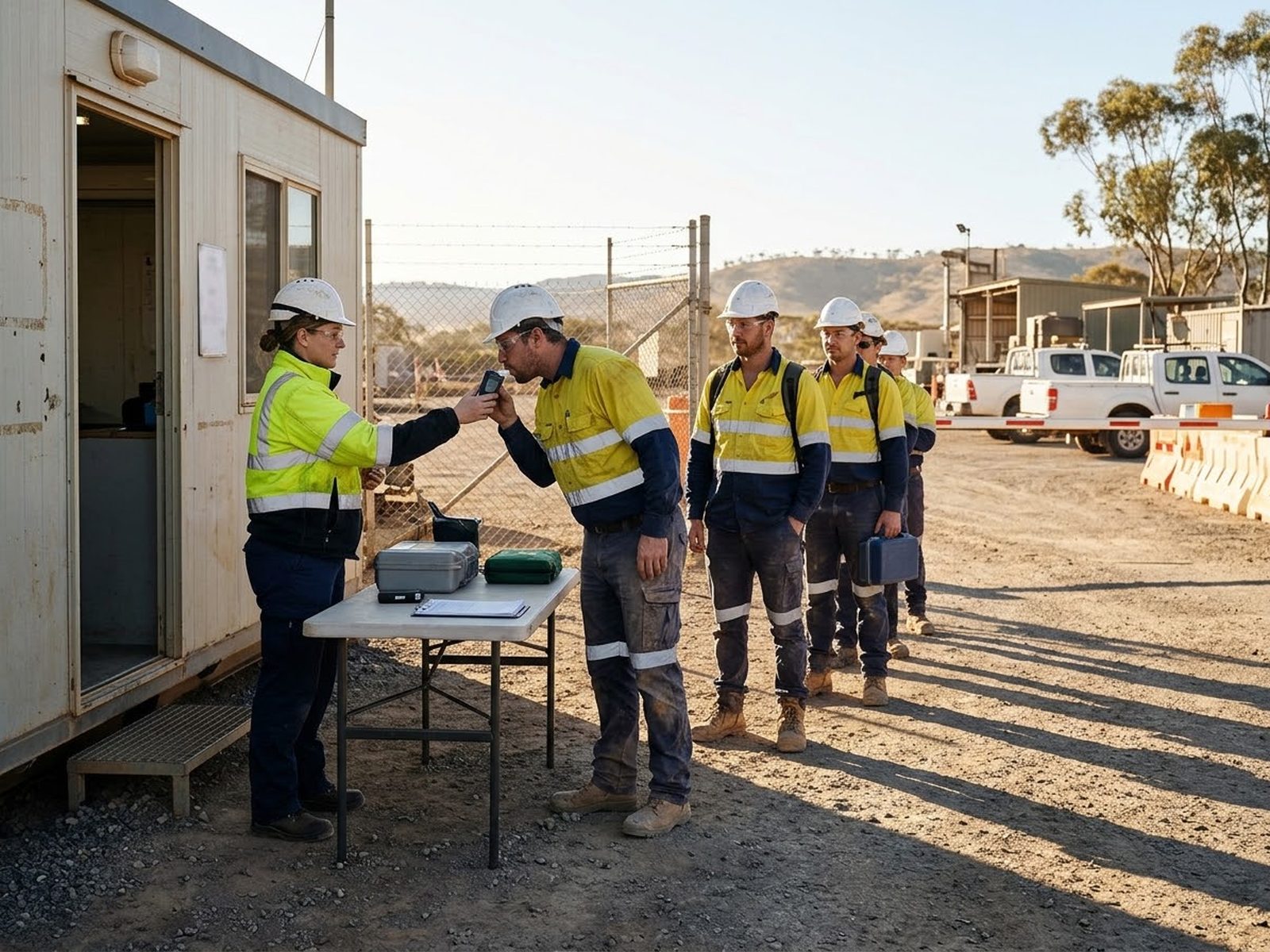
What the state mining laws require
- Queensland coal mines, alcohol. Every coal mine's safety and health management system must provide (Coal Mining Safety and Health Regulation 2017 (Qld) s 41(2)):
- an education program;
- an employee assistance program; and
- voluntary self-testing, random testing before starting work, and testing where someone reasonably suspects a person is under the influence.
- The site senior executive must consult representatives of the mine's workers in developing these fitness provisions (s 41(3)).
- Queensland coal mines, drugs, fatigue and other impairment. The system must provide (s 42):
- an education program and an employee assistance program;
- an obligation on a person to notify the site senior executive of current medication that could impair their ability to do their duties, and a record of each notification;
- self-testing and random testing before or during work; and
- for fatigue, maximum shift hours, rest breaks and maximum hours in a week or roster cycle.
- Health assessments. Queensland coal mine workers need a health assessment before starting and at intervals of no more than five years, arranged by the employer through its appointed medical adviser (s 46).
- NSW mines and petroleum sites. The operator must manage risks to health and safety associated with worker fatigue, alcohol and drugs (Work Health and Safety (Mines and Petroleum Sites) Regulation 2022 (NSW) s 45). The Regulation does not itself prescribe a testing regime; the site's plan does.
- WA mines. The Work Health and Safety (Mines) Regulations 2022 (WA) require the mine operator to manage risks associated with alcohol and drugs (reg 641) and to give workers information on fatigue, alcohol and drug controls (reg 675B).
A non-negative screen, then a negative retest. He was dismissed anyway.
Read the full storyShow less
Result. Valid reason found, but the dismissal was harsh; compensation of $37,222.50.
The operator was placed at a Queensland coal mine by a labour hire agency. He was tested for cause because his housemate had failed a test. He returned a negative home self-test, a non-negative first screen on site and a negative retest.
The site senior executive sent him home, and the agency dismissed him.
The Commission found there was a valid reason, but held the dismissal harsh: the investigation did not consider all the circumstances. It awarded compensation of $37,222.50 ([159] to [160], [165]).
Record every test result, including your own self-tests, and the times. If you are labour hire, the agency still has to look at your circumstances before it dismisses you.
Prescribed medication and medicinal cannabis
- Declare it, and declare any change. An explosives truck operator on BMA coal mines had declared medicinal cannabis, told his employer he had stopped, then resumed it without telling anyone. Policy words like "could impair" mean possible impairment, "even if that possibility is minimal or non-existent". His care not to use it within 30 hours of work did not remove the duty. The failure to declare was a valid reason and the dismissal was fair despite clean tests (Platinum Blasting Services [2023] FWC 2465 at [45] to [48], [62], [89]).
- A prescribed medicine for a disability brings in discrimination law. A FIFO fitter at the Ravensthorpe nickel mine, on prescribed medicinal cannabis for Crohn's disease, could not pass the urine test and was dismissed. Pending his union's disability discrimination complaint, the Federal Court ordered him reinstated on unpaid leave. This was an interim order, not a decision on the complaint (FQM Australia Nickel [2022] FCA 1331 at [1], [36] to [37], [40], [44]).
- Medication as an explanation needs evidence. A dump truck operator at the Boggabri coal mine returned a methylamphetamine reading four times the cut-off and suggested her prescribed medication caused it. The expert evidence did not support the explanation, and the result was itself a valid reason (Downer EDI Mining [2015] FWC 318 at [72] to [75], [78]).
Results, retests and labour hire
- Conflicting results. A labour hire plant operator at a Queensland coal mine was tested for cause because his housemate had failed a test. He returned a negative home self-test, a non-negative first site screen and a negative retest. The site senior executive sent him home and the agency dismissed him. The Commission found a valid reason, but held the dismissal harsh because the investigation did not consider all the circumstances, and awarded $37,222.50 (WorkPac [2025] FWC 2316 at [15], [141], [159] to [160], [165]).
- The method. Urine against saliva has been argued for over a decade. At a Gloucester coal mine, the employer's move to on-site saliva screening with a continuing role for urine was "eminently reasonable", because impairment is an important safety issue at coal mines (CFMEU v HWE Mining [2011] FWA 8288 at [26], [30]).
- Taking a test is a workplace right. A labour hire worker's participation in a drug and alcohol test under the mine's fitness for work policy was the exercise of a workplace right, and the host's later exclusion of her from site was unlawful adverse action (CFMMEU v BM Alliance Coal Operations (No 3) [2022] FCA 1345 at [44] to [45], [62], [133]). That case is told in full on the safety and stopping work page.
New site entry health rules
A new condition of entry to site is a direction, and it must be lawful and reasonable.
Read moreShow less
- At the Mt Arthur coal mine, a COVID-19 vaccination site access requirement was prima facie lawful but not reasonable. The determinative consideration was the failure to consult as required by ss 47 and 48 of the NSW WHS Act (CFMMEU v Mt Arthur Coal [2021] FWCFB 6059 at [85], [251]).
- That does not mean every entry requirement fails. A worker at BMA's Daunia mine dismissed under the BMA vaccination requirement, who argued consultation had not occurred, was refused permission to appeal against the dismissal of his unfair dismissal claim (Central Queensland Services [2023] FWCFB 36 at [80] to [81]). Each case turns on what consultation actually happened.
- The 21-day limit still applies. A Karara Mining worker dismissed for not proving vaccination applied one day late. There were no exceptional circumstances, and permission to appeal was refused (Karara Mining [2022] FWC 494 at [56]; [2022] FWCFB 73 at [49]).
Fitness for work beyond drugs and alcohol
A site requirement can make a licence part of the job. A production operator at a WA salt operation who lost his driver's licence for drink-driving off duty could no longer meet the site's driving requirement, and his dismissal was not unfair (Dampier Salt [2020] FWC 6258 at [138]).
What to do before and after a test
- Before the test. Declare every prescription and change through the site process, and keep a copy. Ask your doctor for a letter on dose, timing and impairment.
- At the test. Ask for the policy and for any retest the policy allows. Read the chain of custody form before you sign it, and note the kit types and times. Do not refuse without advice: refusing a lawful direction is usually fatal to a later claim.
- After a non-negative screen. You will usually be stood down until the laboratory result comes back. If you are labour hire, ask for both the host's and the agency's policies.
- If a disability or a prescribed medicine is involved, get advice quickly about a discrimination complaint as well as unfair dismissal. The unfair dismissal and general protections limit is 21 days from dismissal.