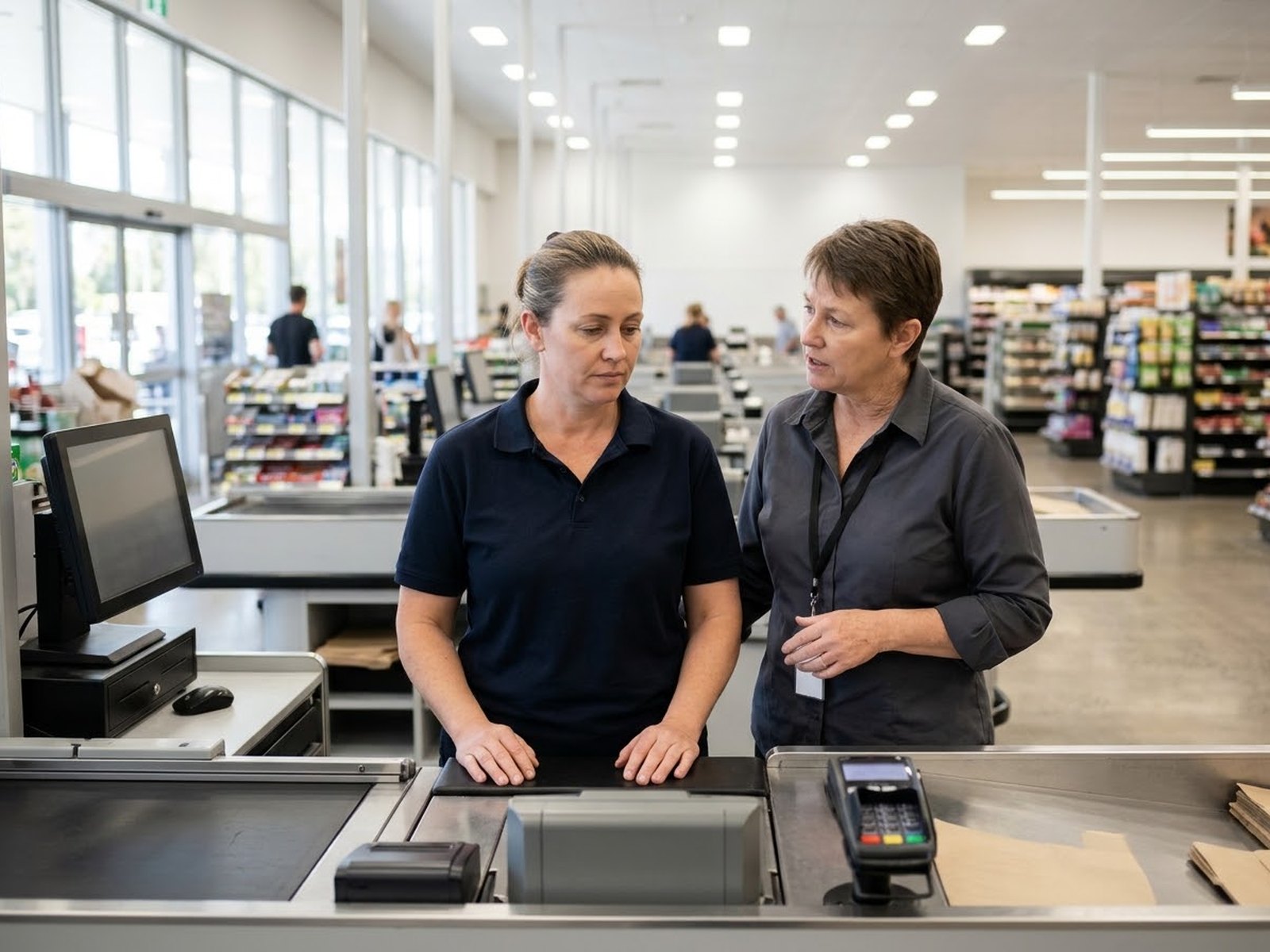
It is a crime, and in three states a specific one
New South Wales
- A retail worker is a person whose duties are mainly working in an area of a shop open to the public (Crimes Act 1900 (NSW) s 60F).
- Assaulting, throwing a missile at, stalking, harassing or intimidating a retail worker in the course of their duty, without actual bodily harm, carries up to 4 years; actual bodily harm, 6 years; wounding or grievous bodily harm, 11 years (s 60G(1) to (3)).
- It applies even when you are off duty, if it is in retaliation for something you did at work (s 60G(4)).
Read moreShow less
Western Australia
Assaulting a worker for a business that operates or occupies a shop, while they are working in an area open to the public or in response to something done there, is a crime carrying 7 years, or 10 years if the offender is armed or in company; dealt with summarily, 3 years and $36,000 (Criminal Code (WA) s 318B, from 2024).
Victoria
- The protection covers customer-facing workers: anyone working at premises a retail or hospitality business's customers attend, such as a fast food restaurant, or delivering goods to them, and shopping centre staff, whether employee, labour hire, volunteer or owner (Summary Offences Act 1966 (Vic) ss 51B, 51C).
- Threatening, abusive, insulting or offensive language or conduct towards such a worker carries 25 penalty units or 6 months (s 17AA); assault, 60 penalty units or 6 months (s 51D). Assault or a threat to assault in connection with the worker's duties is also an indictable offence carrying 5 years (Crimes Act 1958 (Vic) s 31(1)(bb)).
- Both cover abuse while you are on a break or arriving at or leaving work, and abuse in response to something the person believes you did.
In Queensland, the general assault offences apply. Wherever you work, report an assault to the police. The store's CCTV and incident reports are the evidence, so ask that they be kept.
Dismissed for lowering the roller door on shoplifters, then reinstated.
Read the full storyShow less
Result. No valid reason; dismissal harsh, unjust and unreasonable; reinstatement with continuity, and lost pay of about $7,313 discounted by 50%.
Theft at the liquor store had risen from mid-2025, and the employer had trialled closing a roller door over the entrance in the last hour of trade ([9]). After she grabbed an offender's bag in July 2025, the worker got a first and final warning.
In September 2025 she partly lowered the roller door during a swarming, telling the offenders the store was closing. Staff nicknamed her "The Enforcer", and a sticker saying so stayed by the door for months; the manager saw it and left it ([32], [33]).
In January 2026 three offenders swarmed the store. She partly lowered the door, stopped when a colleague signalled, then lowered it again, and an offender threw a bottle that hit the colleague. She was dismissed for serious misconduct.
The Commission found no valid reason. Letting the sticker stay must have been taken as approval ([40]); her conduct was not serious enough to justify dismissal, and the bottle-throwing was more likely provoked by the colleague ([89]). The tolerance of the earlier incident, the different treatment of the colleague, her record and her length of service made dismissal disproportionate ([109]). She was reinstated ([113], [114]).
A warning about one act is not a warning about a different one. If the store let something pass before, or treated others in the same incident differently, that counts.
What your employer must do
Customer aggression and violence are hazards your employer must manage so far as reasonably practicable under the state work health and safety laws (the Occupational Health and Safety Act 2004 in Victoria), including the risk of psychological harm. In practice that means:
Read moreShow less
- security staff and duress alarms where the risk calls for them;
- rules for working alone, especially at night on a service station console;
- cash handling limits;
- a clear "do not intervene" procedure for theft, and training each worker in it; and
- incident reporting and support after an incident.
If a customer injures you, physically or psychologically, for example in an armed robbery, you may be able to claim workers' compensation under your state's scheme: see What changes by state.
Sexual harassment by customers
Sexual harassment of a worker by anyone, including a customer, in connection with their work is prohibited by the Fair Work Act (s 527D), and your employer has duties to prevent it under the Sex Discrimination Act 1984 (Cth) and safety law.
When the worker is the one dismissed
| What happened | Case | Result |
|---|---|---|
| A liquor store worker of 17 years partly lowered the roller door during a swarming theft; an earlier roller-door incident had been tolerated and celebrated | Blair v Endeavour Group Limited [2026] FWC 1873 | No valid reason; harsh; reinstated |
| A casual supermarket worker confronted a suspected shoplifter, then entered a store while suspended; security had been removed and staff routinely intervened | Anderson v Coles Supermarkets Australia Pty Ltd [2026] FWC 3086 | Valid reason but harsh; $7,203.90 |
| An electronics salesperson swore at an abusive customer, who filmed it | Gupta v The Good Guys Discount Warehouses (Australia) Pty Ltd [2022] FWC 3373 | Dismissal upheld |
| A lone night console operator threatened by an unarmed customer was dismissed for not following the armed hold-up procedure | Mistry v Woolworths Ltd t/a Woolworths Fuel [2017] FWCFB 3926 | Appeal upheld; sent back to be reheard |
Read moreShow less
What comes out of these cases:
- a theft-response or hold-up policy gives a valid reason only if it clearly applied to what happened, and you were trained in a way you could follow (Mistry at [26] to [29]; Blair at [40]);
- if the store tolerated or encouraged staff stepping in, a later dismissal for doing so is at risk (Blair at [40]; Anderson at [4], [15], [16]);
- proportionality, long service and a clean record count, even where there is a valid reason (Anderson at [4]); and
- abuse from a customer does not excuse abusing them back, especially on camera (Gupta).