Retail · Junior rates

Under 21? Your rate depends on your age, your level and your award.

The junior percentages under the retail, fast food, pharmacy and service station awards from 1 July 2026, when a 20-year-old gets the adult rate, short shifts for school students, and money taken from a young worker's pay.

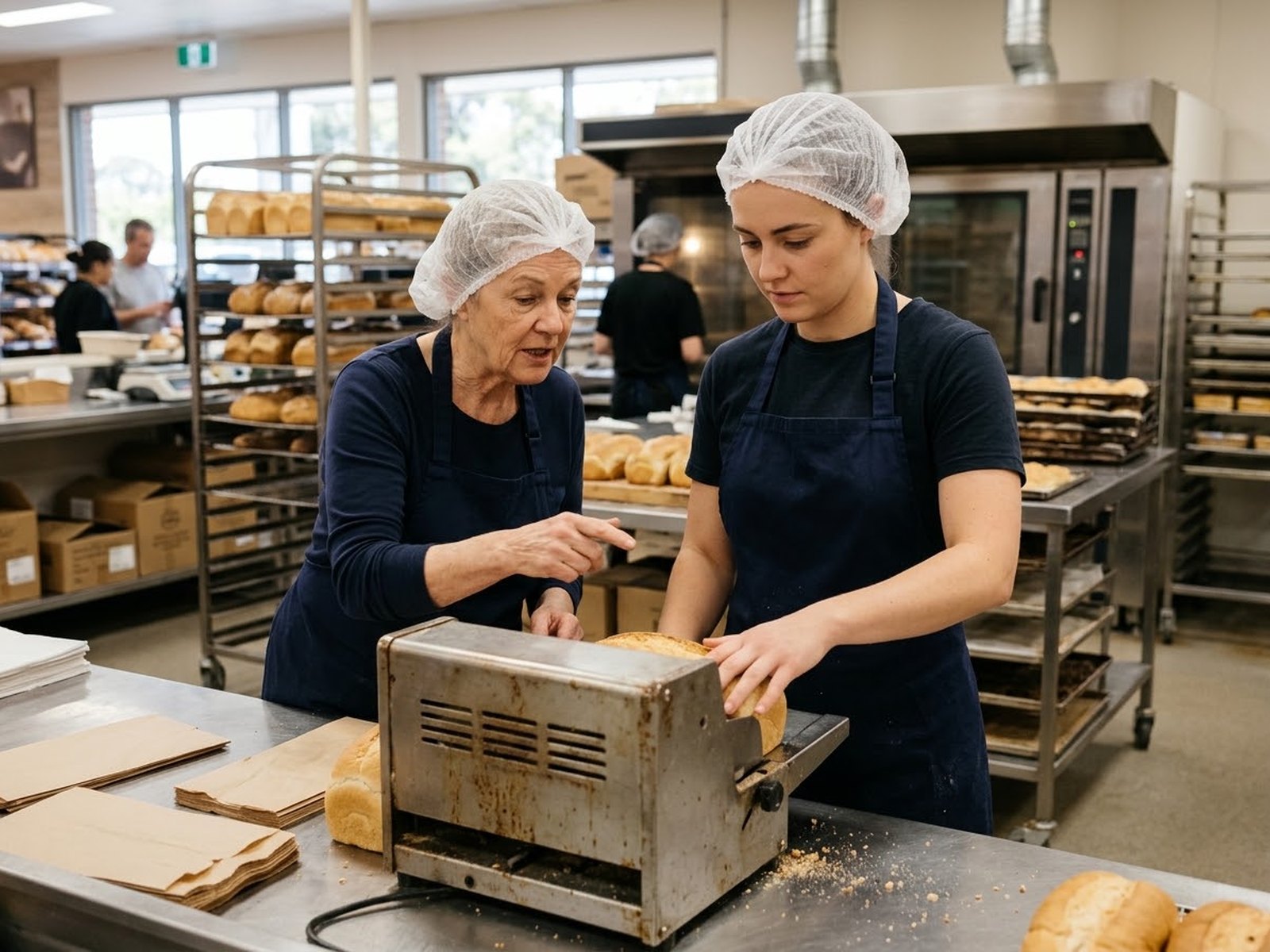
An older baker shows a younger colleague how to slice bread in a supermarket bakery.
21the age at which every retail award pays the full adult rate
6 monthsof service, after which a 20-year-old on the retail award gets the adult rate
Levels 1-3the only retail award levels with junior rates

Check first Check your level first. Under the retail award, junior rates apply only at Levels 1, 2 and 3: a junior supervisor or department manager is paid the adult rate.

A junior is an employee under 21. Each retail award pays juniors a percentage of the adult minimum rate for their level, but the percentages, the levels they apply to and the step for 20-year-olds differ between awards. Penalty rates and the casual loading are percentages of the junior rate. Every figure on this page is the minimum operative from 1 July 2026.

The retail award

AgePercentage of the adult rateLevel 1 hourly
Under 1645%$12.51
1650%$13.91
1760%$16.69
1870%$19.47
1980%$22.25
20, employed 6 months or less90%$25.03
20, employed more than 6 months100%$27.81
Read moreShow less

Source: General Retail Industry Award 2020 Table 5 (cl 17.2) and Schedule B.3.1. A junior casual also gets the 25% casual loading; Schedule B.3 of the award sets out the junior casual figures.

Three rules sit behind the table:

  1. junior rates apply only at Retail Employee Levels 1, 2 and 3. A junior at Level 4 or above, such as a department manager or nightfill supervisor, is paid the adult rate (cl 13.2, 17.2). The Full Bench made that change, operative from 1 May 2021, to fix an anomaly it saw in applying junior rates to supervisors ([2021] FWCFB 946 at [2], [3]);
  2. a 20-year-old who has worked for the employer for more than 6 months gets the full adult rate. The Full Bench accepted evidence that most junior retail employees are proficient within about six months, and that there is little difference between the work of a 20 and a 21-year-old ([2014] FWCFB 1846 at [171]). The employers' challenge failed ([2014] FCAFC 118); and
  3. penalties are percentages of the junior rate: a 16-year-old at Level 1 working on a Sunday earns $20.87 an hour (150% of $13.91).

Fast food, pharmacy and service stations

AgeFast food (all levels)Pharmacy (assistant Levels 1 and 2)Service station casuals (of the adult casual rate)
Under 1640% ($11.12 at Level 1)45%47.5% (under 17)
1650% ($13.91)50%47.5% (under 17)
1760% ($16.69)60%50%
1870% ($19.47)70%62.5%
1980% ($22.25)80%75%
2090% ($25.03)90%Adult rate
Read moreShow less
  1. Fast food: junior rates apply at every level, including shift supervisors, and a 20-year-old stays on 90% until 21 however long they have worked there (Fast Food Industry Award 2020 cl 15.2). The under-16 rate is lower than in retail.
  2. Pharmacy: junior rates apply only to pharmacy assistants at Levels 1 and 2 (Pharmacy Industry Award 2020 cl 16.2).
  3. Service stations: casual driveway, roadhouse and console staff under 20 are paid a percentage of the adult casual rate (Vehicle Repair, Services and Retail Award 2020 cl 27.3(b)). An employee under 18 must not work unsupervised between 7 pm and 9 pm, and must not be employed at all between 9 pm and 6:30 am (cl 27.2).

School students and short shifts

  1. Retail: a full-time secondary school student may work a casual shift of 1.5 hours between 3 pm and 6:30 pm on a school day, with a parent's or guardian's approval, where a longer shift is not possible (retail award cl 11.3).
  2. Pharmacy: 2 hours, if a Level 3 or higher employee is working at the same time to supervise (pharmacy award cl 10.14, 11.5).
  3. Fast food: no exception. Every shift is at least 3 hours (cl 11.3).

State law also limits children's work. Victoria has required employers of children to hold a licence since 1 July 2023, and Queensland's Child Employment Act 2006 limits the hours of school-aged children. Check your state's rules: see What changes by state.

Money taken from a young worker's pay

A term that allows a deduction from the pay of an employee under 18, or requires them to make a payment, has no effect unless a parent or guardian agrees in writing (Fair Work Act s 326(4)). That covers uniforms, till shortages and anything else. Cashing out annual leave or taking leave in advance also needs a parent's signature for an under-18 (retail award cl 28.8, 28.9).

A 16-year-old bakery worker paid in cash, and made to pay business costs from her own money, recovered more than $72,000 from the company and its director: see the case on Awards and pay.

For employers

If you employ juniors

  • Move juniors to the adult rate on time. On their 21st birthday, and under the retail award on the day a 20-year-old passes 6 months' service.
  • Pay the adult rate at retail Level 4 and above. A junior department manager or nightfill supervisor is not on junior rates.
  • No deductions from under-18s without a parent's written agreement. And in any case none that are unreasonable and for your benefit (ss 324 to 326).
  • Keep under-18s off night console shifts. Under the service station award, not unsupervised from 7 pm to 9 pm and not at all from 9 pm to 6:30 am.
  • Supervise short pharmacy shifts. A 2-hour shift for a school student needs a Level 3 or higher employee on at the same time.
For unions and delegates

For unions and delegates

  • Junior rates are a standing bargaining issue. The adult rate for 20-year-olds came from a union application to the Commission, and the limit to Levels 1 to 3 came out of another.
  • Audit the 20-year-old step. Under the retail award, check that 20-year-olds move to the adult rate after 6 months' service.
  • Compare your agreement's junior table with the award. The agreement's base rate cannot be lower than the award's for the same age and level (s 206). Enterprise agreements →
Leading cases

The decisions that set the rules.

Twenty-year-old retail employees with more than six months' service were given the full adult rate.

The employers' challenge to the adult rate for 20-year-olds was dismissed.

Show all leading cases (1)Show fewer

Junior rates limited to retail Levels 1, 2 and 3 from 1 May 2021.

Questions

The things people ask.

I'm 20. When do I get the adult rate?

Under the retail award, once you have worked for your employer for more than 6 months (cl 17.2). Under the fast food award, not until you turn 21: a 20-year-old stays on 90% (cl 15.2).

What does a 16-year-old get paid at a supermarket?

Under the retail award from 1 July 2026, at Level 1, $13.91 an hour (50% of the adult rate), plus the 25% casual loading if you are casual, and penalty rates as a percentage of that rate. An enterprise agreement may pay more.

I'm 19 and a department supervisor. Am I on junior rates?

Not under the retail award if you are at Level 4 or above: junior rates apply only at Levels 1, 2 and 3 (cl 13.2, 17.2). Under the fast food award, juniors are on junior rates at every level.

Can I work a 1.5-hour shift after school?

In retail, yes, if you are a full-time secondary student, the shift is between 3 pm and 6:30 pm on a school day, a parent or guardian has approved it, and a longer shift is not possible (cl 11.3). In fast food every shift is at least 3 hours.

Can my boss take money out of my pay? I'm 17.

Only with a parent's or guardian's written agreement, and even then not for a deduction that is unreasonable and for the employer's benefit (Fair Work Act ss 324 to 326).

Free discussion · no obligation

Talk to us.

Call 1300 967 552, or leave your details and we will call you.

Do it yourself with AI

General information about Australian employment law, not legal advice about your situation. Updated November 2026.