Part-time guaranteed hours
Under the retail award, a part-time employee works fewer than 38 hours a week with reasonably predictable hours (cl 10.1), and:
Read moreShow less
- when you start, your employer must agree with you in writing the hours you will work on each day (your guaranteed hours), your start and finish times, and when you take meal breaks. A text or email exchange is enough (cl 10.5);
- the pattern can be changed by agreement, for one shift or ongoing, recorded in writing before the end of the shift or before the change starts. Agreed extra hours are paid at ordinary rates with penalties (cl 10.6);
- any time beyond your guaranteed hours, as agreed or varied, is overtime (cl 10.8);
- your employer can change the other parts of the pattern, such as start and finish times, on 7 days' written notice (48 hours in an emergency), but not week to week and not to avoid award entitlements. If it does, you are paid as if nothing had changed. Your guaranteed hours, and the days they fall on, change only by agreement (cl 10.10); and
- if you have regularly worked more than your guaranteed hours over the past 12 months, you may ask in writing, once a year, for your guaranteed hours to go up. Your employer must discuss it, reply in writing within 21 days, refuse only on reasonable grounds and give reasons. A dispute can go to the Fair Work Commission (cl 10.11).
Fast food and pharmacy
Under the fast food award, the written pattern must include the days, start and finish times and the 3-hour minimum (cl 10.3). A change for one shift must be recorded in writing, including by text, by the end of that shift. If it is not, the extra hours are overtime (cl 10.5, 10.6). That makes it the easiest underpayment to prove in fast food: ask for the written variation.
Under the pharmacy award, the roster (but not the hours) can change on 7 days' notice, or 48 hours in an emergency; the hours change only by agreement (cl 10.9 to 10.11).
What the big agreements do
- Woolworths: the Woolworths Australian Food Group Agreement 2024 sets part-time contract hours over a 4-week cycle, and cl 9.1 lets Woolworths change a part-time worker's standard roster with safeguards, but not cut contracted weekly hours. The Commission treated the loss of predictability as a relatively small detriment, and the Full Federal Court would not interfere ([2025] FCAFC 105 at [24], [31]).
- Standing consent: the Woolworths agreements let a part-time worker give standing written consent to extra hours, which can be withdrawn at any time. Extra hours worked before you give it can be overtime ([2026] FedCFamC2G 1612).
- Coles: undertakings given when the Coles Retail Enterprise Agreement 2024 was approved mean a dispute about changing a part-time worker's guaranteed hours without agreement can go through the dispute procedure and be arbitrated ([2024] FWCFB 250).
- Endeavour Group (BWS, Dan Murphy's): the Endeavour Group Retail Agreement 2025 lets the employer change guaranteed hours, with what Endeavour described as a number of protections ([2025] FWCA 3828).
Told the drink break was the only time to drink or go to the toilet.
Read the full storyShow less
Result. Penalties of $82,000, $10,000 of it to the crew member and $72,000 to the union ([2020] FCA 1644)
The crew member worked under the McDonald's Australia Enterprise Agreement 2013, which gave a paid 10-minute drink break on shifts of 4 hours or more. The franchisee admitted she did not get it on most qualifying shifts.
After crew tagged their union in complaints on the staff Facebook group, managers posted that the 10-minute break would be the only time crew could drink or go to the toilet.
The Court read the work health and safety duty to provide toilets and drinking water as meaning they must be accessible during paid time, not only in scheduled breaks, subject to reasonable restrictions such as not leaving food to burn ([130], [131]). Access was a workplace right, and the post denying it was made recklessly, contravened the ban on misrepresenting workplace rights, and was also adverse action and coercion ([132] to [134]).
Penalties totalled $82,000, of which $10,000 went to the worker ([2020] FCA 1644). Pressure on the business might explain the conduct, the Court said, but did not excuse it.
Your employer cannot limit toilet and water to your scheduled breaks. A missed paid break is a breach of the award or agreement, and the union can sue for penalties.
Roster changes
For everyone under the retail award (cl 15.9 and 35):
Read moreShow less
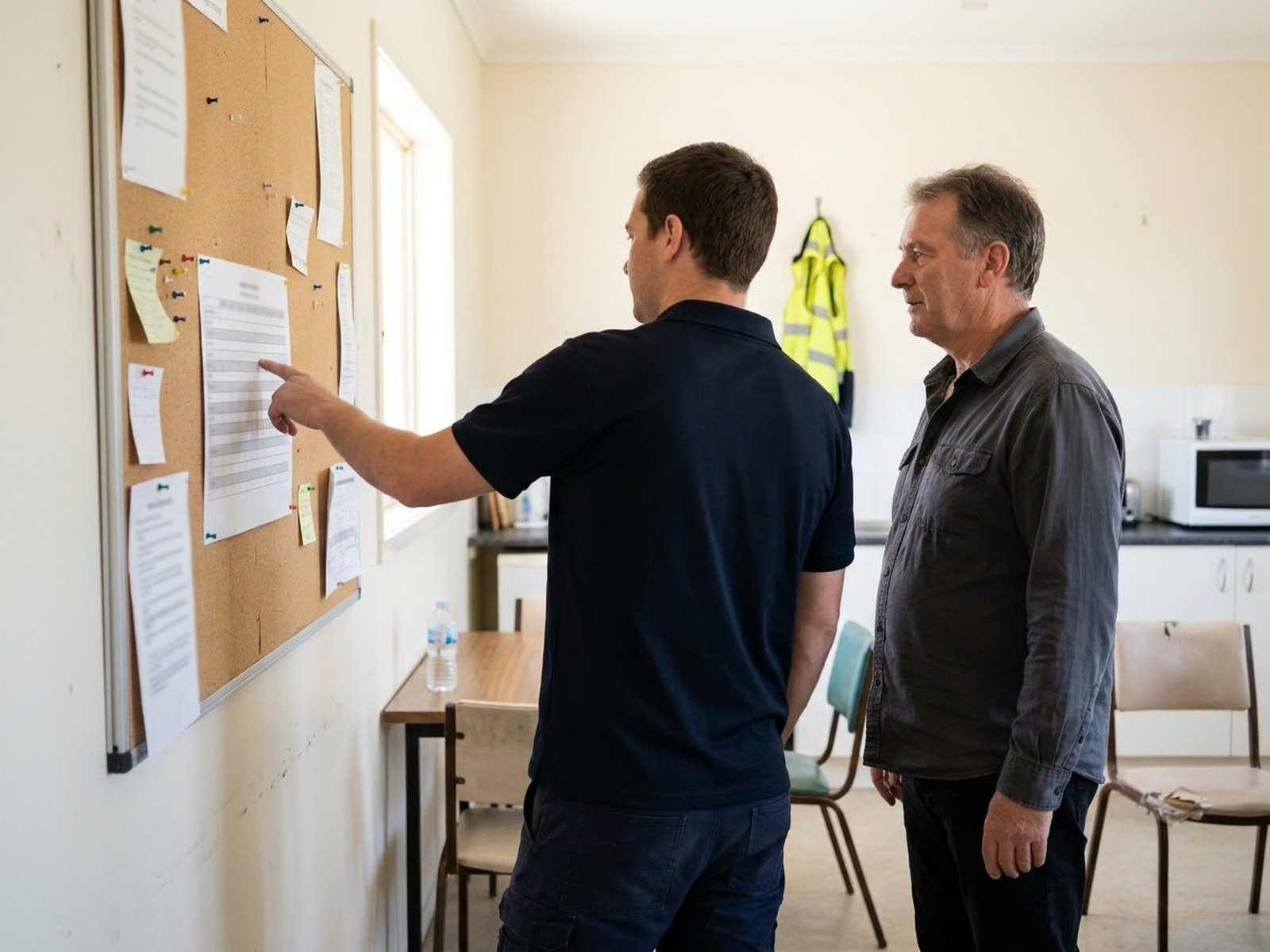
- rosters must be displayed or available electronically, show hours, days and start and finish times, and be kept for 12 months;
- a permanent change for a full-time or casual worker needs 7 days' written notice, or 14 days if you disagree. A one-off change that is not an emergency attracts overtime for the extra time;
- changing a roster to avoid penalty or shift rates is prohibited, and you are paid as if it had not changed (cl 15.9(i)); and
- before changing a regular roster, the employer must consult you: give information, invite your views about the impact, including on family and caring responsibilities, and consider them (cl 35).
Days off
Under the retail award you work ordinary hours on no more than 5 days a week (or 6, then 4 the next week), get 2 consecutive days off a week or 3 a fortnight, work no more than 6 days in a row, and if you regularly work Sundays you get a 3-day weekend every 4 weeks, unless you ask in writing for something different. Your employer cannot make such a request a condition of the job (cl 15.7, 15.8).
Minimum shifts
| Award | Part-time | Casual | Exception |
|---|---|---|---|
| General Retail Industry Award 2020 | 3 consecutive hours (cl 10.9) | 3 hours (cl 11.2) | 1.5 hours for a full-time secondary student, 3 pm to 6:30 pm on a school day, with a parent's approval, where longer is not possible (cl 11.3) |
| Fast Food Industry Award 2020 | 3 consecutive hours (cl 10.2) | 3 consecutive hours (cl 11.3) | None |
| Pharmacy Industry Award 2020 | 3 consecutive hours (cl 10.7) | 3 consecutive hours (cl 11.1) | 2 hours for a school student 3 pm to 6:30 pm, if a Level 3 or higher employee is on to supervise (cl 10.14, 11.5) |
| Vehicle Repair, Services and Retail Award 2020 (fuel) | 2 consecutive hours (cl 11.2) | ||
| Storage Services and Wholesale Award 2020 (warehouses) | 3 consecutive hours (cl 10.5) | 4 hours (cl 11.1) |
Some agreements add to this. The BIG W Stores Enterprise Agreement 2023 pays a casual 3 hours if a shift is cancelled on less than 3 hours' notice (cl 8.6.4).
Breaks, toilets and water
| Shift (retail award) | Paid rest breaks | Unpaid meal breaks |
|---|---|---|
| Under 4 hours | None | None |
| 4 to 5 hours | One 10-minute | None |
| More than 5, under 7 hours | One 10-minute | One, 30 to 60 minutes |
| 7 to under 10 hours | Two 10-minute | One, 30 to 60 minutes |
| 10 hours or more | Two 10-minute | Two, 30 to 60 minutes |
Read moreShow less
Breaks go on the roster, cannot fall in the first or last hour, and you cannot work more than 5 hours without a meal break (cl 16.3 to 16.5). The fast food award (cl 14) and pharmacy award (cl 15) have their own tables.
12 hours between shifts: the close-then-open
Under the retail award, if you start again without 12 hours off, every hour is paid at 200% of the minimum hourly rate until you have had 12 consecutive hours off, and you lose no pay for ordinary hours missed while you take the break. You and your employer, or a group of employees, may agree on 10 hours instead (cl 16.6). That is the rule that bites on a late close followed by an early open.
In a warehouse agreement with a similar clause, the Full Bench held that overtime counts as part of the shift, so the break is measured from the end of any work, including overtime ([2024] FWCFB 410 at [40]). The fast food and pharmacy awards have no 12-hour rule; check your agreement.
Casual for years: going permanent
Retail and fast food run on casuals who work the same shifts every week for years. Under the Fair Work Act you are a casual only if there is no firm advance commitment to continuing and indefinite work, judged on the real substance of the relationship, not only the contract (s 15A). A regular pattern of work, continuing work being likely, and permanent staff doing the same job all point to a firm commitment (s 15A(2)(c)).
Read moreShow less
The employee choice pathway works like this:
- you may notify your employer in writing that you believe you are no longer a casual once you have worked there 6 months (12 months for a small business), if you have no current dispute about it and have not had a notification refused in the past 6 months (s 66AAB);
- your employer must consult you and reply in writing within 21 days. It may refuse only because you still meet s 15A, because of fair and reasonable operational grounds, or because accepting would breach a recruitment process required by law (s 66AAC); and
- if you cannot resolve it at work, either side may take the dispute to the Fair Work Commission, which may arbitrate and must disregard what happened after your notification (s 66MA). The award's own dispute clause can also be used (retail award cl 11.5, cl 36).
If your shifts are cut after you notify, that may be adverse action for exercising a workplace right, which the general protections forbid, and the Commission disregards it when deciding the dispute. No retail decision has settled it yet. Keep your notification and your rosters before and after, and ask us if your hours drop.
Three retail points:
- "Operational grounds" in retail usually means the employer cannot offer a fixed pattern. That is harder to argue when you have worked the same days for months;
- on conversion to part-time under the retail award, your guaranteed hours must be agreed in writing (cl 10.5). That is where the negotiation happens: the hours offered should reflect the hours you actually work, and the cl 10.11 review is there after 12 months; and
- your casual loading stops when you convert, and paid leave starts.