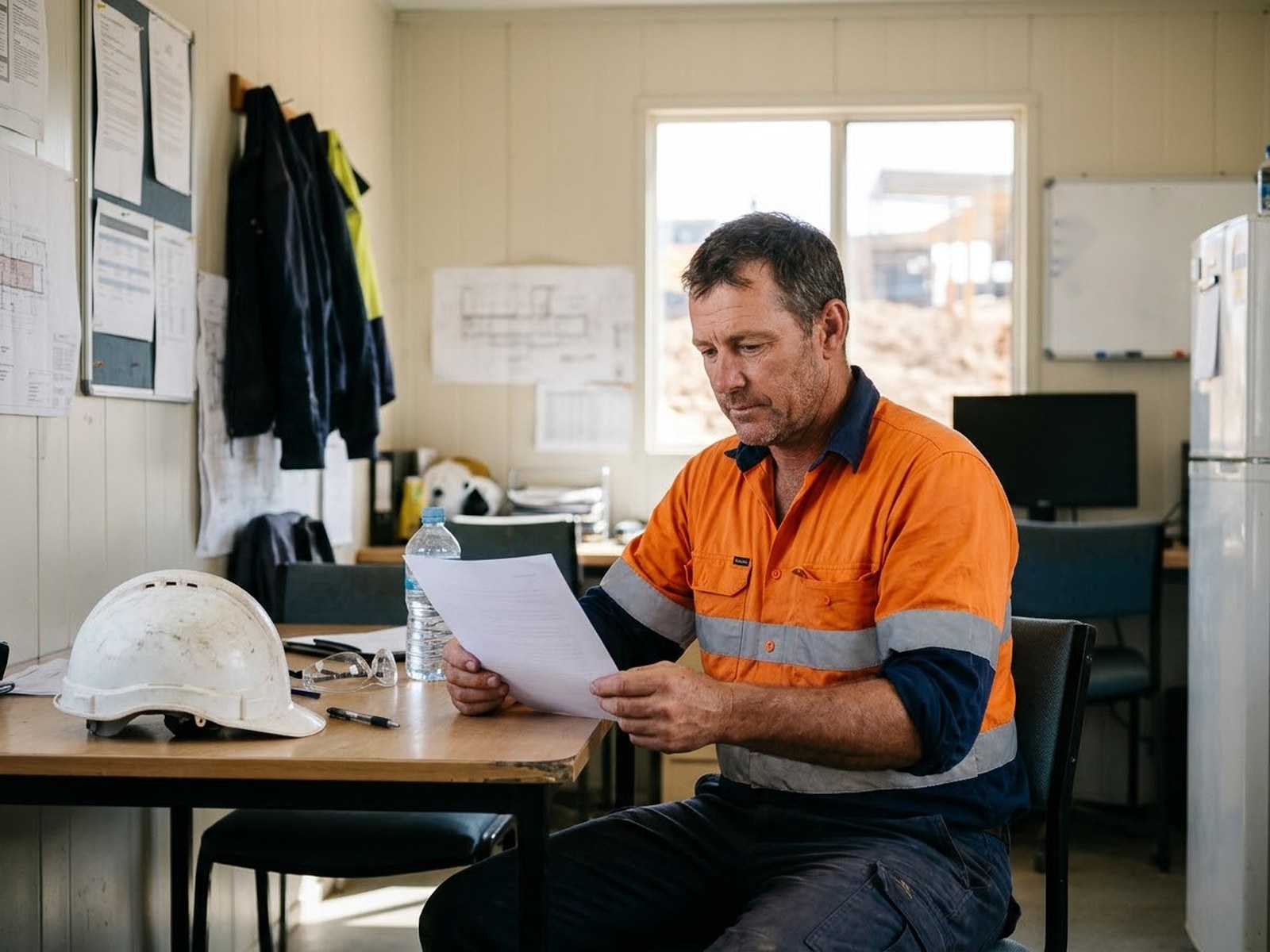
The two claims after a dismissal
- Unfair dismissal: the Commission considers whether there was a valid reason related to your capacity or conduct, whether you were told of it and given a chance to respond, whether you could have a support person, any warnings, the size of the employer and other matters (Fair Work Act s 387). Apply within 21 days (s 394).
- Wrongful dismissal and notice: if the employer dismissed you without notice, it must prove serious misconduct. If it cannot, you can claim damages for the notice period (s 117). Daily hire employees in building and construction are outside the National Employment Standards notice and have one day's notice under the award, and the award keeps summary dismissal "for misconduct or refusing duty" (On-site award cl 9.2).
Safety breaches
A clear breach of a fall-protection safe work method statement can be a valid reason for dismissal, especially for a leading hand who has just been retrained on it, and a more senior worker can be held to a higher standard than a co-worker given a warning for a similar breach. But if the allegations were never put to you in writing with a chance to answer, the dismissal can still be harsh (see the scaffolder's case below).
Read moreShow less
Process cuts both ways. In a scaffolding dismissal, the Full Bench quashed a decision because the employer had been denied procedural fairness, and the case was heard again ([2018] FWCFB 479 at [45] to [53]). The rehearing found the dismissal unfair and ordered $10,695.20 compensation ([2018] FWC 3996 at [79]).
Refusing unsafe work is different from a safety breach. A worker who stops because of a reasonable concern about a serious and imminent risk is protected. See Safety, falls and stopping unsafe work.
Drug and alcohol testing: where the rules come from
None of the main construction awards has a drug and alcohol testing clause. The obligation to test usually comes from:
Read moreShow less
- your employer's policy, made binding by your contract;
- the head contractor's or client's site rules, which pass testing down to every subcontractor's workers as a condition of site access;
- an enterprise agreement's fitness for work or testing clause: several construction agreements append a testing programme, often by oral fluid, and one bars testing or discipline until the worker has done the initial training. See Enterprise agreements;
- the safety law, which requires every worker to take reasonable care and cooperate with reasonable notified safety policies (for example WA Work Health and Safety Act 2020 s 28).
Random and targeted testing is accepted as a legitimate response to safety risk on a site with heavy plant, even though it intrudes on privacy. In an unfair dismissal case the question is only whether the direction actually given was lawful and reasonable, not whether urine or saliva testing is best practice. Refusing a lawful and reasonable direction to test, after warnings, is a valid reason for dismissal; the safer course for a worker who objects is to take the test and then raise a dispute under the agreement ([2013] FWCFB 3316 at [3], [8], [11] to [15], a logistics employer working mainly for resources clients).
After a positive test
The usual process is an on-site screen, then laboratory confirmation, with the worker stood down pending the result. A deadline to produce a clear test is enforceable if it is applied to everyone equally (see the refinery scaffolder's case below). A positive result is not proof of impairment, but a policy that treats a positive result as a disciplinary matter can still be applied.
Read moreShow less
What tends to help a worker:
- the policy did not cover the test given, or was never brought to your attention;
- the employer did not follow its own procedure: no confirmation test, no chance to explain medication, no results provided;
- others with the same result were treated more leniently, with no good reason;
- a first positive result, no evidence of impairment or use at work, a long clean record, and a safer alternative such as a final warning, retesting or rehabilitation.
Whatever the merits, file in time. A traffic controller who refused a drug test requested by the client on site filed late, and the application was dismissed without the refusal ever being heard (see the leading cases below).
Conduct after hours, at functions and in project accommodation
Regional and remote projects put workers in company-booked houses, camps and motels, and project milestones get celebrated. Conduct there may be connected enough with work to justify discipline, but the employer must still prove it.
Read moreShow less
- During bushfire recovery works, staff held an after-hours gathering at a short-term rental the company had booked for them. After complaints from the property owners, the company summarily dismissed a manager for serious misconduct. The trial court found the company had not proved serious misconduct, so the summary dismissal was a repudiation of the contract and contravened the notice provision in s 117; those findings stood on appeal ([2024] FCA 1323 at [1] to [3], [6]).
- At a road maintenance joint venture's Christmas function, only the conduct at the function itself was connected enough with work; what happened afterwards in the hotel's upstairs bar and at a taxi stand was not. One valid reason was found, but the dismissal was harsh, in part because the employer served unlimited free alcohol ("contradictory and self-defeating") and a supervisor's crude remark at a work meeting had only been counselled ([2015] FWC 3156 at [103], [122], [133] to [137]).
Banned from site by the head contractor
A head contractor or client may ban a subcontractor's or labour hire worker's access to its site under the site rules. The ban is not itself a dismissal by your employer. If your employer then dismisses you because of it, you may be able to argue it still needed a valid reason of its own and a fair process, and should have looked at other work; check the reason it gives and whether other placements were available. More at Which system, which award, and labour hire.
If you are stood down or asked to a meeting
- Ask in writing for the allegations, the evidence and the policy said to be breached.
- Answer in writing, and name witnesses who can support your account. Bring a support person or your delegate.
- If you were stood down, ask whether it is paid.
- If you are dismissed, the 21 days runs from the day the dismissal took effect.