Construction · Which system

The logo on the hi-vis is not your employer.

On a building site the head contractor, the subcontractor, the labour hire company and the group training organisation are usually different companies. Who employs you decides your award, your agreement, your system and where you file a claim.

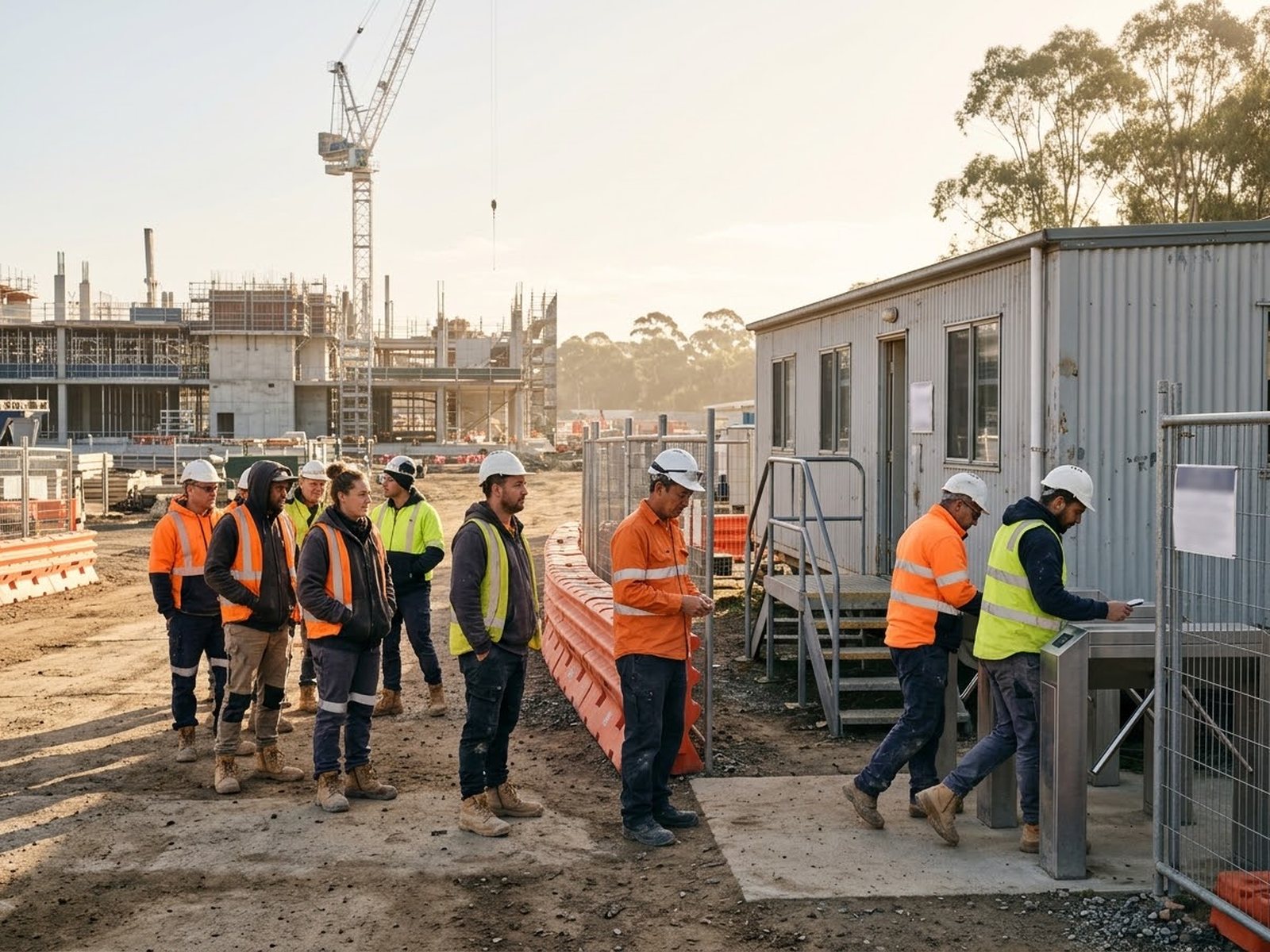
Workers sign in at the turnstile of a large building site in the morning.
Fair Workfor every company in the industry, in all four states
28 daysto file unfair dismissal at the WAIRC if a WA sole trader or partnership employs you
Labour hireworkers on site get the On-site award, and may get the builder's agreement rate

Check first Find the legal name and ABN of the business that pays you: on your payslip, the bank deposit description or your income statement. That entity is usually your employer.

Almost every builder, civil contractor, trade business and labour hire company is a Pty Ltd company, so it is in the Fair Work system in every state. The one exception is in WA: a builder or tradie who employs as a sole trader, a partnership of individuals or a trust with an individual trustee is in the WA state system. Once you know who employs you and which system applies, the award follows from the employer's industry and the work you do.

Who is your employer?

  1. The business that engages and pays you, usually a company. The site sign, the hi-vis logo and the head contractor's induction do not make the builder your employer.
  2. Labour hire: the labour hire company is normally your employer, even though the builder's leading hand directs your work. In the High Court's case about a labourer placed on building sites, the agency's right to control his work was "the key asset" of its business, and that made him its employee ([2022] HCA 1 at [74] to [78]). The host builder does not become your employer by giving directions.
  3. If the "agency" does nothing but pay you, and the builder recruits, rosters and dismisses, you may be the builder's employee, or the arrangement may be a sham. Look at who really runs the relationship.
  4. Group training: an apprentice signed up through a group training organisation is employed by that organisation and hosted by the builder (On-site award cl 4.6).
  5. A joint venture can leave you with no employer at the entity you name. Identify the right company before filing (see the leading cases below).

Which system?

StatePrivate construction employersWhere an unfair dismissal goes
WAFair Work for companies. A sole trader, partnership of individuals or trust with an individual trustee is in the WA state system under the Industrial Relations Act 1979 (WA)Fair Work Commission within 21 days, or the WA Industrial Relations Commission within 28 days for a state system employer
NSWFair Work, including sole traders and partnerships (the state referred its powers)Fair Work Commission, within 21 days
VicFair Work, including sole traders and partnerships (the state referred its powers)Fair Work Commission, within 21 days
QldFair Work, including sole traders and partnerships (the state referred its powers)Fair Work Commission, within 21 days

Public sector builders and road and rail authorities in WA, NSW and Queensland are usually in the state system. See Employment law in WA, NSW and Queensland.

Which award?

The award follows the employer's industry and your work. The Awards and pay page has the full table and rates. The traps:

Read moreShow less
  1. A worker employed by a plumbing or electrical contractor stays under that trade's award on a building site, because the On-site award does not cover employers covered by those awards (On-site award cl 4.4).
  2. A shopfitting or joinery business that also installs on site sits on a boundary the awards do not settle, because the Joinery and On-site awards each exclude the other. You may be under either; check what the business mainly does and where you normally work.
  3. A labour hire worker gets the award of the industry where they are placed: a labour hire labourer on a building site is paid under the On-site award, with the industry allowance, not a general labour hire rate (cl 4.5).
  4. A crane crew of a crane hire company is under the Mobile Crane Hiring Award; an engineer doing professional engineering may be under the Professional Employees Award. See Crane crews and site engineers.
  5. Most tier 1 and tier 2 builders and large civil projects have an enterprise agreement, which replaces the award while it applies; its base rates must not fall below the award's (Fair Work Act ss 57, 206). Check its coverage clause against your actual role. See Enterprise agreements.

Supervisors, managers and the high income threshold

Site managers, project managers and construction managers may be outside the award classifications, and a senior general foreperson on a large project has been held to be above the On-site award's foreperson classification. An award-free employee earning above the high income threshold, with no agreement, cannot claim unfair dismissal (Fair Work Act s 382(b)). Whether a site or project allowance counts toward the threshold depends on its terms: a guaranteed project uplift has been counted (see the second case below). A "supervisor" title alone does not take you outside the award: metal and engineering construction forepersons and supervisors have award rates (On-site award cl 43). The threshold changes every 1 July; check the current figure on the Fair Work Commission's website.

Labour hire on site

  1. Same job, same pay. On application by you, a union or the host, the Fair Work Commission must make a regulated labour hire arrangement order where an employer supplies employees to a host that is not a small business and the host's enterprise agreement would apply to them if the host employed them directly, unless the work is a service rather than a supply of labour or an order is not fair and reasonable (s 306E). Under an order you must be paid at least the host's rate, from 1 November 2024, subject to exceptions such as short-term arrangements.
  2. That matters in construction: major builders' agreements pay a tradesperson about $59 to $62 an hour, against about $31 to $32 under the award. A labour hire worker doing the same work beside the builder's employees may be entitled to the agreement rate if an order is made. Some labour hire agreements already promise the host's higher rates while placed there.
  3. Being taken off site. A host telling the agency to remove you is not itself a dismissal by the agency. If the agency then ends your employment or stops offering you work, you may have an unfair dismissal claim against the agency; check what it did to find out what happened and whether other placements were available. Casual labour hire workers can claim if they worked regularly and systematically with a reasonable expectation of continuing work, once past the minimum employment period. Apply within 21 days.
  4. Moving from labour hire onto the builder's payroll can restart your clock for unfair dismissal: labour hire service usually does not count toward the minimum employment period unless there was a transfer of business, which the Commission has rejected where the builder only topped up its staff with labour hire (see the first case below).

On safety, the host and the agency both owe you the duty and must consult each other, and site inductions, drug testing and site rules are usually the host's. See Safety, falls and stopping unsafe work.

Employee or contractor?

The most common construction dispute about status. Under the Fair Work Act, from 26 August 2024, the question is the real substance, practical reality and true nature of the relationship, including how it worked in practice (s 15AA). An ABN, invoices or owning your own hand tools does not decide it. See Sham contracting and the ABN trap.

Decided cases from construction

What the Commission and the courts decided.

Published decisions of the Fair Work Commission and the courts, retold in plain English from the decision itself. Lawcaptain did not act in these cases. Each links to the full decision.

No jurisdiction; appeal dismissedFair Work Commission (Full Bench) · 18 August 2026

A site manager moved from labour hire to the builder's payroll. His clock started again.

A commercial builder used a labour hire firm, which employed the worker as a site manager on four of its projects. Then the builder employed him directly.

Read the full storyShow less

Result. Permission to appeal granted, appeal dismissed: the labour hire service did not count, so the minimum employment period was not met.

The builder kept a small core staff, including site supervisors, and topped up with labour hire for time-defined projects. The labour hire firm employed the worker as a site manager on four of the builder's projects in 2023 and 2024, and the builder employed him directly from 23 July 2024 ([3], [72], [73]).

His employment ended in May 2025. The builder was a small business, so the minimum employment period was one year; only if his labour hire time counted had he completed it ([3], [5]).

The Full Bench held that "supplementary labour" means labour hire workers engaged in addition to direct employees, however important the role. The site supervision work had never been outsourced, so it could not be brought back in house, and there was no transfer of business ([75] to [78]).

The labour hire service did not count, the minimum employment period was not met, and there was no jurisdiction ([79], [80]).

What it means for you

If you move from labour hire to direct employment with the builder, your unfair dismissal clock usually restarts: 6 months, or 12 months with a business of fewer than 15 employees. General protections, underpayment and contract claims need no minimum period.

Claim dismissedFair Work Commission · 25 September 2026

A 30% project allowance took a FIFO supervisor over the high income threshold.

A structural and lifting supervisor flew in and out to a civil project at a mine site near Newman, WA, on a salary plus a 30% project allowance.

Read the full storyShow less

Result. Earnings at or above the high income threshold and no award or agreement coverage, so no unfair dismissal claim.

The worker's salary was $158,035.71, plus a 30% project allowance ([1], [2]).

The Commission counted the 30% site uplift as part of his earnings, distinguishing an earlier decision that had not counted a non-guaranteed site allowance. So he earned at least the high income threshold ([31] to [36]).

No award or enterprise agreement covered his role, so he could not claim unfair dismissal, and the application was dismissed ([55]).

What it means for you

A guaranteed project or site uplift can take you over the high income threshold. If you are a senior site employee, check whether an award or the project agreement covers your role, because coverage keeps the protection whatever you earn.

For employers

If you employ or host construction workers

  • Write the engagement type on day one. Daily hire, weekly hire, part-time or casual (On-site award cl 8.2), and keep the award or agreement that applies in the file.
  • Check which award covers your business. A business covered by a trade award (plumbing, electrical, joinery) is outside the On-site award; if you have an agreement, check it covers the work and the site.
  • Hosts: check your agreement against your labour hire workers' roles. A regulated labour hire arrangement order can be made on a worker's or union's application, and the protected rate then applies.
  • Agencies: pay the award of the industry of placement. Including the industry and travel allowances, and keep a record of placements offered after a host removes a worker.
  • A WA sole trader builder is in the state system. Different award, different tribunal, different time limit.
For unions and delegates

For unions and delegates

  • Coverage is site and classification specific. Check the agreement's coverage clause against the member's actual role. A union can apply for a regulated labour hire arrangement order (s 306E).
Leading cases

The decisions that set the rules.

A labourer supplied to a builder was the labour hire company's employee; the host did not become the employer.

Labour hire service does not count toward the minimum employment period after the builder employs the worker directly.

Show all leading cases (4)Show fewer

A worker supplied by a labour hire company and then employed directly on a highway project was not a transferring employee; with 18 weeks' service he was short of 6 months.

A guaranteed 30% project uplift counted toward the high income threshold.

A general foreperson on the Sydney light rail project was above the On-site award's foreperson classification, so not award-covered.

A concrete specialist in a homes venture of related companies was not an employee of the company named; identify the right entity.

Questions

The things people ask.

I'm labour hire on a builder's site. Who is my employer?

Usually the labour hire company that engages and pays you, even though the builder's leading hand directs your work ([2022] HCA 1). The builder does not become your employer by giving directions.

Do I get the builder's agreement rate as a labour hire worker?

Not automatically. You, your union or the host can apply to the Fair Work Commission for a regulated labour hire arrangement order, which the Commission must make where the host's agreement would cover you if you were employed directly, subject to exceptions (s 306E). Under an order you are paid at least the host's rate.

Which award covers me on a building site?

Building, civil and engineering construction workers employed by a construction business are under the Building and Construction General On-site Award 2020. Plumbers and electricians of a trade contractor stay under their trade's award on site, and crane hire crews are under the Mobile Crane Hiring Award.

I work for a small builder in WA who isn't a company. Am I in Fair Work?

No. A WA sole trader, partnership of individuals or trust with an individual trustee is in the WA state system. An unfair dismissal claim goes to the WA Industrial Relations Commission within 28 days. In NSW, Victoria and Queensland even a sole trader is in Fair Work.

I was taken off site by the builder. Have I been dismissed?

Not by that alone: the host removing you is not a dismissal by your agency. If the agency then ends your employment or stops offering work, you may have a claim against it. Apply within 21 days of the dismissal.

Free discussion · no obligation

Talk to us.

Call 1300 967 552, or leave your details and we will call you.

Do it yourself with AI

General information about Australian employment law, not legal advice about your situation. Updated November 2026.