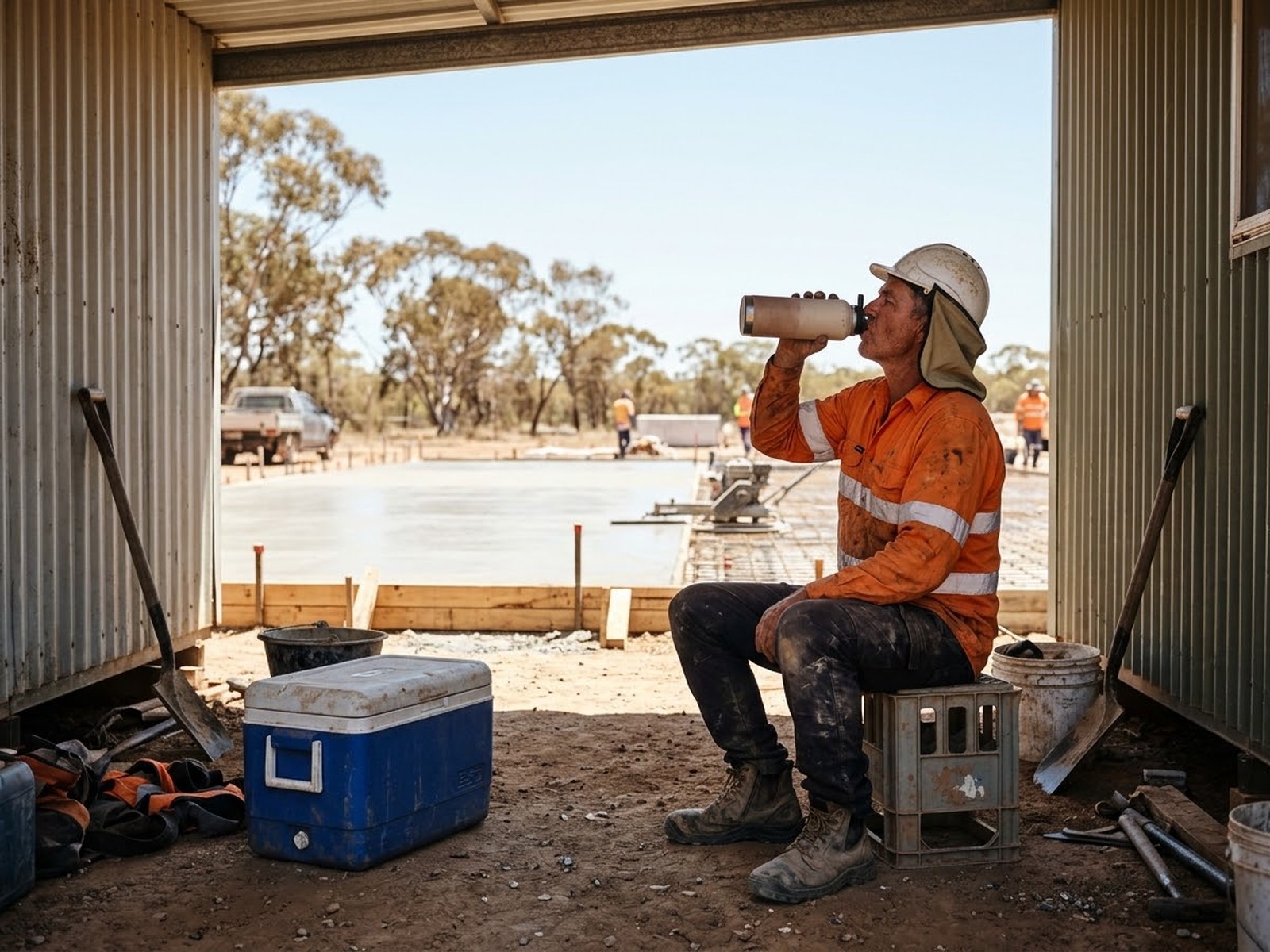
How it works on site
- When the employees or their representative ask, the employer must confer within a reasonable time, and no more than 60 minutes, about whether the conditions apply (cl 24.3).
- The employer must record when work stops and resumes (cl 24.4).
- You are not required to start or continue work where it is unreasonable or unsafe (cl 24.5). Emergency work and finishing a concrete pour already started may continue unless it raises a reasonable concern of imminent risk to your health or safety. A completed pour is paid at 200% to the next hour, with wet weather gear; if you are soaked in a pour and have no dry clothes, you may go home without loss of pay (cl 24.5, 24.6).
- Workers on parts of the site that are not affected keep working (cl 24.12). The employer can move you to a safe part of the site or another site, with transport, if there is work in your classification (cl 24.13).
- Rain: after more than 4 hours of ordinary time lost in a day, more than half the afternoon, or more than an hour in the last 2 hours, the employer cannot require you to stay on site. You need not walk through rain to a dry area without a covered walkway or proper protection (cl 24.14).
What you are paid
If you cannot work anywhere because of inclement weather, you are paid your ordinary hourly rate for the ordinary hours lost, up to 32 hours in each 4-week period, with pro rata credits for new starters and part-timers (cl 24.7, 24.8, 24.10). Nothing is paid for weather stoppages during overtime (cl 24.11). The ordinary hourly rate includes the industry allowance (see Awards and pay).
Read moreShow less
| Award | Inclement weather |
|---|---|
| On-site award (MA000020) | Up to 32 hours in each 4-week period (cl 24.7) |
| Plumbing and Fire Sprinklers Award (MA000036) | Up to 32 hours in each 4-week period, credited at the start of each period, not carried over; you must stay on the job until the conference has happened to be paid (cl 21.11) |
| Electrical Contracting Award (MA000025) | Paid for as long as the conditions last, with no 32-hour cap (cl 15.4(a)) |
| Mobile Crane Hiring Award (MA000032) | Unpaid unless work stopped by agreement with the employer, but you are not required to work in unsafe conditions (cl 20.1) |
| Joinery and Building Trades Award (MA000029) | No inclement weather clause |
Heat
Under the award, "extreme high temperature" stops work only where continuing is unreasonable or unsafe. Agreements usually add a threshold and a procedure. In the sample of builders' agreements:
Read moreShow less
- a WA builder's agreement says employees will not work, or be required to work, where the temperature reaches or exceeds 37.5°C (Lendlease WA cl 34.4(g)), and leaving site without consultation forfeits the payment (cl 34.4(f));
- a Victorian builder's agreement treats 35°C or more as inclement weather in Greater Melbourne, with a staged procedure using the Bureau of Meteorology forecast (Hutchinson cl 32.3(b));
- a NSW builder's agreement adds air pollution and requires the conference within 30 minutes (Multiplex cl 9.8).
Heat clauses are read step by step, in their own words; an old site practice does not override changed wording (see the case below). Work in heat or cold created artificially, above 46°C or below 0°C, earns 20 minutes' paid rest every 2 hours under the award (cl 18.6, 18.7).
Underneath the award and agreement, the safety law still applies: you may stop work if you have a reasonable concern about a serious risk from immediate or imminent exposure to a hazard, and you must not be punished for it. Refusing unsafe work is also a workplace right for general protections purposes. See Safety, falls and stopping unsafe work.
Rostered days off
- Ordinary hours are 38 a week, worked as 8-hour days between 7 am and 6 pm Monday to Friday. 7.6 hours are paid and 0.4 hours a day accrue toward an RDO, one every 19 days worked (cl 16.1, 16.2). Time accrues on paid leave and on public holidays not worked (cl 16.3).
- RDOs are fixed by a written roster issued 7 days before the 4-week cycle, or by a method agreed by the employer and a majority of employees, and never on a public holiday (cl 16.4). Large projects follow the industry RDO calendar in their agreement.
- Up to 5 RDOs may be banked by agreement, and the employer must not unreasonably refuse a request to take a banked one (cl 16.5).
- You can be required to work an RDO by agreement, or on at least 48 hours' notice for unforeseen project delays or emergencies. It is paid at Saturday rates and you keep the RDO (cl 16.6).
- When you leave, for any reason, accrued and banked RDOs and the hours accrued toward the next one are paid out (cl 16.7). This is a frequent item in final pay disputes.
Read moreShow less
Builders' agreements usually work a 36-hour week instead: 8 hours a day, 7.2 paid and 0.8 accrued toward the RDO, on a calendar fixed in the agreement. When a state declares a new public holiday the calendar can clash: in April 2026 the Commission decided to vary 25 NSW builders' agreements so that 27 April 2026 was a public holiday and the RDO moved to 28 April, with the variations issued separately ([2026] FWCA 934 at [4] to [6]).