Construction · Safety

You can stop work that puts you at serious and imminent risk.

Every business directing your work on site owes you a safety duty, whether you are an employee, a subcontractor, labour hire or an apprentice. What you are entitled to expect at height, when you may stop work in each state, the protection for raising safety, and the industrial manslaughter offences.

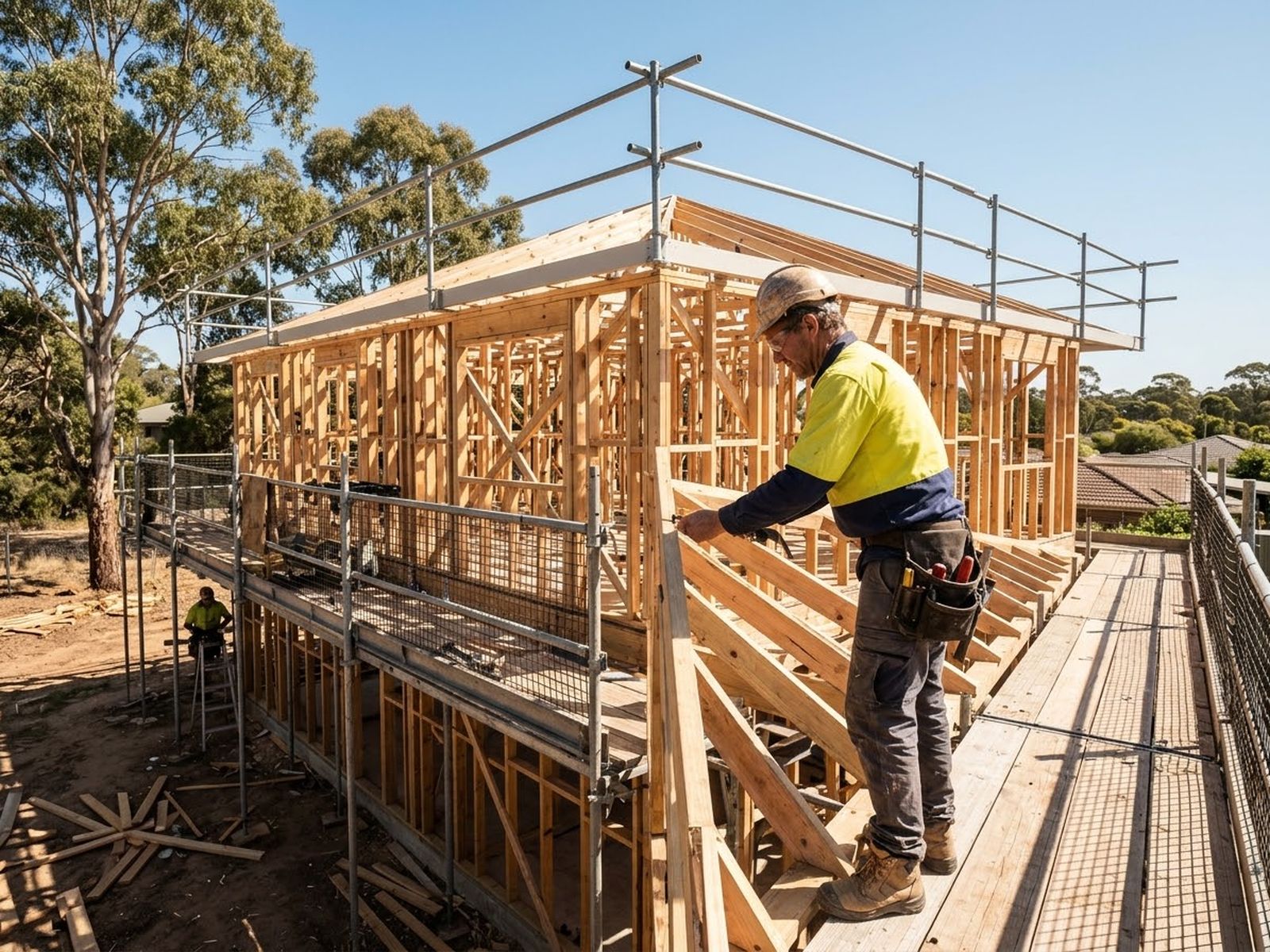
A carpenter works from a planked deck with edge protection on a roof frame.
s 84the right to cease unsafe work under the WHS Acts in WA, NSW and Queensland
$120,000a NSW subcontractor's fine after its carpenter fell six metres through a roof frame
Up to 25 yearsjail for industrial manslaughter in NSW and Victoria

Check first If you stop work for safety, say why straight away, in writing if you can, and accept other safe work you are offered. Under the Fair Work Act a genuine safety stoppage is not industrial action, provided you do not unreasonably refuse other safe available work (s 19(2)(c)).

On a typical job the builder, each subcontractor and any labour hire agency all owe the safety duty at once. A person conducting a business or undertaking must ensure, so far as is reasonably practicable, the health and safety of the workers it engages and the workers whose activities it influences or directs (WA Work Health and Safety Act 2020 s 19(1); the NSW and Queensland Acts are in the same terms). "Worker" means anyone carrying out work in any capacity, including employees, contractors and subcontractors and their employees, labour hire workers, apprentices and trainees (s 7). An ABN does not take you outside the safety duty. Victoria has its own Occupational Health and Safety Act 2004, framed as duties of employers.

Falls from height: what you are entitled to expect

Falls are the risk regulators and courts treat most seriously on building sites. In a 2026 NSW prosecution after a carpenter fell through a roof frame, the reasonably practicable measures pleaded and accepted were:

Read moreShow less
  1. working decks or planks on the roof frame;
  2. void protection over stairwells;
  3. edge protection such as perimeter scaffold;
  4. fall arrest systems;
  5. a rule against roof work without protection, an adequate safe system of work, and instruction, training and supervision.

Every business directing your work owes these, not just the builder. The Court said a subcontractor's obligations "are not diminished by the notion that another entity may have contributed to the risk", and that a safe work method statement is of little use unless it is adequate for its purpose ([2026] NSWIC 33 reasons [28], [32]).

Your right to stop unsafe work, by state

StateThe rightSource
WAYou may cease, or refuse to carry out, work if you have a reasonable concern that it would expose you, or any other person, to a serious risk to health or safety from an immediate or imminent exposure to a hazardWHS Act 2020 (WA) s 84
NSWThe same right, for a serious risk to your own health or safetyWHS Act 2011 (NSW) s 84
QldThe same right; a health and safety representative can also give a written cease work noticeWHS Act 2011 (Qld) ss 84, 85
VicNo individual right in that form. The employer, or the health and safety representative after consultation, may direct that work stop where there is an immediate threat; an inspector can be called, and an employee stood down meanwhile keeps their pay if the inspector issues a prohibition notice or finds reasonable cause for concernOHS Act 2004 (Vic) ss 74, 75
Read moreShow less

In WA, NSW and Queensland a health and safety representative may direct a worker in their work group to cease such work, usually after consulting the business (s 85). You may be directed to suitable alternative work, and in WA stopping does not break your continuity of engagement if you do not unreasonably refuse it (WA s 88).

Under the Fair Work Act, a stoppage based on "a reasonable concern ... about an imminent risk to his or her health or safety" is not industrial action, provided you do not unreasonably refuse other safe available work (s 19(2)(c)). So the no-work, no-pay rules for industrial action do not apply to a genuine safety stoppage.

A safety objection must be genuine and specific. A post-tensioning labourer who refused a direction to move to another site after rain stopped work, saying it was unsafe, lost his claim when the Commission found the direction lawful and reasonable and did not accept the objection (see the second case below). Carry your PPE, raise the concern in writing, and follow the site procedure. For rain and heat, see Wet weather, heat and RDOs.

Protection for raising safety

  1. A person must not dismiss a worker, end a contract for services or otherwise act to a worker's detriment because the worker raised, or proposed to raise, a health and safety issue, used a power under the Act, or was involved in resolving a safety issue (WA ss 104 to 106; NSW s 104).
  2. In Victoria, dismissing or prejudicing an employee because they raised a health or safety concern with the employer, an inspector, a health and safety representative or others is an indictable offence (OHS Act s 76(2)(d)).
  3. A safety complaint is usually also a workplace right under the Fair Work Act's general protections (ss 340, 341). If you were dismissed or punished after raising safety, the employer must prove that was not part of its reason (s 361). Apply within 21 days of a dismissal.

When you are the one in breach

Workers must take reasonable care for their own and others' safety and comply with reasonable instructions and notified policies (WA s 28). A clear breach of a fall-protection safe work method statement can be a valid reason for dismissal, but the process still matters. See Dismissed for a safety breach, a drug test or conduct.

Industrial manslaughter, by state

StateOffenceFaultMaximum penalty
WAWHS Act 2020 s 30A, a business or an officer, since the Act commenced on 31 March 2022A failure of the safety duty causing death, engaged in knowing it is likely to cause death or serious harm and in disregard of thatIndividual 20 years and $5,000,000; body corporate $10,000,000
NSWWHS Act 2011 s 34C, for conduct from 16 September 2024A business's or officer's failure of the duty causing death, with gross negligenceIndividual 25 years; body corporate $20,000,000
QldWHS Act 2011 s 34C (business), s 34D (senior officer)Conduct causing death, negligent about causing it20 years; body corporate 100,000 penalty units
VicOHS Act 2004 s 39G (workplace manslaughter), from 1 July 2020Negligent conduct breaching an applicable duty and causing deathIndividual 25 years; body corporate 100,000 penalty units
Read moreShow less

The WA and Queensland Acts allow a conviction for a lesser offence instead: Category 1, 2 or 3 in WA (s 30A(2), (4)), and Category 1 or 2 in Queensland (s 34E). Directors also carry a personal due diligence duty: in a 2026 NSW case a residential builder was fined $101,250 and its director $21,250 after a newly built party wall collapsed (see What changes by state).

Decided cases from construction

What the Commission and the courts decided.

Published decisions of the Fair Work Commission and the courts, retold in plain English from the decision itself. Lawcaptain did not act in these cases. Each links to the full decision.

Convicted; $120,000 fineIndustrial Court of New South Wales · 10 July 2026

A carpenter fell six metres through a roof frame. The subcontractor could not blame the builder.

A builder used a broker to find carpentry contractors. The broker placed a carpentry company, which engaged a carpenter to work on the roof frame of a two-storey townhouse.

Read the full storyShow less

Result. Convicted on a plea of guilty; fined $120,000, with $36,000 costs.

The carpenter stood on a ceiling joist, which collapsed. He fell about six metres to the concrete below and was seriously injured (particulars 12, 17).

The only fall protection was an internal scaffold that had not been erected by a qualified person and was unsuitable for roof work. There were no working decks or planks, no edge protection and no fall arrest; induction and instruction were informal, and the safe work method statement was not made known to the carpenter (agreed facts [27] to [33]; reasons [30]).

The Court said the company's obligations "are not diminished by the notion that another entity may have contributed to the risk", and called the failures "frankly, egregious". A safe work method statement is of little use unless it is adequate for its purpose, and the steps taken after the fall, such as elevated work platforms and supervision at height, showed how easily the risk could have been dealt with (reasons [28], [29], [32], [33]).

The company was fined $120,000, with its early guilty plea taken into account, and ordered to pay $36,000 costs (reasons [18], [34], [35]).

What it means for you

Before you work at height you are owed working decks, edge protection, void covers or fall arrest by every business directing your work, not just the builder. Whether you are an employee or a subcontractor, you are a worker under the safety Act and may refuse work that exposes you to a serious and imminent risk.

Claim dismissedFair Work Commission · 26 June 2025

He said the move to another site was unsafe. The Commission did not accept it.

A post-tensioning labourer, who had earlier worked on his own ABN and whom the employer said had prior verbal warnings, refused a direction to move to an urgent job at another site after rain stopped work.

Read the full storyShow less

Result. Refusing a lawful and reasonable direction was serious misconduct; the dismissal was consistent with the Small Business Fair Dismissal Code.

Rain had stopped work on the site. The worker was directed to move to an urgent job at another site, and refused, saying it was unsafe because of the rain and because he had no mask ([3], [18], [22], [49] to [51]).

The Commission found the direction lawful and reasonable and did not accept the safety objection. Refusing it was serious misconduct ([50] to [53]).

Because the employer was a small business and the dismissal was consistent with the Small Business Fair Dismissal Code, the application was dismissed ([54]).

What it means for you

The right to stop unsafe work protects a genuine, specific concern about a serious risk. Carry your PPE, raise a concern in writing and follow the procedure, rather than refusing a direction outright.

For employers

If you run a construction business

  • Check the fall protection before anyone goes up. Confirm in writing what the principal has provided and that it suits your task; if not, provide it or do not start.
  • Write task-specific safe work method statements. Brief them to each worker, and keep toolbox and induction records. A generic statement nobody read counts for little.
  • Never discipline a worker for refusing work they reasonably think is imminently dangerous. Redirect them to safe work instead.
  • When a worker breaches a safety rule, follow a process. Stand them down if needed, put the allegations in writing, hear the answer, then decide.
For unions and delegates

For unions and delegates

  • Health and safety representatives can direct work to stop. Once trained, under s 85 of the WHS Acts in WA, NSW and Queensland, and s 74 of the Victorian OHS Act.
Leading cases

The decisions that set the rules.

A carpentry subcontractor could not leave fall protection to the builder; $120,000 fine after a six-metre fall.

A residential builder and its director fined $101,250 and $21,250 after a newly built party wall collapsed; directors are personally liable for due diligence.

Show all leading cases (2)Show fewer

A civil builder's finding of guilt and $100,000 fine (no conviction recorded) stood on appeal after a worker laying geofabric in an excavation was struck by a grader.

A refused direction after rain, with a safety objection the Commission did not accept, was serious misconduct.

Questions

The things people ask.

Can I refuse to work at heights without proper fall protection?

In WA, NSW and Queensland you may cease or refuse work if you have a reasonable concern that it would expose you to a serious risk from an immediate or imminent hazard (WHS Act s 84). Working on an unprotected roof frame is the classic example. Tell the supervisor why and accept other safe work. In Victoria, raise it with the employer or your health and safety representative, who can direct work to stop (OHS Act s 74).

Do I get paid if I stop work for safety?

A genuine stoppage over an imminent risk is not industrial action under the Fair Work Act, so the no-work, no-pay rules for industrial action do not apply, provided you do not unreasonably refuse other safe work (s 19(2)(c)). In Victoria an employee stood down keeps their pay if an inspector issues a prohibition notice or finds reasonable cause for concern (OHS Act s 75).

I am a subcontractor. Does the builder owe me a safe site?

Yes. "Worker" under the WHS Acts includes contractors and subcontractors and their employees, so the builder and every other business directing your work owe you the duty (s 7, s 19).

Can I be sacked for reporting a hazard?

Not lawfully for that reason. Acting to a worker's detriment for raising a safety issue is prohibited by the WHS Acts and, in Victoria, is an indictable offence. It is also usually a workplace right under the Fair Work Act's general protections. Apply within 21 days of a dismissal.

What is industrial manslaughter in my state?

Each state has an offence for a business or officer whose failure of the safety duty causes a death: WA s 30A (up to 20 years for an individual), NSW s 34C (up to 25 years, for conduct from 16 September 2024), Queensland ss 34C and 34D (up to 20 years) and Victoria's workplace manslaughter, s 39G (up to 25 years).

Free discussion · no obligation

Talk to us.

Call 1300 967 552, or leave your details and we will call you.

Do it yourself with AI

General information about Australian employment law, not legal advice about your situation. Updated November 2026.